Published
A brand audit is a structured review of what your brand owns, says, shows and is understood to be. The version below scores it: twenty checks, zero to three points each, sixty maximum. The band your total lands in names the project you should buy — and only one band is a rebrand.
How this was checked. On 2 August 2026 we read the first page of Google results in the United States for “brand audit” — eight organic listings under an AI Overview and a set of People Also Ask boxes. Every listing we opened described a process: seven steps, ten steps, twelve steps. None of them ended in a score. That is the gap this page fills, because a set of steps tells you what to look at and a score tells you what to do about it, which is the part anyone actually needs before spending money.
What a brand audit is, and what it is not
A brand audit measures the gap between the brand you think you have and the brand that is actually in circulation. It is a diagnostic, and it ends in a ranked list of gaps.
It is not four things it gets confused with:
- Not a rebrand. The audit is what tells you whether a rebrand is justified. Running the change first and the diagnosis afterwards is how businesses buy a new logo to fix a positioning problem.
- Not a logo review. Visual identity is five of the twenty checks below. If you only look at the logo you have graded a quarter of the brand and declared it healthy.
- Not a website or SEO audit. Those measure whether machines and users can reach and use your site. A brand audit asks what the site says and whether it says the same thing as your deck. The two meet in two places — the website itself and your own branded search results, rows 11 and 16 — and they ask different questions about both.
- Not a customer satisfaction survey. Satisfaction tells you how the last transaction went. A brand audit asks what people expect before the transaction, which is a different question with a different answer.
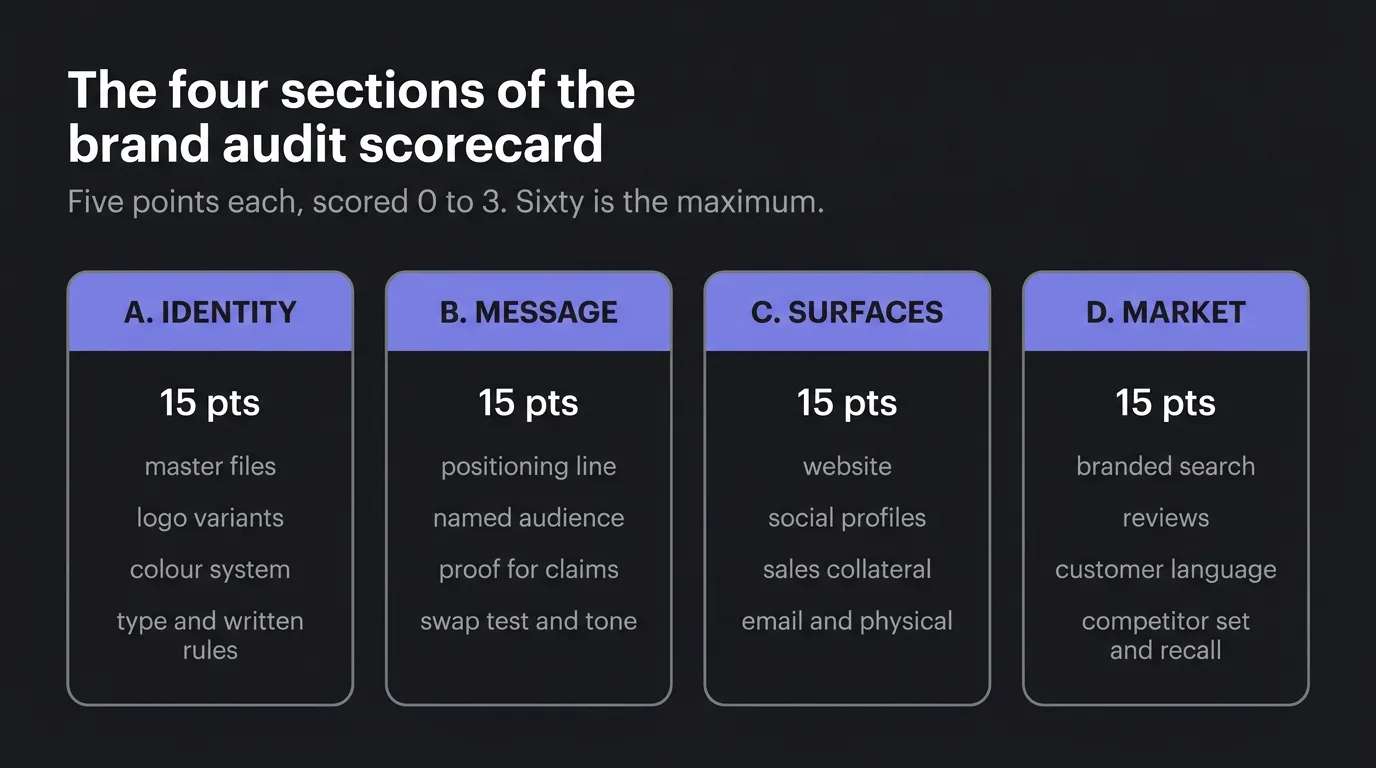
The 20-point brand audit scorecard
Twenty rows in four sections of five. Score each row zero, one, two or three. The scale is defined in the next section; the columns here tell you what a top score and a bottom score look like, so two people scoring the same business land in roughly the same place.
Section A — Identity: what you own
| # | Check | Scores 3 when | Scores 0 when |
|---|---|---|---|
| 1 | Master files | You hold editable vector originals for every logo variant and could send them today | The best file anyone can find is a PNG pulled off the website |
| 2 | Logo variants | Horizontal, stacked, icon-only and single-colour versions exist, with a minimum-size rule | One lockup, resized by hand whenever it does not fit |
| 3 | Colour system | Every brand colour recorded in hex, RGB, CMYK and Pantone, with a contrast-safe pairing named | Colours live in whatever the last designer used |
| 4 | Typography | Typefaces licensed for both web and print, with a defined fallback stack, and the same faces actually in use on the site, the deck and the invoice | Nobody can say what the brand typefaces are, and the site, the deck and the invoice each use different ones |
| 5 | Written rules | A brand guidelines document exists, is dated within 24 months, and someone outside the founding team can find it | The rules exist in one person’s head |
Section B — Message: what you say
| # | Check | Scores 3 when | Scores 0 when |
|---|---|---|---|
| 6 | Positioning line | Three people in the business write the same one-sentence answer to “what do you do and for whom” | Three people write three different sentences |
| 7 | Named audience | The buyer is defined by situation and trigger, not by age bracket and industry | The audience is “small and medium businesses” |
| 8 | Proof | Every claim on the homepage is backed by a number, a named client or an artefact | Claims are adjectives: leading, trusted, innovative |
| 9 | Swap test | Replace your logo with a competitor’s on your homepage and the copy stops being true above the fold | The copy works unchanged for any competitor |
| 10 | Tone rules | Tone is documented as do/don’t pairs with real sentences | Tone is documented as three adjectives |
Section C — Surfaces: where it shows up
| # | Check | Scores 3 when | Scores 0 when |
|---|---|---|---|
| 11 | Website | Current logo, current positioning line, no claims left over from a previous version of the business | The About page describes a company from two pivots ago |
| 12 | Social profiles | Same avatar, same bio line, same link on every live profile, dormant ones included | Profiles disagree, and two of them you had forgotten existed |
| 13 | Sales collateral | Deck, proposal and one-pager all built from current templates, all saying the same thing | Every seller has a personal edit of the deck |
| 14 | Signatures, transactional emails and newsletter header all on-brand and consistent | Signatures are personal, transactional email carries the old mark, and the newsletter header is a third thing again | |
| 15 | Physical and commercial | Invoices, packaging, signage, vehicle livery and uniforms all match the same brand system | Whatever the printer had on file last time |
Section D — Market position: how you are seen
| # | Check | Scores 3 when | Scores 0 when |
|---|---|---|---|
| 16 | Branded search | You rank first for your own name and control the first screen of results for it | Someone else outranks you for your own brand name |
| 17 | Reviews | You know your rating, your review volume and the single most repeated complaint | Nobody has read the reviews in a year |
| 18 | Customer language | You hold dated verbatim quotes from the last twelve months, pulled out of emails, reviews and tickets | Customer wording exists only inside threads nobody has opened |
| 19 | Competitor set | You can name the three competitors you actually lose deals to and the axis you lose on | The competitor list is the three biggest names in the category |
| 20 | Unprompted recall | You have deliberately asked five customers to describe you, and their words match your positioning line | Nobody has ever been asked the question |
How to score each point on the 0 to 3 scale
The scale is deliberately coarse. Fine-grained scoring invites negotiation, and the whole value of a scored audit is that it resists it.
| Score | Meaning |
|---|---|
| 0 | Does not exist, or nobody in the business could produce it if asked today |
| 1 | Exists, but is out of date, unfindable, or contradicted somewhere else |
| 2 | Exists and is current, but is not documented or not applied everywhere |
| 3 | Exists, current, written down, and applied consistently on every surface you checked |
Two rules keep the scores honest. A row you cannot evidence scores zero, not one — “I’m sure we have that somewhere” is a zero, and finding out that it is a zero is the audit doing its job. And score the artefact you find first, not the best one that exists: if the third-best version of your deck is the one in circulation, that is the one the market sees.
Two rows resist middle scores and need their own anchors. Row 9: three if the copy breaks above the fold with a competitor’s logo on it, two if it breaks only further down the page, one if only a client name or a figure breaks it, zero if nothing breaks. Row 20: three when five customers describe you and the words match your positioning line, two when three or four do, one when you have asked and the words do not match, zero when nobody has ever been asked.
Row 15 is the only conditional row. If you have no physical or packaged presence at all, drop it and score out of 57, then multiply your total by 1.05 to bring it back onto the 60-point scale before reading the bands. A 32 out of 57 becomes a 34, which is band 30–41.
Expect rows inside a section to correlate. A business with weak copy tends to lose points on rows 8, 9 and 10 together, and a business with no guidelines tends to lose rows 5 and 10 at once. That is the instrument working, not double-counting: the section subtotals are what you act on, and a section that collapses across several rows is exactly the signal you are looking for.
What your brand audit score means, band by band
Four bands. Each one names a different project, and the reason to score at all is to find out which one you are buying.
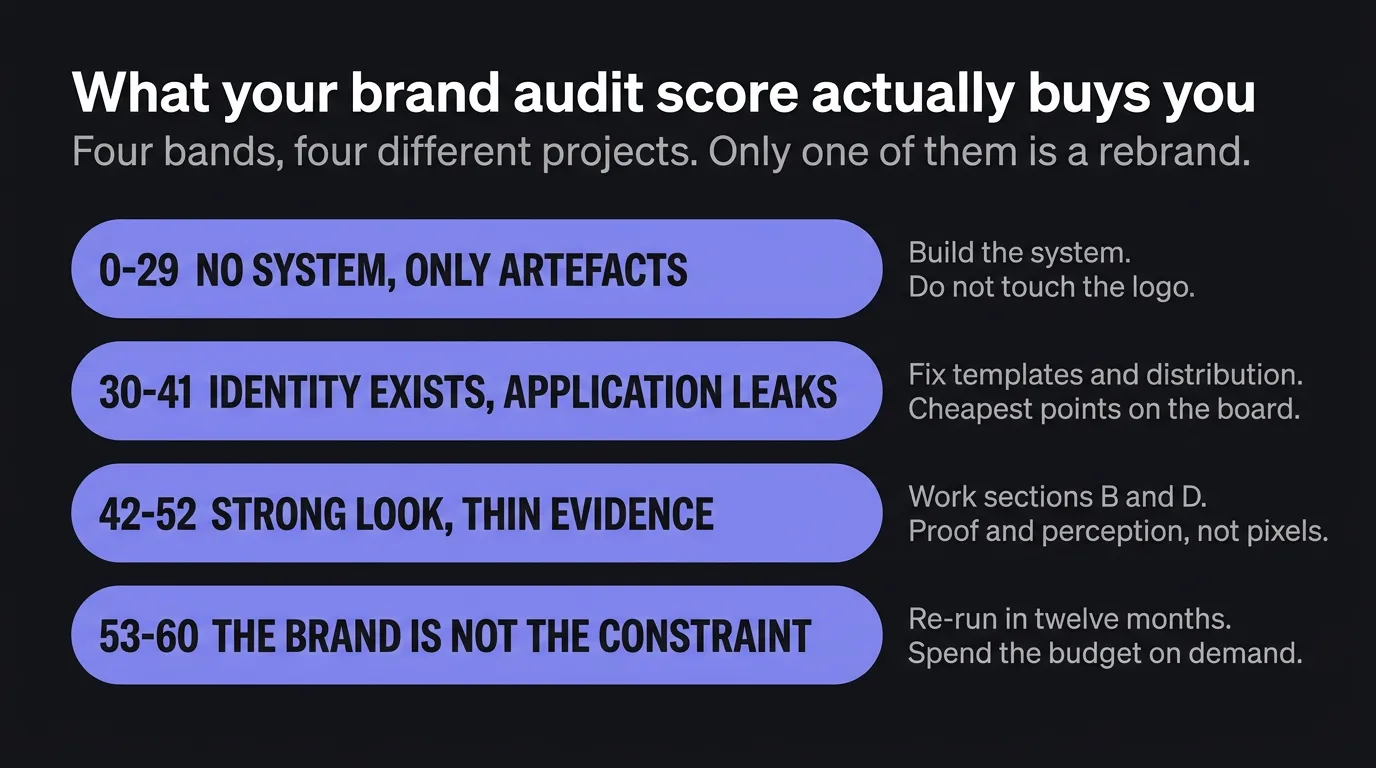
0–29 — you have artefacts, not a brand system. The instinct here is to commission a redesign. Resist it: a new logo dropped into a business with no colour system, no written rules and no positioning line degrades to the same state within a year. Build the system first. The cheapest order is written rules, then a positioning line, then visuals.
30–41 — the identity exists and the application leaks. This is the most common band, and the missing points cluster in Sections B and C rather than in A. Where they sit in C the fix is cheap: rebuilding the deck template, standardising email signatures and cleaning up dormant social profiles need no designer. Where they sit in B, as in the worked example below, the fix is writing, not tidying — and the two call for entirely different budgets.
42–52 — the brand looks solid and the evidence is thin. Points here are almost always missing in Sections B and D: claims without proof, a positioning line nobody has tested against customers, no verbatim language on file. The work is research and copy, not design.
53–60 — the brand is not your constraint. Stop auditing and go and buy demand. Re-run the scorecard in twelve months or after your next significant change, whichever comes first.
A filled brand audit example: a wholesale coffee roaster at 34 out of 60
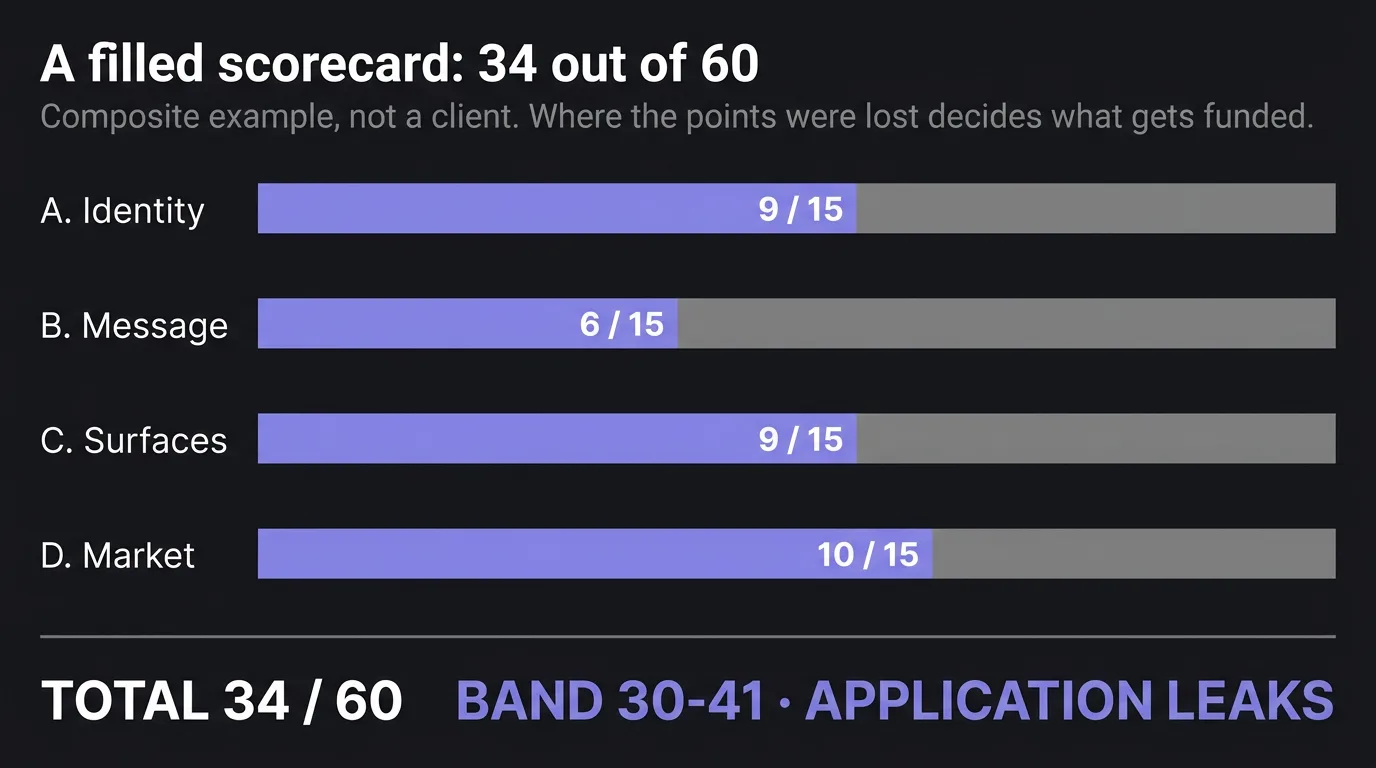
The example below is a composite, not a client — it is assembled from the pattern we see most often in businesses of this size, and every score comes with the reason it was given. Read it as a worked demonstration of the scale, not as a benchmark.
The business. Eleven people. Roasts and sells coffee wholesale to about forty cafés, plus a small direct-to-consumer subscription that has grown by accident. Rebranded once, four years ago, by a freelancer who has since become unreachable.
| Section | Score | Where the points went |
|---|---|---|
| A — Identity | 9 / 15 | Master files exist and are clean (3). Two variants, no icon version and no minimum size (2). Colours in hex only, nothing for print, and the bags come back slightly wrong every run (2). Fonts licensed for web but not for packaging, so the label sets in something else (1). A one-page brand sheet from the handover, never updated, and only the founder knows where it lives (1) |
| B — Message | 6 / 15 | The founder and the sales lead give different one-sentence answers, and the third person asked repeated the founder’s (2). Audience defined as “independent cafés” — a channel rather than a buyer, though the wholesale lead can describe the trigger that starts a switch (2). Homepage leads on adjectives — small-batch, ethically sourced, passionate — with one real number, the forty cafés served, buried on the About page (1). Fails the swap test above the fold: the copy fits any roaster in the country (0). Tone is three adjectives, plus two worked examples left in the handover deck (1) |
| C — Surfaces | 9 / 15 | Website is current and correct (3). Three social profiles, two abandoned, all with different bios (1). Wholesale deck is current, the DTC one-pager is not (2). Newsletter header is on-brand, signatures are personal, transactional email carries the old mark (2). Bags and invoices agree, van livery is the old mark (1) |
| D — Market | 10 / 15 | Ranks first for its own name (3). Knows the rating, has not identified the repeated complaint (2). Customer wording exists in old email threads, never pulled out or dated (1). Names two of the three roasters it actually loses to, and the axis — lead time, not price — but the third name is a guess (2). Two café owners have described the business unprompted in email and the words broadly match; nobody has ever run the question deliberately (2) |
| Total | 34 / 60 | Band 30–41: identity exists, application leaks |
What the score decides. The founder’s stated plan was a rebrand — new mark, new bags, new site. The scorecard says otherwise. Section A is level with Section C and three points clear of Section B, which is the weakest area on the board; and Section B does not have a visual solution. The ranked work becomes: fix the swap-test failure by writing a positioning line the copy can be rebuilt from, define the buyer as a situation rather than a channel, replace three adjectives with three provable facts, then spend what is left on the van and the two dead social profiles.
The rebrand comes off the table entirely. What replaces it is writing the business already has the material for, which is why the ranked list starts with Section B and never reaches the logo.
Where the evidence for each score comes from
None of the twenty rows needs a paid tool. What each one does need is an artefact you can point at.
| Section | What to collect before you score |
|---|---|
| A — Identity | The folder your designer last handed over, the current site’s favicon and logo files, whatever the printer has on file, the last invoice you sent |
| B — Message | Your homepage above the fold, your three most-used sales sentences, and the same one-line question asked separately to three people in the business |
| C — Surfaces | The last three decks actually sent to prospects, every live social profile including dormant ones, one transactional email, one signature from each seller |
| D — Market | A logged-out search for your own brand name, your review pages, twelve months of customer emails searched for the phrases people use when they introduce you to someone else, and five short customer calls |
The last one is the only row that costs real time, and it is the one that changes minds. Five customers, one question — how would you describe what we do to someone in your position? — and a transcript of the exact words. A founder can argue with a score. It is much harder to argue with five customers using the same wrong word.
Row 5 is worth a note of its own, because it is the row most often scored generously. A guidelines document earns its three when it fixes logo clear space, colour values for both screen and print, type licences, and at least one worked do/don’t page for tone. A four-page PDF with a logo and a colour strip is a one, however well designed it is — it is the document everything else in Section A gets compared against, so grade it strictly.
The brand audit template, and how to keep it usable
Copy the twenty rows into a spreadsheet with six columns and you have the template. The columns matter more than the format:
- Check — the row number and name, unchanged, so scores stay comparable between runs
- Score — 0 to 3, nothing in between
- Evidence — a link, a filename or a screenshot. A score without this column is an opinion
- Owner — the one person who can move this row
- Effort — hours, half-days or a project. Not a priority number; priority falls out of effort against score
- Next run — the score you expect at the next audit, filled in now
The sixth column is what separates a template that gets used twice from one that gets used once. Writing down the expected score commits you to a result, and at the next run you find out whether the work moved the number or just felt like progress.
Two failure modes to avoid. Do not add weightings — every attempt we have seen to weight the sections turns the audit into an argument about the weights instead of the scores. And do not expand past twenty rows. A forty-row version is more thorough and never gets finished, which makes it worth less than the version that does.
Where the score points at rules and visuals that need rebuilding rather than documenting, that is the point at which outside branding work earns its cost — after the diagnosis, not instead of it.
Three findings that look like brand problems and are not
The most expensive audit mistakes are not missed rows. They are correctly-observed symptoms attributed to the wrong cause.
Low awareness is usually a media problem. “Nobody has heard of us” reads as a branding failure and is almost always a distribution failure. A brand that nobody has been exposed to is not weak; it is unseen. Check spend and reach before you check the logo.
A logo that varies across decks is a distribution problem. When the mark appears in four slightly different forms across the sales team, the identity is fine and the file delivery is broken. The fix is one accessible folder and a locked template, not a redesign — and it is the kind of work that shows up on rows 13 and 14 at the next run.
Bad reviews are usually an operations problem wearing brand clothing. If the repeated complaint in row 17 is about lead times, delivery or a person, no amount of message work will move it. The audit’s job here is to hand the finding to the right department and stop, rather than absorbing an operational failure into a brand project where it will be quietly repackaged as a “perception gap”.
How often to re-run a brand audit, and what to watch between runs
Annually, plus a re-run after anything that changes what you sell or who you sell it to. What matters more is the gap between runs: in our experience seventeen of the twenty rows barely move in six months, and three of them move constantly.
Those three are worth a quarterly ten-minute look:
- Row 12, social profiles — drift returns the moment someone launches a new channel
- Row 16, branded search — a competitor bidding on your name, or a review site outranking you, can change this in weeks
- Row 17, reviews — the repeated complaint changes as operations change, and it is the earliest warning that something upstream has broken
Keep the old scorecard. The single most useful artefact a second audit produces is not the new total but the per-row delta, because it tells you which of the fixes you paid for actually held.
10 / Reader questions
Frequently asked questions
01What is a brand audit?
A brand audit is a structured review of what your brand owns, says, shows and is understood to be, scored so the result is a decision rather than a list. It covers four areas: identity assets, message, the surfaces the brand appears on, and how the market actually describes you. The output that matters is the ranking of what to fix first.
02How do you start a brand audit?
Start by collecting evidence, not opinions. Open a sheet with the twenty rows of the scorecard, then spend the first sitting gathering artefacts: master logo files, the last three sales decks, every live social profile, your review pages and the last twelve months of customer emails. Score only what you can point at. A row you cannot evidence scores zero, which is itself a finding.
03How long does a brand audit take?
Four to six hours of desk work for a business under fifty people, split across two sittings — one to gather evidence, one to score it. That covers nineteen of the twenty rows. The twentieth needs five short customer calls, so allow a further week of calendar time; it is the only part that cannot be compressed, and skipping it means scoring that row zero.
04Can you give an example of a brand audit?
A filled example runs to 34 out of 60: a composite wholesale coffee roaster whose identity section is respectable and whose message section is the weakest on the board. That puts it in the band where the correct project is rewriting the positioning line and the homepage claims, not commissioning a new logo. Every score on the page carries the reason it was given.
05What is the difference between a brand audit and a rebrand?
An audit measures; a rebrand changes. The audit is the diagnostic that tells you whether a rebrand is even the right intervention, and most of the time it is not. A low score concentrated in identity assets means you have a documentation problem; a low score concentrated in message and market position means the words and the proof are wrong, and new visuals will not move either.
06Do you need an agency to run a brand audit?
No. Nineteen of the twenty checks can be run from inside the business with a spreadsheet, your own files and a browser; the twentieth needs five customer calls. An outside team is worth paying for in two situations: when nobody internally can score the message section honestly, and when the audit needs to survive an argument with a founder who designed the logo themselves.
07How often should you run a brand audit?
Once a year for a stable business, and again after any event that changes what you sell or who you sell it to — a new product line, a merger, a pricing change, a move upmarket. Re-running it more often than annually produces noise, because most of the twenty rows barely move in six months.