Published
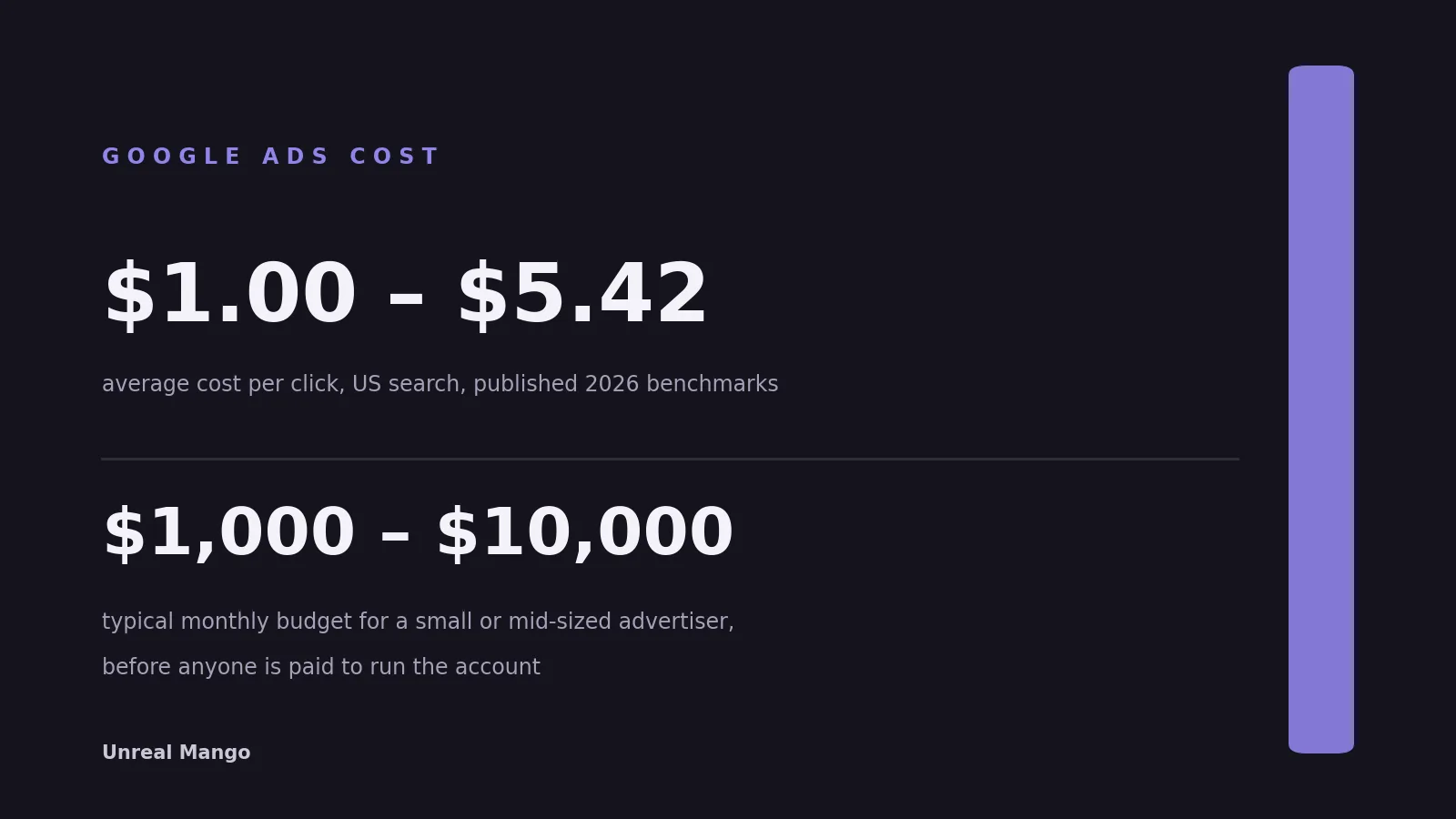
Google Ads cost $1.00 to $5.42 per click on US search, and most small and mid-sized advertisers spend $1,000 to $10,000 a month. Add management at 10–20% of spend or a $500–$5,000 retainer, and expect 20–40% of your first 90 days to buy data rather than customers.
That last sentence is the part almost nobody prices in advance. The pages ranking for this question answer it as a media question — what does a click cost, what does a month cost — and stop there. The number that actually lands in your accounts is media plus management plus a learning period, and only one of those three arrives as an invoice.
How these figures were sourced. The click and budget ranges above are compiled from the ten results Google itself ranked for this query in the United States on 1 August 2026, cross-checked against Google’s own published budgeting documentation. They are benchmark bands, not quotes, and no single advertiser’s account will sit neatly inside them.
What Google Ads cost per month for most advertisers
Most advertisers land somewhere between $1,000 and $10,000 a month in media spend. The spread inside that band tracks how many enquiries a business needs and how expensive its category’s clicks are, not how big the company is.
| Advertiser | Typical monthly media | What that buys |
|---|---|---|
| Single-location local business | $500–$1,500 | One city, a handful of service terms, 100–500 clicks |
| Multi-service SMB | $1,500–$5,000 | Several campaigns, brand defence, some remarketing |
| Regional or national SMB | $5,000–$20,000 | Multiple regions, Shopping or Performance Max alongside search |
| Competitive category at scale | $20,000+ | Contested head terms where a click alone can cost $50 |
Two numbers move a business up or down this table. The first is your category’s click price. The second is your conversion rate, because a 2% conversion rate makes every click three times more expensive per enquiry than a 6% rate at the same bid.
The three numbers that make up a Google Ads bill
Every published answer to this question covers the first number. The second is usually mentioned in passing. The third is almost never named, and it is the one that makes month one feel like a mistake.
- Media spend. What Google charges you for clicks or impressions. You control it with a daily budget and you can change it whenever you like.
- Management. What it costs to have someone competent build, watch and correct the account — an agency fee, a freelancer, or the internal hours of whoever ends up owning it. Unpaid does not mean free; it means paid in someone’s time.
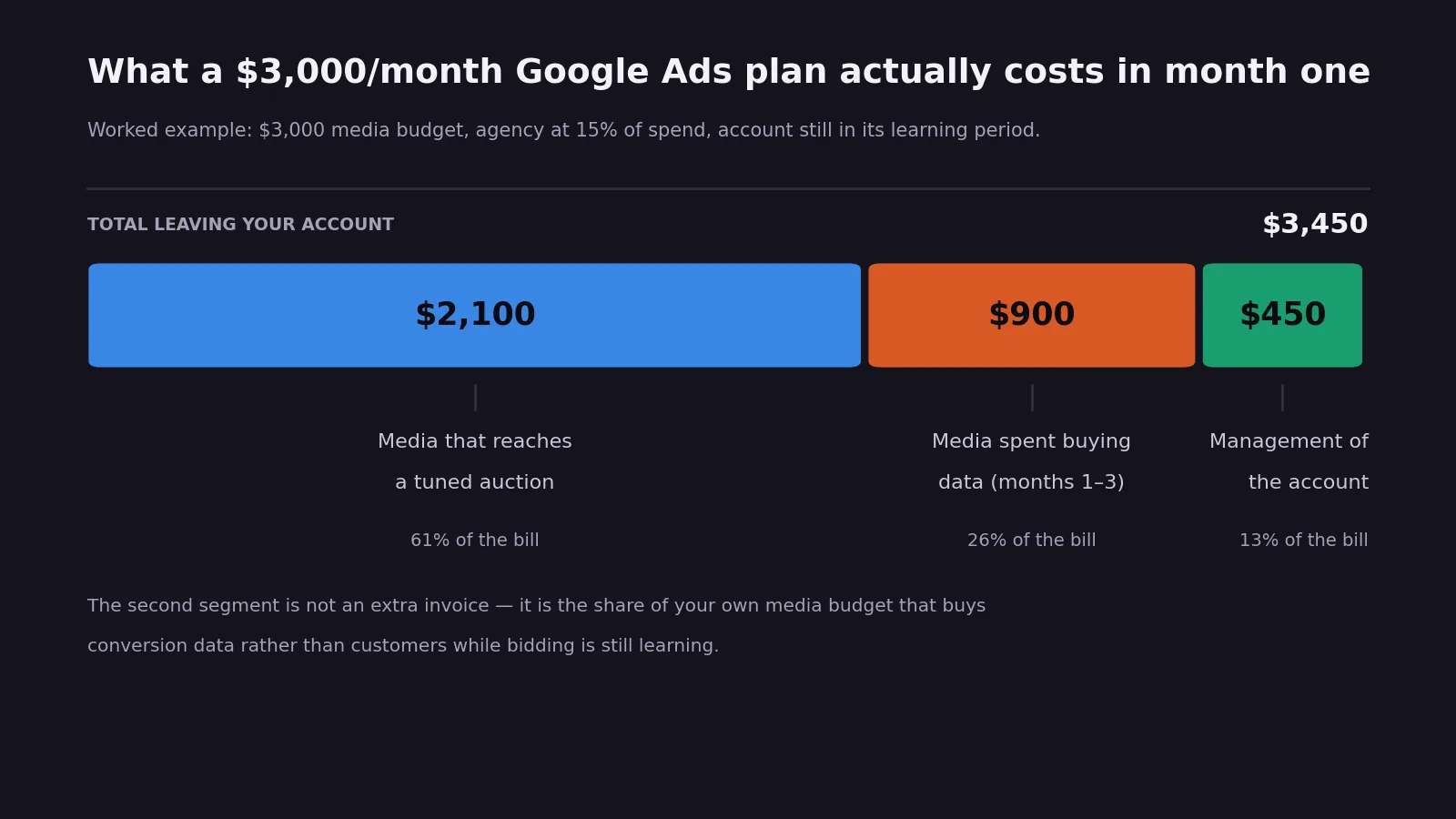
- The learning period. The share of your own media budget that buys conversion data instead of customers while automated bidding calibrates. It is not a separate invoice — it is a slice of number one, and budgeting as if it does not exist is what turns a reasonable plan into a disappointing first quarter.
A concrete version: a business planning $3,000 a month with an agency at 15% of spend writes off $3,450 in month one. Of the $3,000 of media, expect $600–$1,200 across the first two or three months to be tuition rather than turnover.
Average cost per click on Google Ads, and why yours will differ
The average cost per click across all industries on US search sits at roughly $1 to $5.42, with the higher figure reported for 2026. That average is close to useless for planning, because the auction does not care about averages.
Your click price is set by three things: what competitors are willing to pay for the same query, how relevant Google judges your ad and landing page to be, and how commercially loaded the query is. The third matters most. “Emergency plumber near me” and “how does a boiler work” sit in the same trade and are not remotely the same auction.
The lever you actually control is the second one. A higher Quality Score lowers what you pay for the same position, which is why two advertisers bidding on identical keywords can pay materially different amounts per click. Relevance is a discount mechanism, not a vanity metric.
Google Ads cost by industry: where the click price bites
Categories differ by an order of magnitude, and the reason is arithmetic rather than fashion. A click costs what it costs because of what a customer is worth: an insurance policy or a personal injury case justifies a bid that would bankrupt a homewares shop.
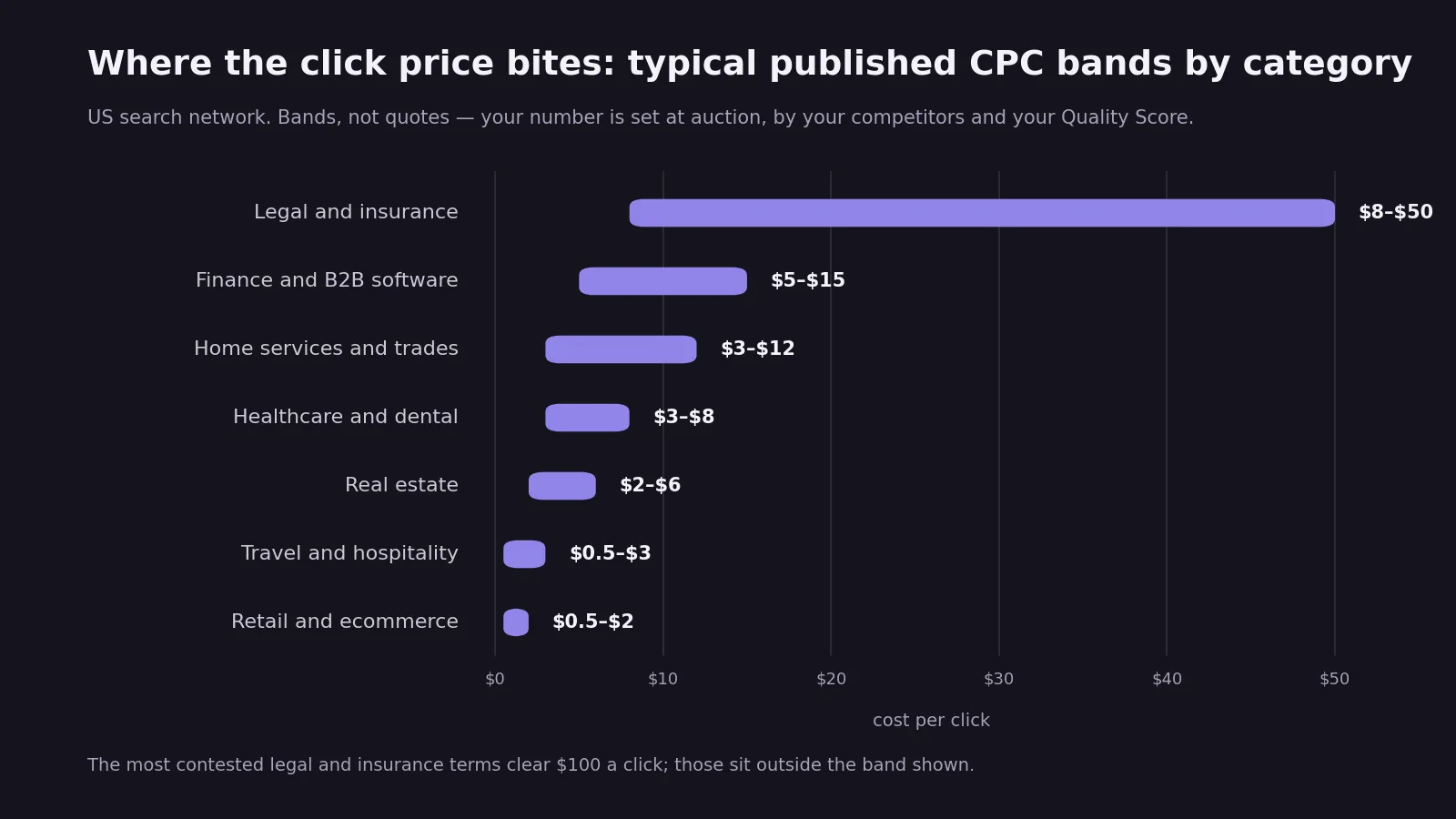
- Legal and insurance: roughly $8–$50 a click, with the most contested terms clearing $100.
- Finance and B2B software: roughly $5–$15, driven by long deal cycles and high contract values.
- Home services and trades: roughly $3–$12, and highly seasonal.
- Healthcare and dental: roughly $3–$8.
- Real estate: roughly $2–$6.
- Travel, hospitality, retail and ecommerce: roughly $0.50–$3, where volume rather than margin per click is the game.
These are published benchmark bands, not quotes. Treat them as a sanity check on a plan, never as a forecast: your own account will produce a truer number within two weeks of running.
How to estimate your Google Ads budget without a cost tool
Searches for a Google Ads cost estimator have grown more than thirty-fold in a year, which suggests a lot of people want a calculator. You do not need one. Four inputs and two divisions get you a defensible number, and unlike a calculator you will understand which assumption is wrong when reality disagrees.
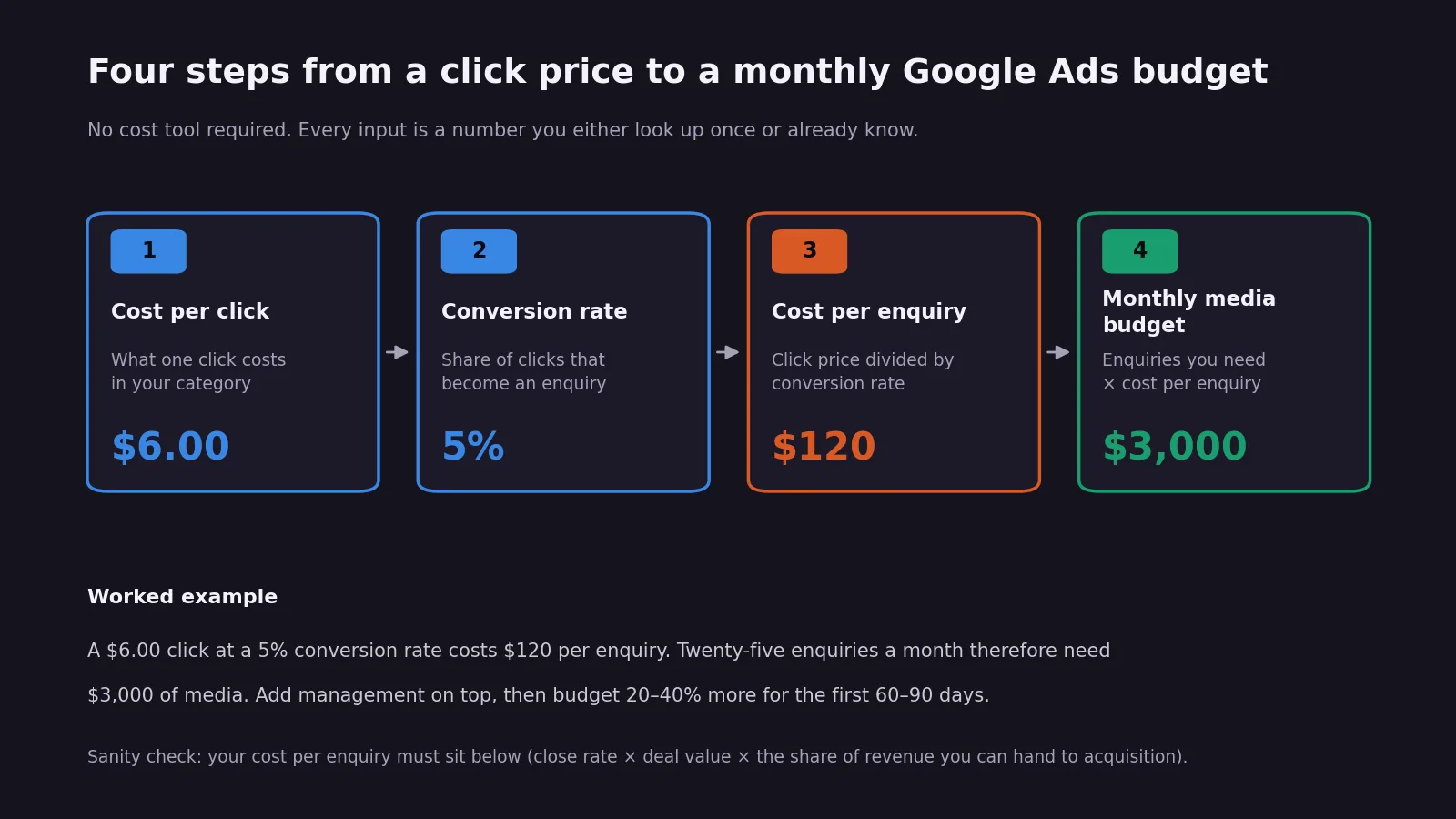
- Take your category’s click price. Start with the band above, then replace it with your own number as soon as you have two weeks of data.
- Estimate your conversion rate. Landing-page enquiries per 100 clicks. If you have no history, 2–5% is a conservative starting assumption for a service business.
- Divide to get cost per enquiry. A $6.00 click at a 5% conversion rate costs $120 per enquiry.
- Multiply by the enquiries you need. Twenty-five enquiries a month at $120 is $3,000 of media.
Then run the sanity check in the other direction, because step four tells you what you would spend, not what you can afford. Multiply your close rate by your average deal value, then by the share of revenue you are willing to hand to acquisition. If you close 30% of enquiries on $1,500 jobs and can spend a fifth of revenue on acquisition, an enquiry is worth about $90 to you — and a $120 enquiry means the plan needs a better conversion rate before it needs a bigger budget.
Is $10 a day enough for Google Ads?
$10 a day, or about $300 a month, is enough to test a single tightly-targeted campaign in a cheap category and not enough to run a business on. At a $2 click it buys roughly 150 clicks a month; at an $8 click it buys 37, which will not produce enough conversions for automated bidding to learn anything.
The honest threshold is not a dollar figure, it is a volume figure. Aim for enough clicks to generate around 30 conversions in 30 days, because that is roughly where Google’s automated bidding starts performing. Work backwards: 30 conversions at a 4% conversion rate needs 750 clicks, which at $3 a click is $2,250 a month.
If that number is out of reach, the answer is not a thinner budget spread across the same plan. It is a narrower plan — fewer keywords, one location, one offer — funded properly.
Why Google charged you $500 when your daily budget was $20
Because Google Ads bills you at a threshold, not on a schedule, and thresholds climb as you build payment history. This is the single most common “surprise charge” in the platform and it is not an error.
With automatic payments, Google charges you whenever your account reaches its billing threshold, or on your monthly billing date — whichever comes first. New accounts start at a low threshold, often $50, and it steps up as you pay on time: $50, then $200, then $350, then $500 and beyond. A $500 charge mid-month usually means you crossed a threshold, not that you overspent.
The related surprise is daily budget overruns. Google treats your daily budget as an average, and may spend up to twice it on a high-traffic day. It compensates on quieter days, and the monthly cap is your daily budget multiplied by 30.4. Seeing $40 spent on a $20 daily budget is documented behaviour, not a billing fault.
What Google Ads management costs on top of ad spend
Management is the second line of the bill and it is priced in three common shapes. None is inherently better; they fail in different places.
| Model | Typical range | Where it breaks |
|---|---|---|
| Percentage of ad spend | 10–20% of monthly media | The incentive points at bigger budgets, not better ones |
| Flat monthly retainer | $500–$5,000 depending on account complexity | Small accounts pay a disproportionate share |
| Hybrid: base plus percentage | Base $500–$1,500 plus 8–15% | Only worth it above roughly $10,000 of monthly media |
| In-house | 5–15 hours a month of a capable person | The hours are real even when nobody invoices for them |
These are market structures rather than anyone’s price list. The one number worth asking any provider is who actually touches the account each week, because that is what separates a managed account from a monthly report about an unmanaged one. We are a small agency and the owners run the accounts themselves on a monthly retainer, which is the same reason we cap how many we take — the details of how we run Google Ads accounts sit on the service page.
Wherever the management sits, price it before you set the media budget. A $1,000 media budget with a $1,000 retainer is a 50/50 split that will not produce results in most categories; the same retainer against $6,000 of media is ordinary.
Where Google Ads budgets get wasted first
Waste is rarely exotic. In a poorly-run account it concentrates in four predictable places, and all four are visible in the first month.
- Broad match without negatives. The fastest way to buy clicks from people describing a problem you do not solve.
- Traffic sent to a homepage. A homepage answers “who are you”, not “can you fix this today”. The click price is the same; the conversion rate is not.
- Untracked conversions. If Google cannot see which clicks became enquiries, automated bidding optimises towards clicks. You pay full price for the auction and get none of the learning.
- Brand terms counted as wins. Bidding on your own name is often sensible, but it converts well because those people were already coming. Reading it as campaign performance flatters the account and hides what the acquisition campaigns are actually doing.
Fixing these is not a budget question. A $2,000 account with conversion tracking, negatives and a real landing page routinely beats a $5,000 account without them, which is the most useful thing to know before deciding what Google Ads should cost you.
10 / Reader questions
Frequently asked questions
01Is $20 a day good for Google Ads?
$20 a day, about $600 a month, is a workable test budget where clicks cost $1–$5 and far too thin where they cost $15. Divide the budget by your category's click price: under roughly 100 clicks a month you will not collect enough conversion data to optimise anything.
02How much do Google Ads cost per day?
Most small advertisers run $10–$50 a day, which is $300–$1,500 a month. Google treats the daily budget as an average: it can spend up to twice that figure on a high-traffic day, but never more than your daily budget multiplied by 30.4 across a calendar month.
03What do Google Ads cost per 1,000 impressions?
Display campaigns billed by impression usually run $1–$5 per 1,000 impressions in published US benchmarks, and YouTube video sits higher. Impression buying is far cheaper per unit of reach than search clicks, but it converts slowly, so it belongs in awareness budgets rather than lead generation.
04Is there a minimum spend for Google Ads?
Google Ads has no minimum spend and no account fee — you can start at a few dollars a day and stop whenever you like. The practical minimum comes from bidding, not billing: Google's own guidance points at roughly 30 conversions in 30 days before automated bidding works properly.
05Are Google Ads worth it for a small business?
Google Ads are worth it when your cost per enquiry stays below what a customer is actually worth, which depends on close rate and deal value rather than click price. A plumber closing 40% of enquiries on $600 jobs can afford a $60 enquiry; a shop selling $30 items cannot.
06How much do Google Local Services Ads cost?
Local Services Ads are billed per lead rather than per click, with published US ranges of roughly $25–$100 per lead depending on trade and city. They appear above the search results, require Google screening, and often come in cheaper per enquiry than search ads for trades.