Published
A design brief is a short document — one to two pages for a single deliverable — that tells a designer what to make, who it is for, and what finished looks like. It is not a wish list. It is the set of decisions you have already made, written down, so nobody has to guess them and bill you for guessing wrong.
How this was checked. On 2 August 2026 we pulled the results Google ranked in the United States for “design brief”: seven organic results, an AI Overview above all of them, a video pack and a People Also Ask block. Two of the seven serve designers practising on invented briefs rather than clients writing real ones. The remaining five list the sections a brief should contain — background, objectives, audience, deliverables, timeline, budget — and one of those five shows a filled example. None of them explains what each line does to the work once a designer reads it. That gap is what this article is.
What a design brief is, and the three documents it gets confused with
The confusion is not academic. Bringing the wrong document to a project is how a two-week job turns into six weeks of alignment meetings.
- A design brief is not a creative brief. A design brief says what to make. A creative brief says what to say. If you already know you need packaging for four SKUs, you need a design brief. If you know you need a campaign and not what it is yet, the creative brief comes first and produces design briefs downstream.
- A design brief is not a scope of work. The scope is contractual: hours, milestones, payment schedule, what happens on the fourth round. The brief is editorial. The scope protects the relationship; the brief directs the work. Most studios turn your brief into their scope, which is why a vague brief produces a vague quote.
- A design brief is not a mood board. A mood board shows what you like. It cannot say why, and “why” is the transferable part. Ten images of Scandinavian packaging tell a designer nothing about whether you want the restraint, the palette or the price signal.
One line settles it: a design brief is the list of decisions the designer is not allowed to make for you.
A filled-in design brief, field by field
The brief below is a composite. It is assembled from the shape of projects we actually run — a regional coffee roaster moving from its own cafés onto supermarket shelves and refreshing its 250 g bag — rather than lifted from one client’s file, so the names and numbers are stand-ins and the structure is not. For each field: what got written, and what a designer actually does with it.
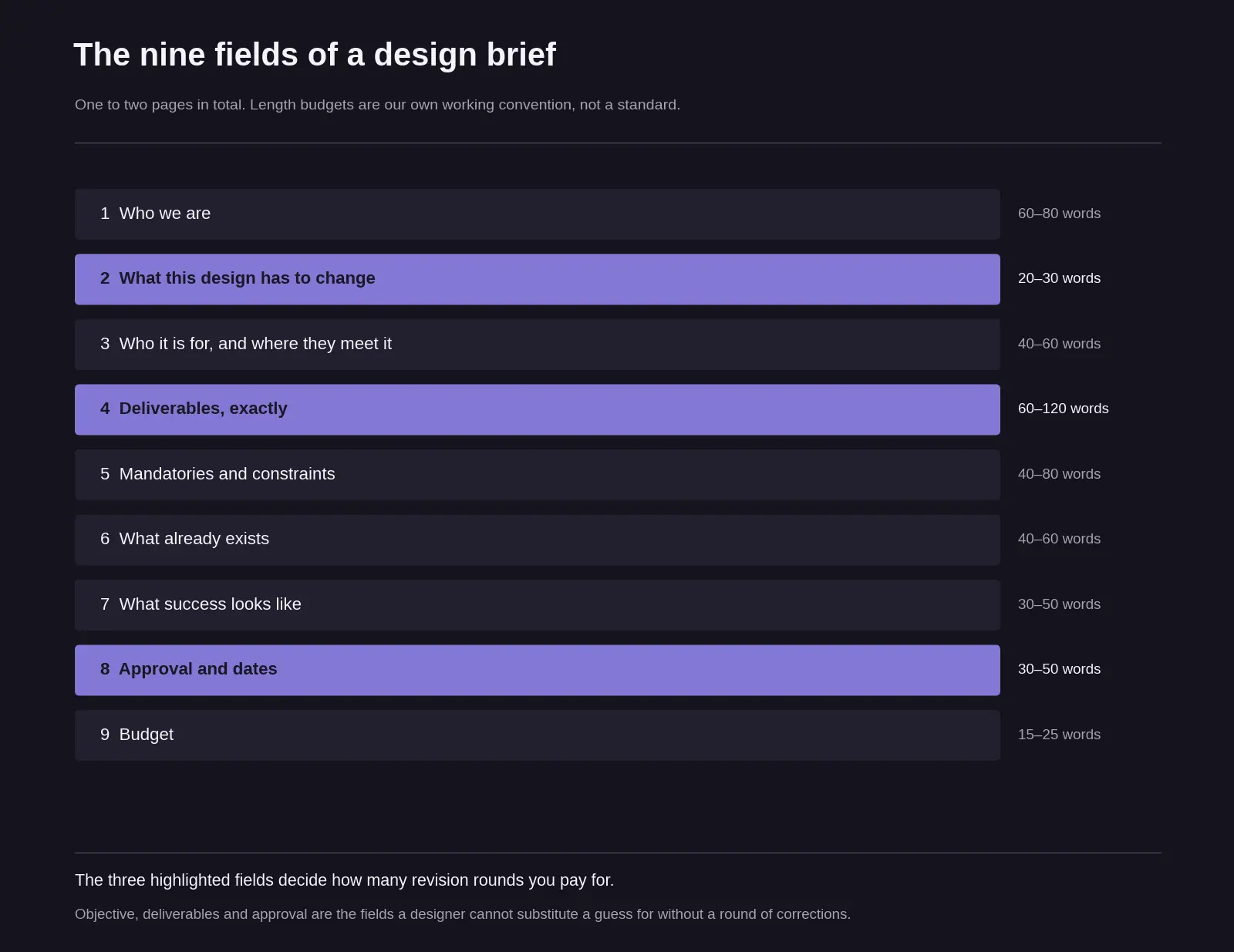
1. Who we are
Written: “Northbound Roasters. Nine years old, one roastery, three cafés in the same city. Around 70% of revenue is wholesale to restaurants; the retail bag exists mostly as a souvenir customers buy after a coffee. From late October it goes into 40 supermarket stores in the region.”
What the designer does with it. Reclassifies the job. This is not a packaging refresh — it is a first-time retail launch for a brand whose current bag has never had to sell itself to a stranger. Every design decision that follows changes because of that sentence. A bag that works on a café counter, where a barista has already sold the coffee, fails on a shelf where it has four seconds and no advocate.
2. What this design has to change
Written: “A shopper who has never heard of us should pick our bag up instead of Verdant Coffee or Harbour Lane, which sit on the same shelf, and do it without a discount. Success is being reordered by the chain after the first 90 days.”
What the designer does with it. Gets a decidable objective. “Modernise the brand” cannot be tested; “picked up next to two named competitors, without a discount” can. It also rules things out — anything that reads as a premium gift item is now wrong, because gift packaging gets bought once, not reordered.
3. Who it is for and where they meet it
Written: “Supermarket shoppers, 30–55, buying coffee as part of a weekly shop. They meet the bag on a shelf at chest height, in cold overhead light, alongside eight to twelve other bags. Almost none of them have been to our cafés.”
What the designer does with it. Sets the physical test the design has to pass: legible at arm’s length, in bad light, in peripheral vision, against neighbours. That single line eliminates half of the typography choices before anyone opens a file. Audience described only as “coffee lovers, 25–45, urban” would not have eliminated anything.
4. Deliverables, exactly
Written: “250 g bag, four blends. Front, back and side panels. Print-ready files to the converter’s dieline (attached). Plus: one shelf-strip, 800 × 120 mm, and images for the chain’s online listing — five pack shots on pure white, 2000 × 2000 px, and one styled flat-lay for the lifestyle slot.”
What the designer does with it. Quotes accurately and does not discover the online listing images in week three. The dieline matters more than it looks: packaging is designed inside the die the converter will actually cut, and a brief without it produces artwork that has to be redrawn once the converter replies. Naming pack shots and flat-lay separately matters for the same reason — they are different shoots with different setups, and “product images” would have bought one of them.
5. Mandatories and constraints
Written: “Must carry: the existing wordmark (unchanged — it is on the café signage and we are not repainting), the roast date panel, the EAN barcode with the quiet zone the chain specifies, net weight, the recycling mark, the organic certification logo. Cannot: matte lamination — the converter’s matte film starts at 10,000 bags per blend and we are printing 4,000. Must not resemble Verdant Coffee’s green-and-kraft look — we sit next to them.”
What the designer does with it. Works inside the real boundary instead of finding it by presenting the wrong thing. The barcode is the quietest and most binding item on that list: its quiet zone dictates the back-panel layout before a single word of copy is placed. The “must not resemble” line is the single most useful sentence most briefs never contain — negative constraints eliminate faster than positive ones. And “wordmark unchanged” silently converts the job from a rebrand into a packaging system built around a fixed asset, which is a different quote.
6. What already exists
Written: “Current bag artwork in Illustrator, 2019. Wordmark in vector, two versions and we are not sure which is current. No brand guidelines. Photography: café shots only, no product shots on white.”
What the designer does with it. Budgets for the missing pieces before the deadline is set. “Two versions and we are not sure which is current” is worth an hour of someone’s time on day one instead of a colour mismatch discovered at proof stage. “No product photography” means a shoot goes in the schedule now, not after the design is approved.
7. What success looks like
Written: “Blend name legible from 60 cm. Passes the chain’s packaging spec (attached) and the chain’s buyer as a spec gate. Final approval is Anna’s alone. Design does not need to be liked by the café staff.”
What the designer does with it. Gets an acceptance test and knows which of the two checks is a gate and which is a decision. The last sentence is doing real work: it names a group whose opinion will be collected and is not decisive. Without it, the fourth round arrives as “the baristas think it’s too corporate” and nobody can rule on that.
8. Approval and dates
Written: “Feedback is collected by Maria and sent as one consolidated list. Final approval: Anna (founder). Concepts 18 August, two rounds of revisions, print-ready files 5 September — the converter’s slot is booked and does not move; bags land mid-October, first shelf date 1 November.”
What the designer does with it. Plans backwards from a hard date and knows whose note wins when two notes conflict. Naming the shelf date as well as the file date also stops the schedule being read as generous: flexible packaging takes weeks to print, laminate, convert and fill, and those weeks live after the deadline that appears in the brief. A single named approver is worth more than any other line here, including the budget.
9. Budget
Written: “$9,000–$12,000 for design, excluding photography and print. Photography budgeted separately at around $2,500.”
What the designer does with it. Proposes the right shape of work. A budget is not a negotiating weakness — it is what decides whether you are quoted a four-blend system built on commissioned illustration or a typographic system that scales. Withholding it does not get a better price; it gets a proposal that has to be redone.
Five brief lines that each buy you an extra round of revisions
These are not stylistic complaints. Each of the five removes a decision from the brief, and every decision that leaves the brief comes back as a revision round — the designer guesses, presents, and gets corrected. That is the mechanism. The fix in each case is to make the decision on paper instead of in a review meeting.
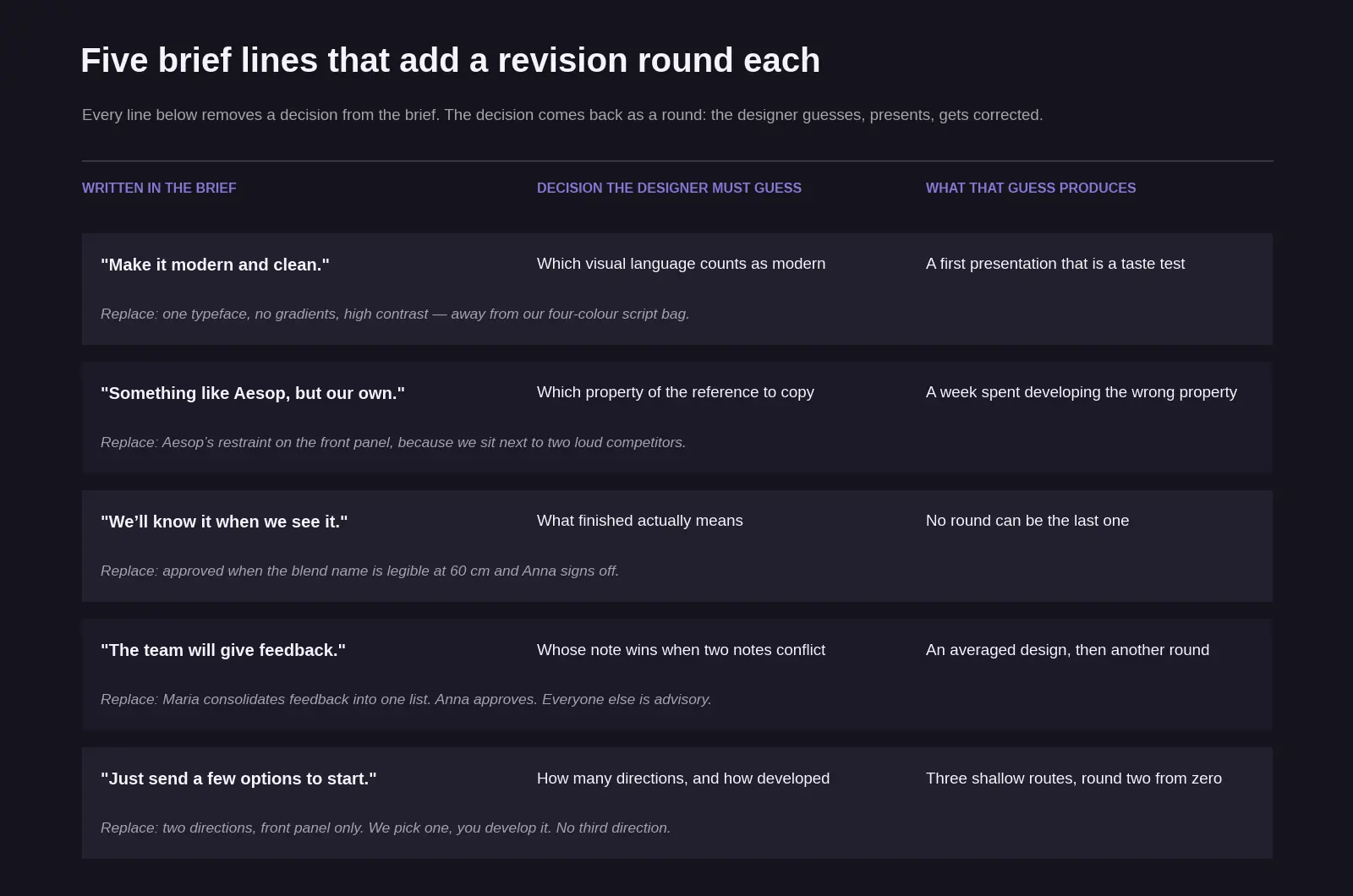
1. “Make it modern and clean.” Every designer’s “modern” is the last three things they admired. The word carries no constraint, so the first presentation becomes a taste test rather than a review — and taste tests do not converge, they iterate. Replace with: “Modern here means one typeface, no gradients, high contrast, no illustration. Our current bag uses four colours and a script font; that is what we are moving away from.”
2. “Something like Aesop, but our own.” A reference without a named property is an instruction to copy an unspecified thing. Aesop’s front-panel discipline? Its typographic density? Its price signal? Its shelf behaviour? The designer picks one, and the odds are against them picking the one you meant. Replace with: “We want Aesop’s front-panel discipline — one typeface, no illustration, no decorative layer — because our bags sit next to two very loud competitors.”
3. “We’ll know it when we see it.” This is the honest one, and it is also the expensive one. Without a stated acceptance test, no round can be the last round by definition. The project ends when someone gets tired, not when it is finished. Replace with: “Approved when the blend name is legible at 60 cm and Anna signs off.”
4. “The team will give feedback.” An unnamed number of people with implied veto power. Contradictory notes arrive in one document, the designer averages them, and the average satisfies nobody — so another round begins. Replace with: “Maria collects feedback into one list. Anna approves. Anyone else’s view is advisory.”
5. “Just send a few options to start.” “A few” is not a number and “to start” implies the real work happens later. The designer produces three shallow directions instead of one developed one, you choose the least wrong, and round two begins from close to zero. Replace with: “Two directions, developed to the front panel only. We pick one; you develop it. No new direction after that point.”
What a design brief cannot fix
A brief removes guessing. It does not remove judgement, and it is worth being honest about the three things it will not do.
It will not settle taste. Two people who disagree about whether a design looks expensive will still disagree with a perfect brief in front of them. What the brief does is move that argument to a criterion — “does it read as expensive next to Verdant on a shelf” — where one answer can win.
It will not survive a changing objective. If the supermarket listing turns into a subscription launch halfway through, the brief is out of date and every round after that point is being spent renegotiating it silently. Rewrite the brief instead. It takes an hour, and it is cheaper than the rounds it prevents.
It will not help if the person doing the work never reads it. This is the failure mode nobody writes down: the brief is discussed in the pitch by senior people and then handed to whoever is available. It is also the one you can test for, cheaply, and the last section of this article is how.
How long a design brief should be, by deliverable
What drives the length is the number of independent decisions, not the size of the project. A four-SKU packaging system is one set of decisions applied four times; a website is a different set of decisions per template. The shapes below are what we plan against, not measured averages — your approval chain moves them more than the deliverable does.
| Deliverable | Which brief, and how long | Who drafts it | Prep time | Rounds to plan for |
|---|---|---|---|---|
| Logo or identity | Design brief, 2 pages | Client and designer together | 2–4 hours | 3–4 |
| Packaging, one SKU family | Design brief, 1–2 pages + dieline and spec sheet | Client; designer adds specs | 2–3 hours | 2–3 |
| Landing page | Design brief, 1 page + the copy | Whoever owns the page | 1–2 hours | 2 |
| Full website | Design brief, 3–5 pages + sitemap | Client and strategist | Several days | 2–3 per template |
| Pitch or sales deck | Design brief, 1 page + the actual content | The person who will present it | 1 hour | 2 |
| Campaign across channels | Creative brief first, then one design brief per asset | Strategist | — | — |
The website row is where most budgets break. People write one brief for “the website” and are surprised when the eighth template costs as much as the first. The number that matters is templates, not pages, and it is worth understanding before signing anything — we broke it down in what a website redesign actually costs.
Design brief vs creative brief: which one you need
They overlap on audience, tone and mandatories, which is why they get treated as synonyms even by tools that publish templates for both. They are not interchangeable, and using the wrong one is a diagnosable mistake.
| Design brief | Creative brief | |
|---|---|---|
| Answers | What to make | What to say |
| Owns | The artefact: files, sizes, formats, mandatories | The message and the campaign idea |
| Written for | A designer, illustrator or packaging engineer | A creative team: copy, art direction, media |
| Starts when | You know what needs making | You know what needs achieving, not what to make |
| Output | A specified deliverable | A concept that then generates deliverables |
| Fails by | Being too vague to execute | Being too specific too early |
The order matters. A campaign that starts with design briefs produces a set of well-made assets that do not add up to an argument. A single deliverable that starts with a creative brief produces a strategy document and no bag.
A design brief template you can copy
Nine fields, one to two pages. Delete what does not apply — an empty field is more honest than a padded one.
DESIGN BRIEF — [project name]
Date: [ ]   Approver: [one name]   Deadline: [hard date + what it is tied to]

1. WHO WE ARE
   One paragraph. What the business sells, to whom, at what scale.
   Include the thing that is changing right now.

2. WHAT THIS DESIGN HAS TO CHANGE
   One sentence, phrased as a decision by someone else that you want to go
   differently. Not an adjective.

3. WHO IT IS FOR, AND WHERE THEY MEET IT
   Who, and — more useful — the physical or screen context. Distance, light,
   device, what sits next to it.

4. DELIVERABLES, EXACTLY
   Every item, with format, size and file type. Include the ones that feel
   obvious. Attach any dieline, spec sheet or platform requirement.

5. MANDATORIES AND CONSTRAINTS
   Must carry: [legal marks, barcodes, fixed assets]
   Cannot do: [finishes, formats or materials ruled out, and why]
   Must not resemble: [name the competitor]

6. WHAT ALREADY EXISTS
   Files, formats, and honestly which version is current. Note what is
   missing — photography, copy, guidelines — so it gets scheduled.

7. WHAT SUCCESS LOOKS LIKE
   A test someone can run on the finished thing. Name any group whose
   opinion will be heard but is not decisive.

8. APPROVAL AND DATES
   Who consolidates feedback. Who signs off — one name. Milestone dates,
   which date cannot move, and what happens after the files are delivered.

9. BUDGET
   A range. What it excludes (print, photography, licensing, extra rounds).
Are design briefs still worth writing now that AI can generate one
Yes, and the reason is narrow: a generator produces the container, not the decisions. Ask a model for a design brief and it will return nine well-formatted headings in a few seconds. Every one of them will be empty of the only things that direct work — which competitor you must not resemble, who signs off, what your shelf looks like, which version of your wordmark is current, whether the matte finish exists at your print run.
Formatting a brief was never the hard part. Deciding was. What a model is genuinely good at is the pass afterwards: read the draft back and ask which fields could be answered two different ways by two different designers. That is a real use, and it takes minutes.
How to hand a brief over so it survives the first meeting
Send it before the call, not during. A brief read live becomes a discussion about the document; a brief read in advance becomes a list of questions about the work, which is what you want.
Then watch what comes back. Questions about constraints, formats and the approval chain mean it is being read by the person who will do the work. Compliments about the business mean it has been read by whoever is selling. That difference tells you more about how the project will run than any portfolio does — and it is why, in our own graphic design work, the brief gets rewritten by the person holding the pen rather than passed down to someone who was not in the room.
One brief will not make a project painless. It will move the arguments to the start, where they cost an hour, instead of the end, where they cost a round.
10 / Reader questions
Frequently asked questions
01What is a design brief?
A design brief is a short document that tells a designer what to make, who it is for, and what finished looks like. It records the decisions the client has already made — objective, audience, deliverables, constraints, deadline and approver — so the designer does not have to guess them.
02What are the 5 parts of a design brief?
The five that carry the work are objective, audience, deliverables, constraints and approval — and approval brings the acceptance test with it, because an approver without a criterion is just a taste. Company background, budget, timeline and existing assets support those five rather than replacing them.
03How do I write a design brief?
Write the objective first as a decision you want changed, not an adjective. Then list the exact deliverables with formats and sizes, the constraints that cannot move, one named approver, and the date. An hour or two of writing for most deliverables saves whole rounds of revisions later.
04Who writes the design brief, the client or the designer?
Usually the client drafts it and the designer rewrites it. The client owns the objective, audience, constraints and deadline; the designer owns the specifications — formats, sizes, print requirements, number of directions. On identity and website work it is more often drafted jointly from the start.
05What is the difference between a design brief and a creative brief?
A design brief answers what to make; a creative brief answers what to say. The design brief specifies an artefact — files, sizes, formats, mandatories. The creative brief specifies a message and a campaign idea that then generates several artefacts, each of which may need its own design brief.
06How long should a design brief be?
One to two pages for a single deliverable, three to five for a full website. What drives the length is the number of independent decisions, not the size of the project. Past five pages a brief usually contains research that belongs in an appendix and constraints that belong in a specification sheet.
07Are design briefs still relevant when AI can generate one?
Yes. A generator produces the container, not the decisions. It can format nine headings in seconds, and it still cannot tell you which competitor you must not resemble, who signs off, or what your shelf looks like. The brief was never hard to format — it was hard to decide.