Published
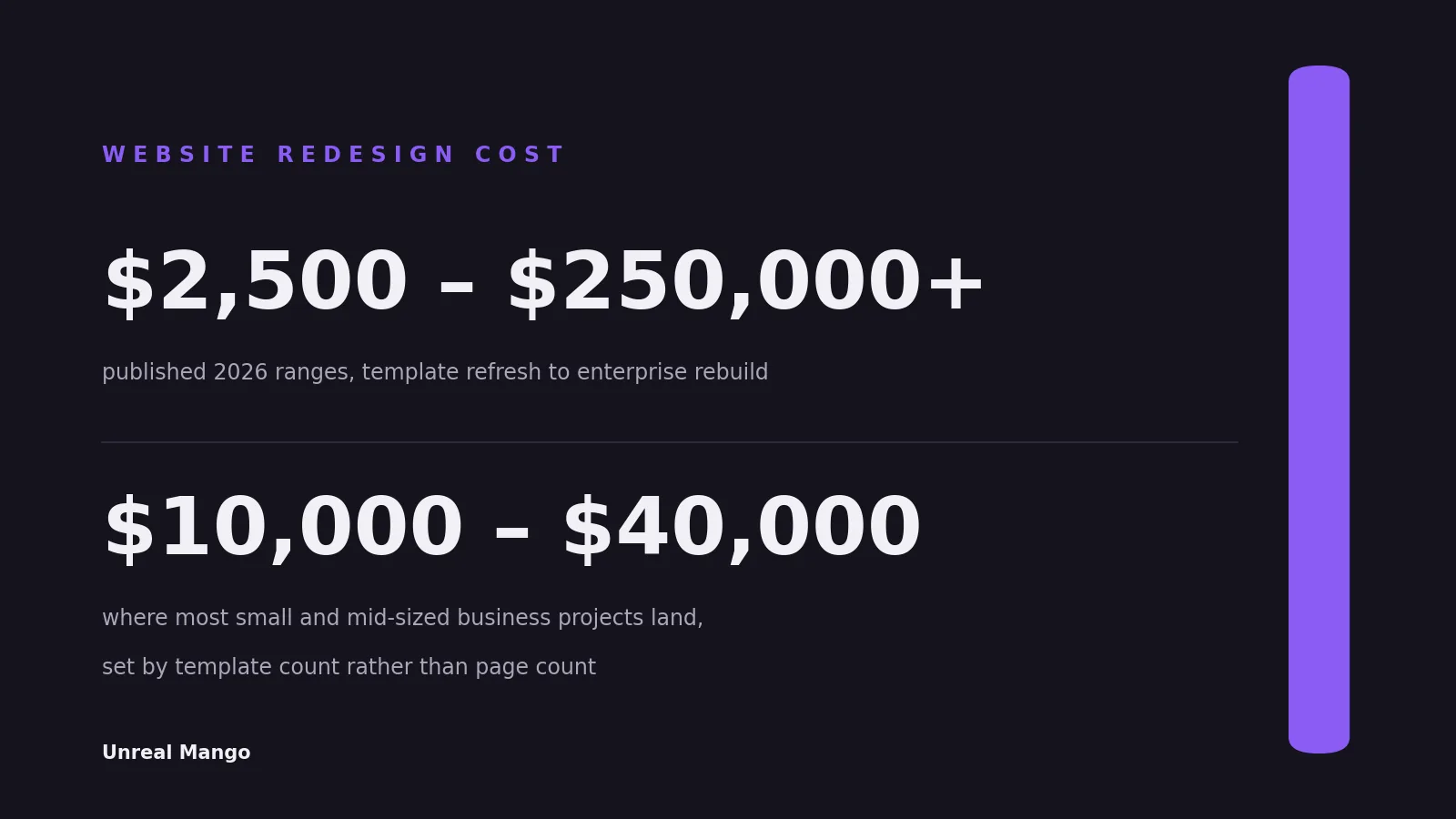
A website redesign costs $2,500 to $250,000+, and most small and mid-sized businesses land between $10,000 and $40,000. What decides where you sit is not your page count — it is how many distinct templates need designing and how many URLs need moving. The largest cost in a redesign is often the organic traffic lost during migration, and it appears in no quote.
How these figures were sourced. The ranges here are compiled from the ten results Google itself ranked for this query in the United States on 2 August 2026, including the AI Overview and its cited sources. They are published benchmark bands, not quotes, and the hour figures are craft norms rather than survey data. Your own estimate should come from counting templates and URLs, which the sections below show how to do.
Average website redesign cost by site size and provider
The published bands cluster by who is doing the work and how many templates the site needs. Page count is the number everyone quotes because it is easy to count, but it is the weaker of the two predictors.
| Project | Pages | Distinct templates | Typical published band |
|---|---|---|---|
| Template refresh, same structure | 5–15 | 4–6 | $2,500–$12,000 |
| Small-business redesign, new structure | 10–25 | 6–9 | $10,000–$40,000 |
| Mid-market site with content migration | 30–75 | 9–15 | $40,000–$100,000 |
| Ecommerce or enterprise rebuild | 100+ | 15+ | $100,000–$250,000+ |
Provider tier moves the same project by a factor of ten. DIY on a site builder runs $500–$5,000, a freelancer $1,500–$10,000, and a full-service agency $5,000–$75,000 and up for what is nominally the same brief. The work is not identical — what changes is how many of the decisions someone else makes for you, and who is accountable when the launch goes wrong.
Why published redesign prices range from $2,500 to $250,000
Because almost every published number is written by a company describing its own floor. An enterprise studio that will not take a project under $15,000 will publish $15,000 as its small-business band; a template marketplace will publish a figure in the hundreds. Both are honest about themselves and neither is an average of the market.
Three things move a real quote, in descending order of impact:
- Whether the structure changes. A visual refresh on existing templates is design hours. A new information architecture is design plus development plus migration plus redirects, which is a different project wearing the same word.
- Template count. Each distinct layout is designed, built responsive, QA’d across breakpoints and wired into the CMS. That is the unit of work.
- How much content moves. Every URL that changes address needs mapping, redirecting and verifying, and every page that changes shape needs its content reformatted.
Everything else — animation polish, custom illustration, integrations — sits on top of those three and is easier to cut when the budget is fixed.
Redesign or rebuild: the decision that moves the number most
These get used interchangeably in sales conversations and they are not the same purchase. Getting the label right before you brief anyone is the cheapest decision in the whole project.
| Redesign | Rebuild | |
|---|---|---|
| What changes | Visual layer, some templates, copy | Structure, CMS or platform, templates, URLs |
| What stays | Page structure, URLs, CMS, content model | Usually only the content itself |
| Share of budget in build, roughly | 30–40% | 55–70% |
| Migration work | Little to none | The largest single line item |
| Realistic timeline | 4–10 weeks | 3–6 months |
| Risk to organic traffic | Low | High, and concentrated in one launch day |
The honest trigger for a rebuild is structural: the CMS blocks the pages you need, the content model cannot express your services, or the front-end is slow in a way no amount of design fixes. “It looks dated” is a redesign trigger. Paying rebuild prices to solve a redesign problem is the most common way a $12,000 project becomes a $45,000 one.
How a redesign estimate splits across design, build and migration
Most quotes arrive as a single number with a paragraph of scope. Broken into its parts, an agency estimate tends to distribute roughly like this — the shape most estimates take, not a fixed formula.
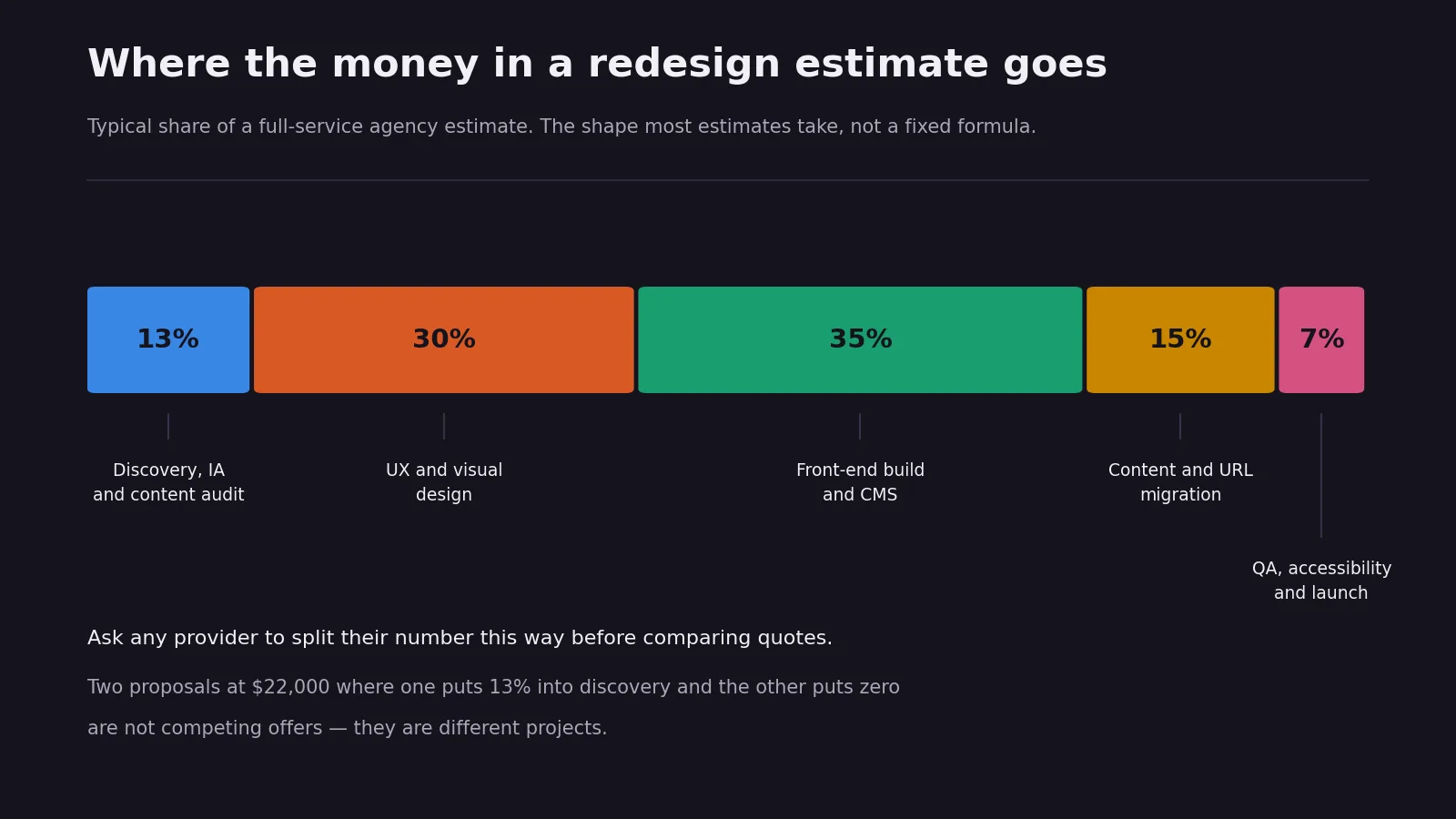
- Discovery, IA and content audit — 10–15%. Page inventory, what gets kept, merged or killed, and the sitemap everything else is priced against. Skipped on cheap projects, which is why cheap projects run over.
- UX and visual design — 25–35%. Priced per template, not per page. Wireframes, visual design, responsive states.
- Front-end build and CMS — 30–40%. Turning templates into working, editable pages. The share rises with every custom component.
- Content and URL migration — 10–20%. Almost always the underestimated line. Detail below.
- QA, accessibility and launch — 5–10%. Cross-browser checks, form testing, redirect verification, the launch itself.
Ask any provider to split their number this way before comparing quotes. Two proposals at $22,000 where one puts 13% into discovery and the other puts zero are not competing offers — they are different projects. We are a small agency, and an estimate here is written by the person who will be accountable for the build — which is the only reason the split is ours to show; how we design and build sites sits on the service page.
Template count, not page count, is what you are paying for
A 40-page site built from six templates is cheaper to redesign than a 12-page site where every page is a bespoke layout. This is the single most useful thing to know before you request quotes, and it contradicts how nearly every pricing page on this topic is organised.
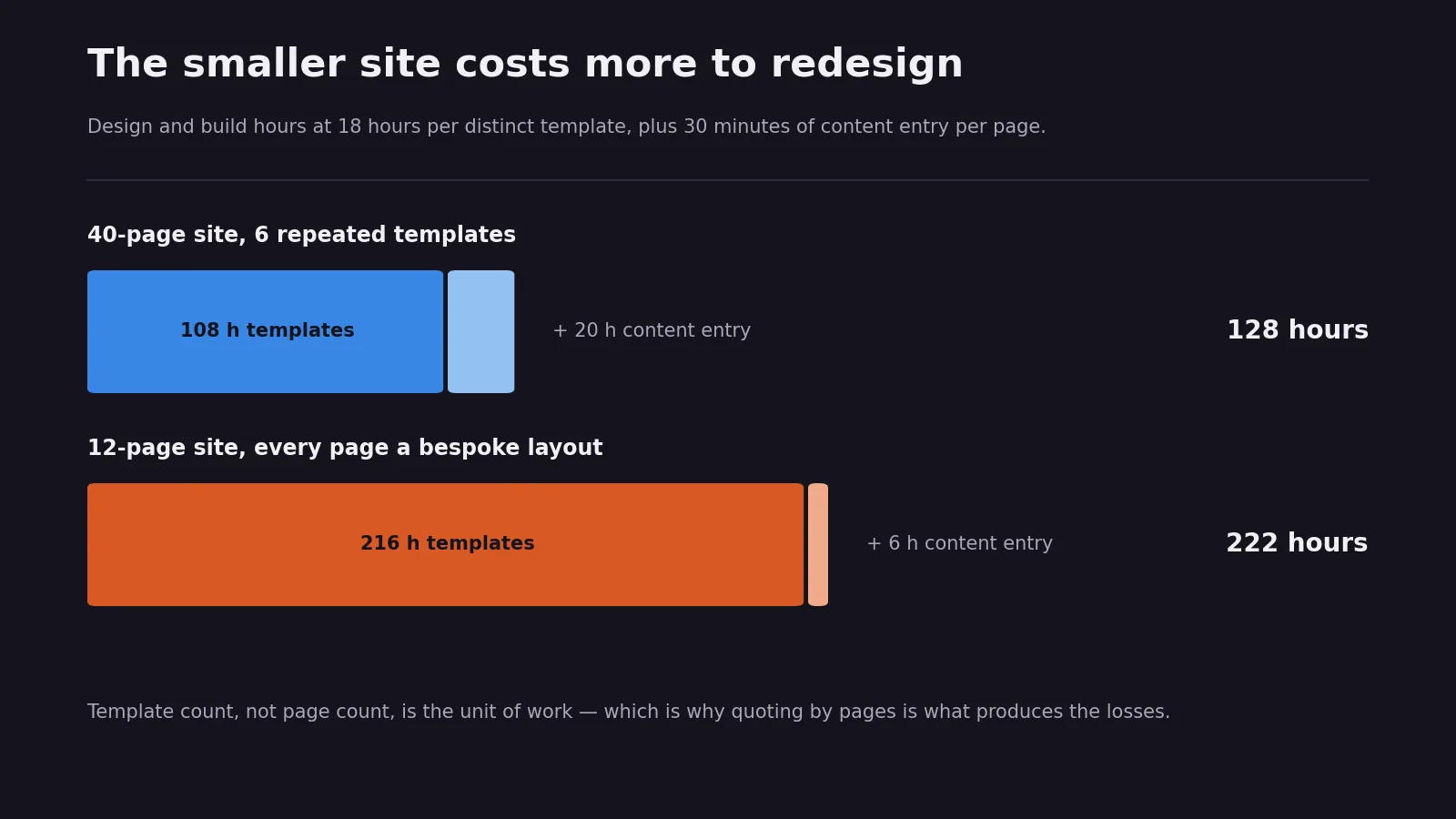
The reason is that a template is designed once and reused. A page built from an existing template costs content-entry time. A page with its own layout costs design, build, responsive work and QA all over again. At 18 hours a template and half an hour a page, the 40-page site is 108 hours plus 20; the 12-page site is 216 plus six.
So the estimate you can build yourself, before anyone quotes you:
- Count distinct layouts, not pages. Home, service, case study, blog index, blog post, contact, legal. Most business sites have six to nine, and people are usually surprised it is that few.
- Multiply by 12–25 hours each for design plus build on a standard marketing template, more for anything with filtering, calculators or configurators.
- Count URLs that change address. Multiply by 0.25–1 hour for migration and redirect mapping.
- Apply a blended rate. US market rates run roughly $60–$150 an hour depending on provider tier.
Eight templates at 18 hours is 144 hours; 120 migrated URLs at half an hour is 60 hours. At $100 an hour that is $20,400 — and now you know which assumption to challenge when a quote comes back at $45,000.
What content and URL migration costs on a redesign
Budget 0.25 to 1 hour per URL, which on a 120-page site is 30 to 120 hours, or roughly $1,800 to $18,000 at the $60–$150 blended rates above. The range is that wide because migration is three jobs that get quoted as one.
The first is moving content into the new content model, which is fast when the shapes match and slow when they do not. The second is the redirect map: every old URL pointed at its closest new equivalent, one entry at a time, with no shortcuts to a homepage catch-all. The third is verification after launch, which is the one that gets cut.
Verification matters more than it sounds. On our own studio’s rebuild we found that an uppercase variant of every URL was returning a healthy 200 while the canonical version was lowercase — a silent duplicate of the entire site, invisible until someone checked every address rather than a sample. That class of defect costs nothing to fix on day one and months of ranking to fix on day ninety. The full teardown is in our SEO case study.
The redesign cost that appears in no quote: lost organic traffic
Here is the arithmetic nobody puts in a proposal. Take a site drawing 3,000 organic sessions a month, converting 2% into enquiries, closing a quarter of them at $2,000 a job. That is 60 enquiries and roughly $30,000 of closed business a month.
Lose 40% of organic traffic for four months after a bad migration and you lose 24 enquiries a month, 96 in total, worth about $48,000 in closed business. The redesign that caused it cost $20,000. The invisible line item was more than double the visible one — and four months is the forgiving version, as the recovery curve below shows.
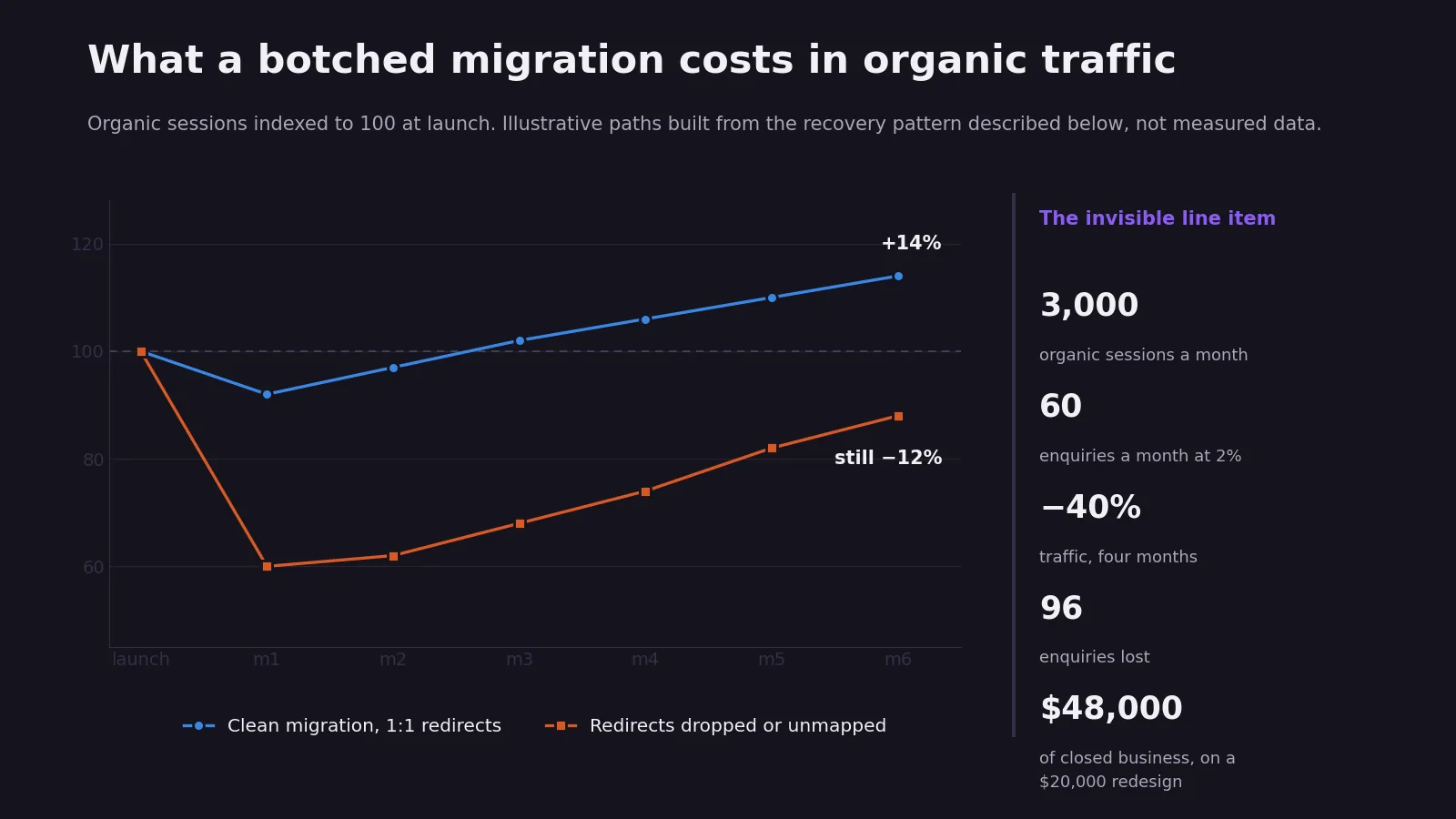
A clean migration with one-to-one redirects usually dips for a few weeks and recovers within one to three months. A migration that drops redirects, changes URL patterns without mapping them, or quietly removes pages that were ranking can take six months or more, and some of it never comes back. This is a pattern observed across migrations rather than a guaranteed timeline — but the asymmetry is consistent, and it is why the cheapest quote is frequently the most expensive project.
Two questions separate providers who price this in from providers who do not. Ask who produces the redirect map and when. Ask what gets verified on launch day and by whom. Vague answers to either are the single best predictor of a painful third month.
What a CMS choice adds to the redesign bill
The platform decision is usually made on a feature list and paid for in build hours and recurring fees. Each option is genuinely reasonable — they simply fail in different places.
| Platform | Effect on build hours | Recurring cost | Where it hurts |
|---|---|---|---|
| Site builder (Wix, Squarespace) | Lowest — template-driven | $200–$500 a year | Ceiling on custom layout and page speed |
| WordPress | Baseline | $500–$3,000 a year in themes and plugins | Plugin sprawl and maintenance debt |
| Headless CMS plus custom front-end | +20–40% front-end hours | $0–$300 a month for the CMS tier | Every content change needs a developer if modelled badly |
| Static site generator | Similar to headless | Near-zero hosting | Structural changes need a developer, not an editor |
The expensive mistake is choosing a platform your team cannot edit. A site that requires a developer for a price change stops being updated within a year, and an unmaintained site is a redesign brief waiting to be written. Ask to update a page yourself during the handover, before the invoice is settled.
What surfaces after the quote is signed
Nothing on the overrun list is a surprise by the time it arrives; it is a surprise only because nobody put it in the brief. These four account for most of it.
- Content nobody has written. Design assumes copy exists. If it does not, someone writes it, and that is either your team’s weeks or, at published freelance copywriting rates, $150–$500 a page.
- Photography and imagery. Stock reads as stock. Published rates for original photography or CGI span $1,000–$10,000 depending on scope, and the need is discovered at the design stage, not in the brief.
- Third-party integrations. CRM, booking, payments, ERP. Each is a discovery task disguised as a checkbox, and each can add 10–40 hours.
- Accessibility remediation. If WCAG conformance is a requirement rather than a nice-to-have, it belongs in the original scope. Retrofitted, expect it to add a double-digit percentage to design and build rather than a rounding error.
Put all four in the brief as explicit yes-or-no items. A provider who scopes them honestly will quote higher than one who does not, and cost less by the end.
What a redesigned site costs to run after launch
Expect $35–$650 a month for hosting and maintenance on a typical business site — published figures put hosting at $15–$150 a month and maintenance at $20–$500 depending on how much someone is actually doing. CMS and plugin licences from the table above sit on top of that. That is the floor for keeping the site working, not for making it perform.
The larger recurring number is whatever feeds the site traffic. A redesign changes conversion rate; it does not create demand. If paid search is part of that plan, its arithmetic is a separate bill that lands after the redesign invoice is paid, and we broke that one down in how much Google Ads cost.
Price the recurring line before you sign the project one. A $30,000 redesign with no budget left to maintain or promote it is how sites end up needing another redesign in three years, which is the most expensive way to buy a website there is.
11 / Reader questions
Frequently asked questions
01How much does it cost to change a website?
Changing an existing website costs $2,500–$12,000 while the current templates stay in place, and $10,000–$40,000 once the page structure, navigation or CMS changes. The dividing line is whether templates are being edited or rebuilt: editing is design hours, rebuilding is design plus development plus migration.
02How much will it cost to redesign a website in 2026?
Published 2026 ranges run from $2,500 for a template refresh to $250,000+ for an enterprise rebuild, with most small and mid-sized business projects landing at $10,000–$40,000. The spread comes from provider tier and template count, not from the year.
03How often should a website be redesigned?
Full redesigns are typically worth doing every four to six years, while the templates and content should be revised continuously in between. A site that is rebuilt from scratch every two years is usually being used to avoid a positioning problem that a redesign cannot fix.
04How much should you charge for a website redesign?
Freelancers and small studios usually price a redesign by counting templates and migrated URLs, then applying a blended rate of $60–$150 an hour in the US market. Quoting by page count is what produces the losses, because two sites with the same page count can differ threefold in build hours.
05Can AI redesign my existing website?
Partly — AI can generate layouts, copy drafts and code scaffolding, which compresses the design and build hours, but it cannot make the decisions. Information architecture, redirect mapping and conversion logic still need a person who is accountable for the result, and those are the parts of a redesign that cost real money when they go wrong.
06Is there a monthly cost to a website redesign?
The redesign itself is a one-off project cost, but the site it produces carries $35–$650 a month in hosting and maintenance, with CMS and plugin licences on top of that. Budget the recurring line before signing the project, because a site nobody has budget to maintain reverts to needing a redesign faster.