
Published · Updated
A media pitch is a short email that offers a journalist one story, not one company. The six examples below are split by story type — funding, product launch, executive hire, data release, customer result and newsjack — because the type, not the wording, sets your odds of a reply.
That claim has a number behind it. Across 405,964 pitches, Propel measured a 3.43% overall response rate. Inside that same dataset, funding pitches were answered far more often, and the rate climbed with the round: 12.42% for Series A, 17% for Series B, 21.72% for Series C. Same platform, same quarter, same average pitch-writing skill — six times the baseline, purely because of what the story was.
How this was checked. Every number on this page comes from a published study, named where it appears. The type-level response rates are from the Q2 2024 Propel Media Barometer, which analysed 405,964 pitches sent through the platform in Q1 2024 — the most recent Propel edition that breaks results down by pitch type rather than reporting one headline figure. Journalist preferences are from Muck Rack’s State of Journalism 2026 survey of roughly 1,100 journalists and Cision’s 2025 State of the Media survey of 3,000. Where a story type has never been measured, this page says so rather than inventing a percentage. The six example emails are written for this article: the companies, the people and the figures inside them are invented, while the benchmarks quoted around them are not.
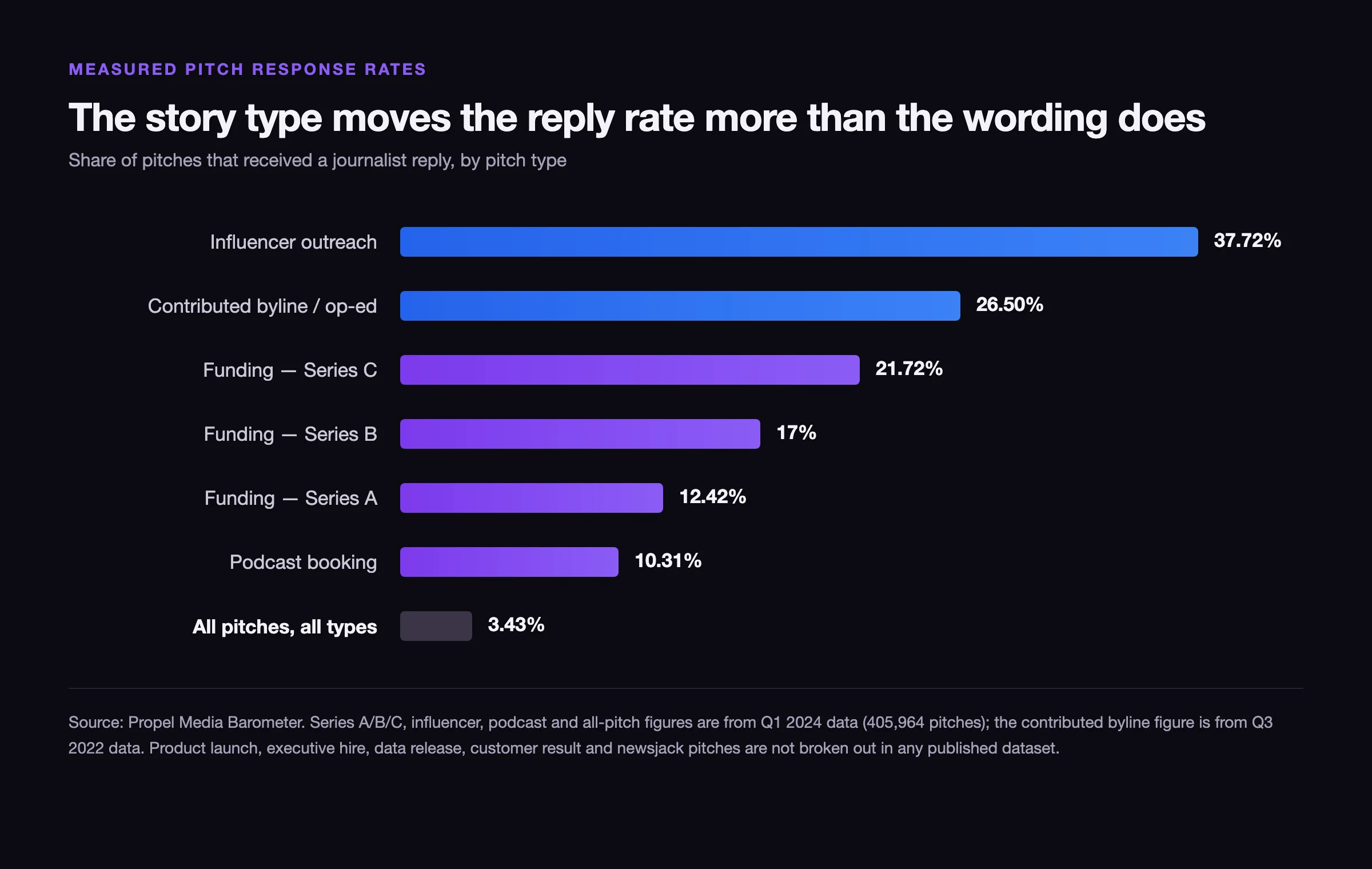
Why story type moves the reply rate more than the wording does
Most advice on pitching is advice on writing: shorten the subject line, cut the adjectives, personalise the opening. That advice is correct and it is also small. Propel’s data puts the best subject-line length at a 4.73% response rate and the best body length at 7.51%. Both are improvements on the 3.43% baseline. Neither is the 21.72% a Series C announcement gets for existing.
The reason is that a journalist is not grading your email. They are deciding whether a story exists, and some story types answer that question before the second sentence. Funding rounds carry a verifiable number, a date and a named investor. A contributed byline — a pitch offering the journalist finished copy rather than asking them to write it — drew a 26.5% response rate in Propel’s Q3 2022 data, roughly eight times the average of that quarter, because it removes work instead of adding it. Influencer outreach, measured in the same Q1 2024 set, ran at 37.72%, and podcast bookings at 10.31%.
The practical read: before you rewrite a pitch, check whether you are pitching a story or an update. If it is an update, no subject line saves it.
| Pitch type | Measured response rate | Source and period |
|---|---|---|
| Influencer outreach | 37.72% | Propel, Q1 2024 |
| Contributed byline / op-ed | 26.5% | Propel, Q3 2022 |
| Funding — Series C | 21.72% | Propel, Q1 2024 |
| Funding — Series B | 17% | Propel, Q1 2024 |
| Funding — Series A | 12.42% | Propel, Q1 2024 |
| Podcast booking | 10.31% | Propel, Q1 2024 |
| All pitches, all types | 3.43% | Propel, Q1 2024 (405,964 pitches) |
Two honest caveats. These are platform figures, not universal truths: they describe pitches sent through one PR tool by people who pay for a PR tool. And five of the six story types below have never been broken out this way by anyone publishing numbers — product launch, executive hire, data release, customer result and newsjack each get a direction and a reason on this page, not a fabricated percentage.
Funding announcement pitch example
What it has to prove: that the number is new, verifiable and attached to a named investor.
Funding is the one type with hard evidence behind it, and the evidence says the round size does the persuading. Series A pitches were answered 12.42% of the time, Series B 17%, Series C 21.72% — a gradient, not a step. If you are pre-seed, the honest expectation is the baseline, and your leverage is the local or vertical outlet rather than the national desk.
Send window: under embargo, two to four business days before the announcement date, so the reporter can write ahead. Same-day funding pitches compete with every other same-day funding pitch.
Subject: Northbeam raises $14M Series B
Hi Dana,
Northbeam Logistics closes a $14M Series B on 12 August, led by Halden Ventures with Arc Capital following on. That takes total funding to $23M and the headcount from 40 to about 95 by year end, mostly in Rotterdam and Chicago.
The angle I think fits your freight-tech beat: this is the third European mid-market carrier round this quarter, and all three are hiring engineers into ports rather than into head office. I can put you on with the CEO and share the term sheet basics under embargo until the 12th.
Useful? Happy to send the release and a founder headshot either way.
Ivan
What kills it: burying the number below a paragraph about the company’s mission. If the amount, the lead investor and the date are not all in the first two lines, the pitch is asking the journalist to hunt for the only facts that matter.
Product launch pitch example
What it has to prove: that something changed for someone other than you.
This is the hardest of the six and the most frequently sent. Nobody publishes a response rate for product launches specifically, and the reason is probably that they sit at or below the all-pitch baseline — a launch is the default thing a company has to say, so the volume is enormous and the news value is whatever you can argue it into. Muck Rack’s 2026 survey found 88% of journalists delete pitches that are not relevant to their beat immediately, and a generic launch email is the purest form of that.
Send window: launch day or the day before. A launch pitched a week early has no hook; a launch pitched a week late is a review request.
Subject: Scheduling that works offline
Hi Marco,
From Tuesday, Northbeam’s dispatch app plans routes without a connection — drivers in the Alps and in port dead zones get the same interface they get in the city, and it reconciles when signal returns.
You wrote in June about offline-first tools quietly returning to logistics. This is a small data point for that argument: we built it because 11% of our drivers’ shifts included at least 20 minutes with no usable signal.
I can send you a build, or put you on with the engineer who did the sync layer. No embargo, so use it whenever suits.
Ivan
What kills it: adjectives in place of a change. “Revolutionary”, “seamless” and “next-generation” are all claims about the product’s importance, which is the journalist’s call to make, not yours. Replace each one with a fact and the pitch usually gets shorter and better at once.
Executive hire pitch example
What it has to prove: that the person is the story, or that the hire signals a direction.
The smallest of the six by news value, and the one most often sent to the wrong desk. A new CMO is not national news; it is trade news, and often only in the vertical the person came from. There is no published response rate for hire announcements. Treat the baseline as optimistic and pitch two or three named trade reporters rather than a list.
Send window: the morning the person starts, or the morning the appointment is public. Later than that and it is a profile pitch, which is a different email.
Subject: Carrier veteran joins Northbeam
Hi Priya,
Lena Fischer starts as Northbeam’s COO on 1 September. She spent nine years at one of the top three global container lines, most recently running intermodal operations across northern Europe, and she is the first operator on our exec team — everyone else came from software.
The reason I am sending it to you rather than the wires: you have covered the software-to-operator swing at three carriers this year. Lena is happy to talk about why she left a 100,000-person company for a 40-person one, which is the part I think your readers would actually read.
Ivan
What kills it: the résumé paragraph. A list of previous titles proves the person exists; it does not propose a story. One sentence of history plus one sentence of why-now is the whole job.
Data release pitch example
What it has to prove: that the data is original, that the method is stated, and that the finding is counter-intuitive enough to argue about.
This is the type with the strongest supporting evidence outside funding. Muck Rack’s 2026 survey found 40% of journalists name original data as something they specifically want from PR sources, and 70% said beat alignment is what they prioritise. A dataset does something no other pitch type does: it can be checked, so it lowers the risk of running your story.
Send window: Tuesday morning, under embargo for three to five days, so a reporter has time to interrogate the method. Data pitched without lead time reads as a press release with a chart in it.
Subject: Empty miles rose in 2025
Hi Dana,
We pulled 2.1 million completed European road freight jobs from our own platform for 2025 and counted deadhead — miles run with an empty trailer. It went up, not down: 21.4% of all miles, against 19.8% in 2024.
That runs against the industry line that matching software is squeezing empty running out of the network. Our read is that spot-market volatility is doing more damage than software is repairing, and the effect is worst on lanes under 300km.
Full method, the raw cuts by country and a chart pack are ready. Embargo to Friday 09:00 CET if that helps you get it past a desk editor.
Ivan
What kills it: a finding that confirms what everyone already assumed. “Fuel costs are a challenge for hauliers” is data, and it is not news. If your headline number would surprise nobody in the industry, keep looking inside the dataset before you send.
Customer result pitch example
What it has to prove: that the customer will talk, on the record, with numbers.
No published response rate exists for this type either, and unlike the executive hire it is not because the type is weak — it is because most customer pitches never become customer stories. The pitch is easy; the permission is hard. A case-study pitch where the customer is unnamed is asking a journalist to publish an advertisement.
Send window: anytime, but only once the customer has already agreed in writing to speak. Pitching first and asking the customer second is how this type dies.
Subject: Grocery chain cut night deliveries
Hi Marco,
Vesting, the Dutch grocery chain, moved 60% of its store replenishment to night windows over eight months and cut its urban delivery cost per drop by 18%. Their logistics director, Sanne de Vries, has agreed to talk numbers on the record, including what went wrong in the first two months.
They used our routing product, which is why I know the story, but the interesting part is the labour agreement they had to renegotiate to make night windows legal for their drivers. That part has nothing to do with us.
Want an intro to Sanne?
Ivan
What kills it: making the vendor the protagonist. The line that earns this pitch a reply is the one that hands the story to the customer and keeps your product in a subordinate clause.
Newsjack pitch example
What it has to prove: that you can say something specific about a story already running, today.
Timing is the entire type. Propel’s data shows 50.29% of pitches are opened within an hour of arrival and 64.94% of all replies that ever arrive come the same day — which means a newsjack has roughly one working day of life, not a week. There is no measured response rate for commentary pitches, and the realistic expectation is bimodal: mostly nothing, occasionally a same-hour quote in a piece already being written.
Send window: within four hours of the news breaking. After that the reporter has already found a source.
Subject: Rotterdam strike — operator view
Hi Priya,
On this morning’s Rotterdam terminal strike: we can see it in live data. Queue depth at the two affected terminals has tripled since 06:00, and on current gate throughput our projected dwell runs to 88 hours against a normal 31. About 1,400 of our jobs have already rerouted to Antwerp and Zeebrugge.
If you need a number or an operator quote for today’s piece, Lena Fischer, our COO, ran intermodal at a top-three global carrier for nine years and can be on the phone within the hour. I can also send the rerouting split by lane. No product mention needed.
Ivan
What kills it: commentary with no specific. “This highlights the fragility of global supply chains” is a sentence any of two hundred companies could send, and on a strike day, two hundred of them will.
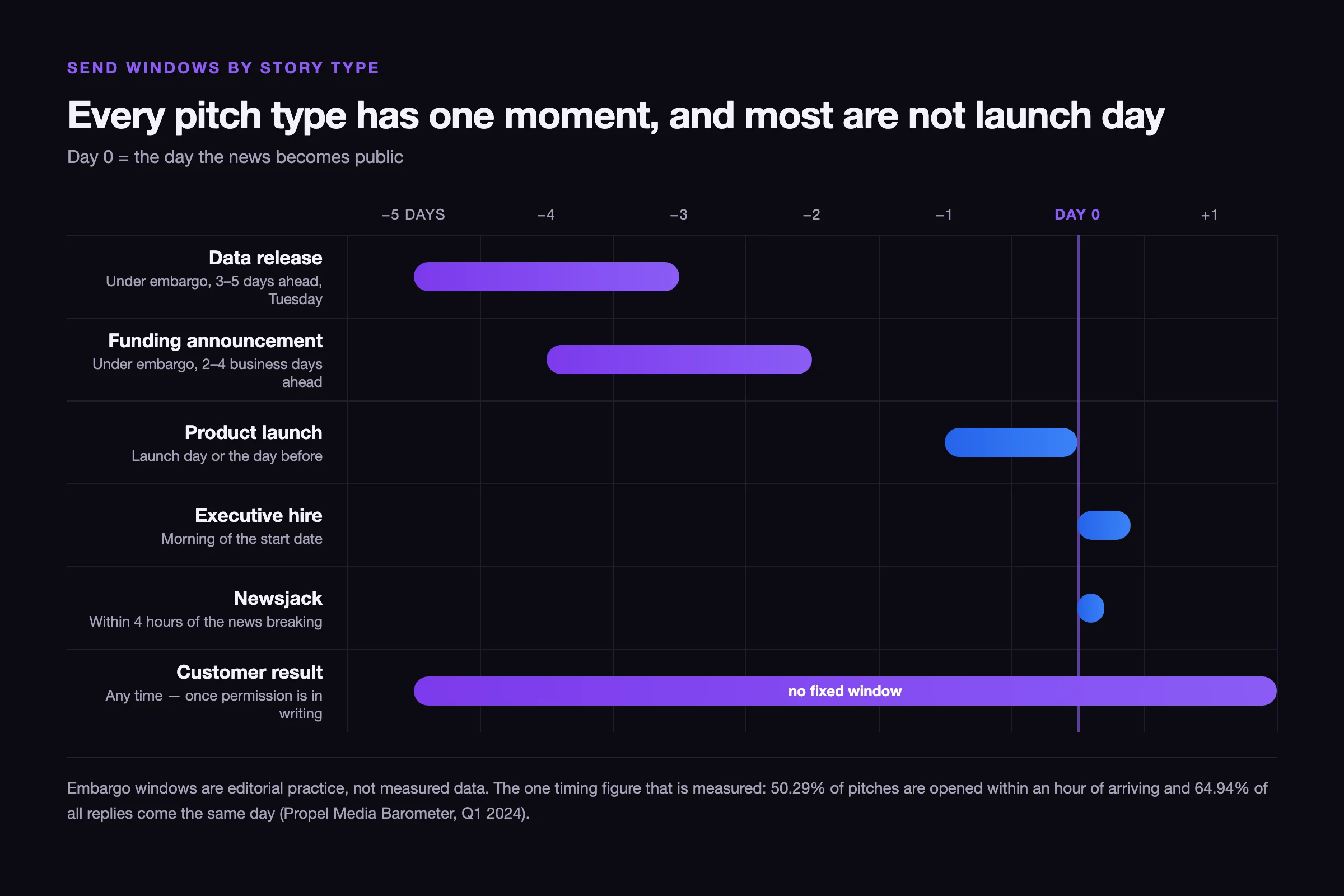
Six pitch types side by side: the question, the window, the killer
| Story type | The question the journalist is asking | Send window | Realistic expectation |
|---|---|---|---|
| Funding announcement | Is the number real and who else believed it? | 2–4 business days ahead, under embargo | Measured: 12.42% Series A → 21.72% Series C |
| Product launch | What changed, for whom? | Launch day or the day before | Not measured; assume at or below the 3.43% baseline |
| Executive hire | Is this person a story, or a signal? | Morning of the start date | Not measured; lowest news value of the six |
| Data release | Can I check this, and does it surprise me? | 3–5 days ahead, under embargo, Tuesday | Not measured; 40% of journalists ask for original data |
| Customer result | Will the customer talk on the record? | Any time, once permission is in writing | Not measured; gated by permission, not by writing |
| Newsjack | Do you have a specific I cannot get elsewhere? | Within 4 hours of the news breaking | Not measured; mostly nothing, occasionally same-hour |
Read the last column honestly. One of the six types has a published number behind it, five do not, and any article giving you a tidy percentage for all six has made five of them up. The useful planning move is not to forecast a rate per type — it is to notice that funding and data pitches carry evidence a journalist can verify, and the other four do not, which is exactly why they need the specifics in the first line.
What journalists delete in the first paragraph
Muck Rack’s 2026 survey of roughly 1,100 journalists found 88% delete pitches that are not relevant to their beat immediately, and 70% said beat alignment is the thing they prioritise most. Relevance is not a tone problem, so it cannot be fixed by writing more warmly. It is a targeting problem, and it is decided in the first two lines.
Four things reliably belong nowhere near the opening paragraph:
- Your company boilerplate. “Founded in 2019, Northbeam is a leading provider of…” answers a question nobody asked. It belongs at the bottom, or in the release.
- A compliment about their recent article that could apply to any article. “I loved your recent piece” without naming the piece is worse than no personalisation, because it proves the email is a template.
- The word “exciting”. It describes your feelings about the news. The journalist is deciding whether their readers will have feelings about it.
- A request before an offer. “Would you be interested in covering…” in line one asks for a decision before supplying the facts needed to make it.
The mechanical guidance from Propel’s dataset is narrow and worth following exactly: subject lines of one to five words drew the highest response at 4.73%, while the most common choice — 10 to 15 words, used on 36.54% of all pitches — did worse. Bodies of 51 to 150 words drew 7.51%. Muck Rack’s journalists put the ceiling slightly higher, with 69% preferring pitches under 200 words. Between the two, a working target is a five-word subject line and a body between 90 and 150 words, which is roughly the length of every example above.
Tuesday is when most pitches go out, at 33.22% of all sends. Thursday is when most replies come back, at 24.17%. That gap is smaller than it looks and should not reorganise your week — 50.29% of pitches are opened within an hour of arrival, so the day matters far less than being in the inbox while the story is live.
Following up without getting blocked
One follow-up, a few days to a week after the original. In Cision’s 2025 State of the Media survey of 3,000 journalists globally, 62% said a single follow-up is appropriate; among US respondents specifically, 69% accepted one, 6% were fine with several, and 24% wanted none at all. Muck Rack’s 2026 reporters landed in the same place, with about half calling one follow-up ideal and roughly half putting the right gap at a few days to one week.
The downside risk is concrete rather than reputational-in-the-abstract. Cision’s 2024 edition found 48% of journalists would block a PR contact over repeated aggressive follow-ups, and a 2019 Fractl survey of 500 writers and editors found 53% had already blacklisted at least one person over bad pitches. A second follow-up buys you very little upside against that.
One structural point most follow-up advice misses: the follow-up should add something. Forwarding your own email with “just bumping this” gives the journalist the same decision they already declined to make. A follow-up that carries a new number, a confirmed spokesperson or a competitor’s move is a second pitch, and it gets read as one.
A media pitch email template you can fill in
The skeleton below is the shape all six examples share. It is deliberately short — if filling it in takes more than 150 words, the story is probably not one story.
Subject: [3–5 words, the news itself, no company name unless the name is the news]

Hi [first name],

[Line 1 — the fact. Number, date, named party. No preamble.]

[Line 2–3 — why this reporter. Reference one specific piece of
theirs by its argument, then say what your fact adds to it.]

[Line 4 — the offer. Interview, embargoed data, exclusive, build
access. One offer, not a menu.]

[Line 5 — the exit. One sentence letting them say no cheaply.]

[Your first name]
Two rules that are not in the skeleton but decide whether it works. First, one journalist per email, chosen because of something they wrote, not because they appear in a database under the right beat tag. Second, send the pitch and the supporting document together — the pitch makes the argument, and a press release supplies the on-the-record detail once the argument has landed. Those are different jobs, and a release sent alone leaves the argument unmade.
If pitching by story type is something you would rather have run for you than run yourself, that is the work our digital PR service does: story selection, journalist targeting and the outreach itself, measured against the same benchmarks quoted on this page.
What to do with all this on Monday morning
Sort whatever you were about to pitch into the six types first. If it lands in funding or data release, you have evidence on your side and should invest in the embargo window and the method note. If it lands in product launch, executive hire or customer result, the writing has to work harder because the story does not carry its own proof — so put the single most checkable fact in line one and cut everything that is a claim about importance. If it lands in newsjack, send it today or do not send it.
Then set the expectation with whoever asked for coverage. Three replies per hundred emails is the published average across 405,964 pitches, and a good campaign is one that beats it by choosing better stories, not by writing better adjectives.
13 / Reader questions
Frequently asked questions
01What is a media pitch?
A media pitch is a short email offering a journalist one specific story, addressed to that journalist and no one else. It is not a press release and not an announcement about your company — it is a proposal for a piece they could publish, sized to be read in under a minute.
02How long should a media pitch be?
Under 200 words, which is what 69% of journalists said they prefer in Muck Rack's State of Journalism 2026 survey. Propel's analysis of 405,964 pitches is tighter still: bodies of 51 to 150 words drew a 7.51% response rate, against a 3.43% average across all lengths.
03What is a good response rate for a media pitch?
Anything above 3.43% beats the platform-wide average Propel measured across 405,964 pitches in Q1 2024. The overall figure has moved inside a narrow 2.6–3.5% band since 2022, so a campaign landing three replies per hundred emails is normal, not broken.
04How long should a media pitch subject line be?
One to five words. That was the highest-responding subject line length in Propel's data at 4.73%, while the most common choice — 10 to 15 words, used on 36.54% of pitches — performed worse. Lead with the news itself, not with your company name.
05When is the best time to send a media pitch?
Tuesday morning is the default, and Thursday is when the most replies come back — 24.17% of all responses in Propel's data. Timing matters far less than the story type, though: half of all pitches are opened within an hour of arriving, and 64.94% of the replies that ever come arrive the same day.
06Should you follow up on a media pitch?
Once, a few days to a week later. In Cision's 2025 survey of 3,000 journalists, 62% said a single follow-up is appropriate, and among US respondents 24% wanted none at all. Cision's 2024 edition found 48% would block a contact for repeated aggressive follow-ups.
07What is the difference between a media pitch and a press release?
A pitch is an email to one journalist proposing a story; a press release is a document written for everyone at once. The pitch argues why this reporter should care, the release supplies the on-the-record detail once they do. Sending a release with no pitch attached leaves the argument unmade.