
Published
A press release is a document written for every newsroom at once, assembled from eight blocks: headline, subhead, dateline, lead, body, quotes, boilerplate and contact. The three annotated examples below mark every block, and mark what a journalist actually takes from each one — which is a good deal less than the page implies.
Start with the number that reframes the whole document. In the largest text-reuse study of its kind by article count, Jasper Boumans compared 4,455 press releases against 26,132 published articles and found that fewer than 1% of media texts were a verbatim copy of a release — near-identical copies turned up in three newspaper articles out of 19,985, or 0.01%. Releases get picked up constantly. They almost never get printed.
How this was checked. Every figure on this page is attributed where it appears, with the sample size and the year of the data rather than the year of the report. Wire specifications come from Business Wire’s, PR Newswire’s, GlobeNewswire’s and ACCESS Newswire’s own published guidance pages, quoted as they are written even where two of them disagree. AP rules are as reproduced in university style guides and AP’s own public posts; the AP Stylebook itself is paywalled, so exact entry wording could not be verified line by line. The three example releases are written for this article — the companies, the people and the figures inside them are invented, and are labelled as such. The research and survey figures around them are not.
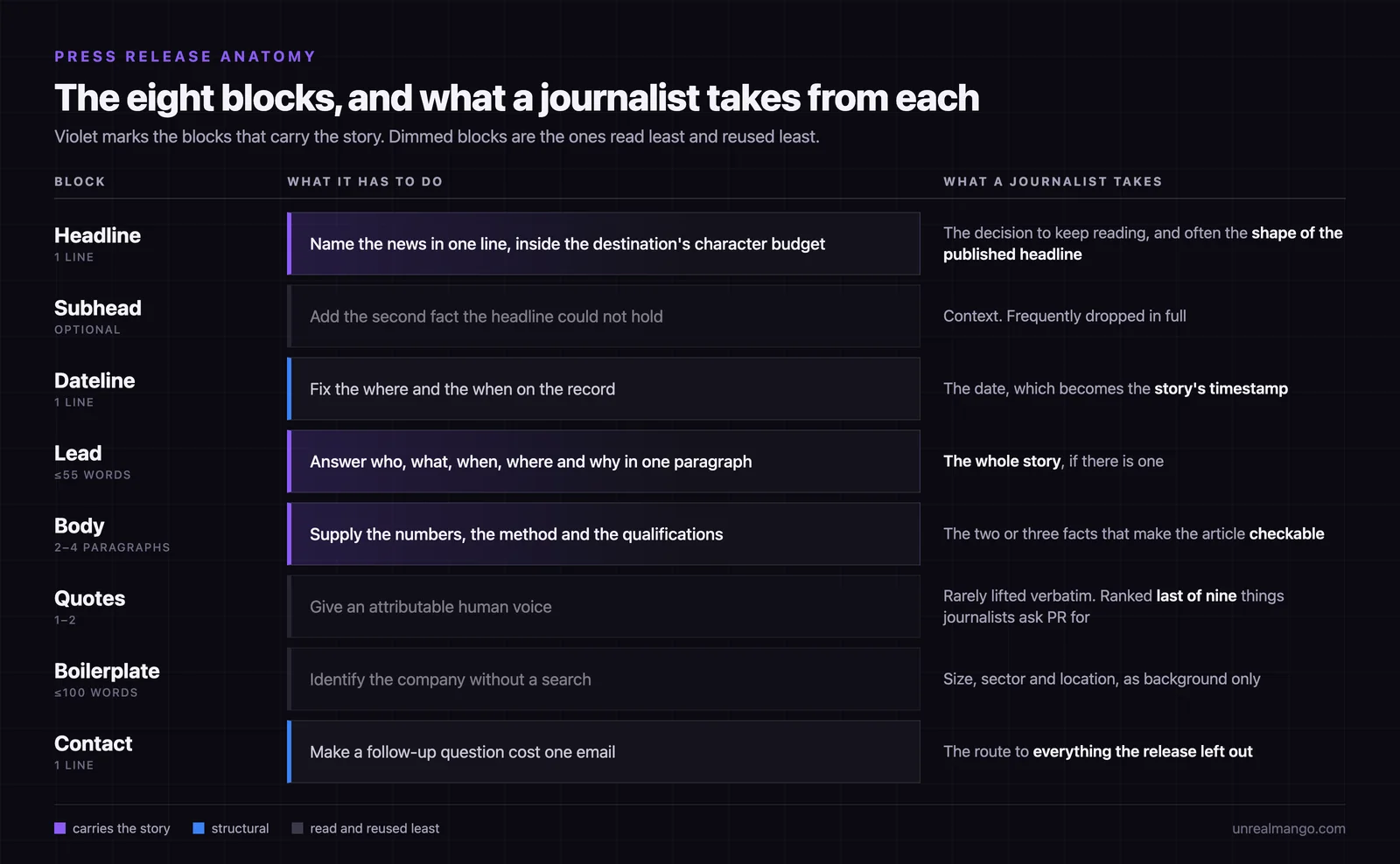
The eight blocks a press release is assembled from
Every convention in the format exists to let a stranger decide, in the time it takes to scan one screen, whether there is a story here. The blocks below are the standard set. The subhead is optional in practice, and so is the end marker that templates put below the contact block — more on that further down.
| Block | What it has to do | What a journalist takes from it |
|---|---|---|
| Headline | Name the news in one line, in the destination’s character budget | The decision to keep reading, and often the published headline’s shape |
| Subhead | Add the second fact the headline could not hold | Context; frequently dropped entirely |
| Dateline | Fix the where and the when on the record | The date, which becomes the story’s timestamp |
| Lead | Answer who, what, when, where and why in one paragraph | The whole story, if there is one |
| Body | Supply the numbers, the method and the qualifications | The two or three facts that make the article checkable |
| Quotes | Give an attributable human voice | Rarely used verbatim; see the survey figures below |
| Boilerplate | Identify the company without a search | Company size, sector and location, as background |
| Contact | Make a follow-up question cost one email | The route to everything the release left out |
Length follows from the same logic. Published advice clusters at 300 to 500 words — PR Newswire recommends 300 to 500, ACCESS Newswire 300 to 400, Newswire.com 250 to 600 — but the more honest explanation is commercial: 400 words is the base unit both PR Newswire’s packages and Business Wire’s US rate card are priced around. GlobeNewswire skips word counts and gives the rule that matters: news engines closely examine approximately the first 100 words. Everything you need read has to sit inside those.
Fewer than 1% of a release is republished word for word
This is the finding that changes how the document should be written, and it is missing from every gallery of examples currently ranking for this term.
| Study | What was measured | Result |
|---|---|---|
| Cardiff University, published 2008 — 2,207 UK press stories sampled over two weeks in March and April 2006 | Share of stories derived from PR material | 19% wholly or mainly from PR, plus 11% partly; 49% reproduced wire copy wholly or mainly; 60% came wholly or mainly from pre-packaged sources — wire, PR, or both |
| Boumans, Journalism Studies, 2018 — 4,455 releases against 19,985 newspaper and 6,147 news agency articles, Netherlands, 2004–2013 | Text overlap between release and article | About 10% of newspaper articles and 16% of agency articles traceable to a release; mean similarity 0.26 for newspapers and 0.28 for the agency, on a scale where 0.70 counts as near-identical; fewer than 1% of media texts a verbatim copy |
| Schafraad and Van Zoonen, Communications, 2020 — 823 corporate releases from the 30 largest Dutch corporations, 2012 | What happened after pickup | 26.8% were picked up, producing 784 articles; 84% of those showed journalistic treatment — added facts, added quotes, or folding into a wider story |
| Vogler and Schäfer, International Journal of Communication, 2020 — 5,378 University of Zurich releases against 13,985 Swiss newspaper articles, 2003–2017 | Trend over fifteen years | Share of science articles based on a release rose from about 12% to about 17% |
Read together, the four say the same thing from four directions. A release reliably supplies the story — the fact that something happened, the number attached to it, the name to call. It almost never supplies the text. Boumans scored similarity on a 0-to-1 scale where anything above 0.70 counts as near-identical; the mean landed at 0.26, and only three newspaper articles in the entire corpus cleared 0.70. Whatever crosses over arrives inside an article somebody else wrote.
Two caveats worth stating. All four datasets are European, and three of the four are more than a decade old at the point of measurement — the Boumans corpus ends in 2013. And a picked-up release is a small share of releases sent: Schafraad and Van Zoonen found 26.8% pickup among the largest corporations in a national market, which is a ceiling, not an average.
The practical consequence runs through the rest of this page. Write every block to be mined, not published. A sentence that only works in its original order is a sentence that will not survive being lifted.
Annotated example: a product launch release, block by block
Invented company, invented figures. The AP style, the character counts and the block structure are the parts to copy.
Firmware Update Adds Vibration Monitoring to 12,000 Kelbourne Sensors
New firmware turns 12,000 already-installed sensors into predictive maintenance units with no hardware swap
PITTSBURGH, Aug. 6, 2026 — Kelbourne Instruments today released Field 4.0, a firmware update that adds continuous vibration monitoring to every K-Series bearing sensor sold since 2021. Field 4.0 reaches about 12,000 units already installed in North American plants and requires no new hardware, removing the site visit a sensor upgrade would normally need.
Plants running K-Series sensors have until now received a temperature reading every 15 minutes. Field 4.0 samples vibration at 3.2 kHz and flags bearing wear an average of 34 days before a temperature alarm would trigger, based on 18 months of data from seven pilot sites. The pilot dataset is published in full alongside this release.
“We shipped the sensor with the accelerometer already inside it and never switched it on, because we could not process the data at the edge,” said Ana Petrov, chief technology officer at Kelbourne Instruments. “Three years of firmware work later, we can.”
Riverbend Paper, a pilot site in Wisconsin, replaced four bearings on advance warning during the 18-month pilot and recorded no unplanned line stops over those 18 months, against three in the year before.
“The alert gave us about five weeks, which is the difference between a scheduled swap and a night shift,” said Dell Okoro, maintenance manager at Riverbend Paper.
Field 4.0 is available now at no charge to customers with an active support contract. Kelbourne will publish the pilot dataset in September 2026.
About Kelbourne Instruments Kelbourne Instruments designs industrial condition-monitoring hardware for paper, cement and metals plants. Founded in 2014 and based in Pittsburgh, the company supports about 19,000 deployed sensors across 240 sites in the United States and Canada.
Multimedia Photograph: a K-Series sensor installed on a bearing housing at Riverbend Paper, Sheboygan, Wisconsin, June 2026. Caption and high-resolution file supplied with this release.
Media contact Marta Rees, communications, Kelbourne Instruments — press@kelbourne.example · 412-555-0142
Now the annotation.
| Block | What it is doing here | The check it passes |
|---|---|---|
| Headline | Names the change first and the company inside it, not in front of it | 69 characters and nine words — inside the 51–75 band PR Newswire measured, and under ACCESS Newswire’s ten-word rule |
| Subhead | Carries the fact that decides whether this is news at all: no hardware swap | Adds a fact rather than restating the headline |
| Dateline | PITTSBURGH stands alone without a state; Aug. is abbreviated because a specific date follows | AP: month abbreviated only with a date; no ordinal suffix |
| Lead | Who, what, when, where and why in two sentences, 49 words | Everything a rewrite needs sits above the fold |
| Body paragraph | Gives the mechanism, the measured gain and the sample it came from | 34 days, 3.2 kHz, seven sites, 18 months — all liftable in isolation |
| First quote | Explains why the capability existed and went unused. Carries a fact the body does not | Says something the company could not say in its own voice |
| Third-party paragraph and quote | A named customer, a countable result, and a duration a maintenance manager would recognise | Textbook convention: one company quote, one third-party quote |
| Boilerplate | Sector, founding year, scale, geography. 35 words | Well under PR Newswire’s 100-word ceiling, and its sensor count is the company total, not the 12,000 in the lead |
| Multimedia | One image, with what, who, where and when in the caption | Cision’s 2024 survey found 72% of journalists had used a PR-supplied image in the previous year |
| Contact | One person, one address, one phone number | Business Wire requires an email address or a phone number as a minimum |
The lead is the block to labour over. A journalist who reads only that paragraph should be able to write two accurate sentences without asking a single question.
The same launch, rewritten so that nothing survives
Same event, same week, same company. This version is the one that gets closed.
Kelbourne Instruments, a Leading Innovator in Industrial IoT Condition Monitoring, Is Proud to Announce the Launch of Its Revolutionary Next-Generation Field 4.0 Platform
PITTSBURGH, PA, August 6th, 2026 — Kelbourne Instruments, the industry-leading provider of best-in-class industrial monitoring solutions, is thrilled to announce the launch of Field 4.0, a game-changing platform that empowers manufacturers to unlock unprecedented value from their existing infrastructure and accelerate digital transformation across the enterprise.
“We are incredibly excited about this milestone,” said Ana Petrov, Chief Technology Officer. “Field 4.0 represents a paradigm shift in how our customers think about predictive maintenance, and we are passionate about delivering world-class solutions that exceed expectations at every touchpoint.”
The solution leverages cutting-edge algorithms to deliver actionable insights in real time, driving significant ROI for organizations of all sizes and cementing Kelbourne’s position as a trusted partner in the Industry 4.0 journey.
What has actually gone wrong, in order of how much it costs:
- The opening paragraph runs 40 words and delivers no fact. The first version’s lead is 49 words and names the product, the sensor generation, the year they shipped from and the installed base of 12,000 units. This one names a product and nothing else measurable, so there is nothing to lift and nothing to check.
- The headline is 170 characters. That clears Business Wire’s 250-character system limit, so it would transmit — and it is 70% over PR Newswire’s under-100 recommendation and more than double Cision’s 51–75 optimum band. It also front-loads twenty words of self-description before the product name arrives.
- The dateline breaks AP three times.
PAis a postal code where AP style in a dateline isPa.Augustshould beAug., because a specific date follows it. And6thcarries an ordinal suffix AP never uses on a date. - The title after the name is capitalised. AP capitalises a formal title only immediately before the name: Chief Technology Officer Ana Petrov, or Ana Petrov, chief technology officer.
- The quote contains no information. Strip the adjectives and it says the company launched a product, which the headline already said. Compare the Petrov quote in the first version, which admits the hardware shipped with a disabled sensor — a fact no body paragraph could deliver in the company’s own voice.
- There is no third party. Riverbend Paper, its four bearings and its three prior line stops are what let a journalist write about an outcome rather than an announcement.
It is also missing two of the eight blocks entirely: there is no boilerplate and no contact line, so a journalist who wanted the story anyway has no way to ask the one question standing between them and filing it.
None of these is a writing-quality complaint. Each one removes a specific thing a journalist would otherwise have taken.
A research release, annotated: when the dataset is the story
Data releases invert the structure. The method paragraph stops being housekeeping and becomes the block the pickup depends on, because a number no one can interrogate is a number no desk will print.
46% of Plants Own Condition-Monitoring Sensors They Never Read
Survey of 412 maintenance managers, fielded May 2026, finds unused capability concentrated in plants under 500 staff
CHICAGO, June 3, 2026 — Forty-six percent of North American manufacturing plants have condition-monitoring sensors installed that they never read, according to a survey of 412 maintenance managers published today by Corran Analytics.
The unused-sensor share rises to 61% at plants with fewer than 500 employees and falls to 22% at plants above 2,000. Among respondents leaving sensors unread, the most common reason given was having no one to interpret the output (48%), ahead of cost (19%) and doubts about data quality (14%).
“The gap is not a technology gap,” said Renée Aubert, research director at Corran Analytics. “It is a staffing gap that the sales cycle keeps describing as a technology gap.”
Method. Corran Analytics surveyed 412 maintenance managers at manufacturing plants in the United States, Canada and Mexico between May 4 and May 22, 2026, through an online panel, with quotas set on plant size and sector. The margin of error is plus or minus 4.8 percentage points at 95% confidence. The questionnaire, the full cross-tabulations and the anonymised response file are published alongside this release.
About Corran Analytics Corran Analytics is an independent research firm covering industrial maintenance and asset management. Founded in 2019, it publishes two syndicated surveys a year and is based in Chicago.
Media contact Priya Raman, research communications, Corran Analytics — press@corrananalytics.example · 312-555-0188
| Block | What changes in a research release | Why it matters |
|---|---|---|
| Headline | Leads with the finding; the publisher’s name is left to the dateline and the lead, where it costs no headline characters | 62 characters and nine words, inside every published limit |
| Lead | The headline figure, the population it describes and the source, in one sentence | Spelled out as Forty-six percent because AP spells out a number that opens a sentence |
| Body | Breaks the headline number by segment, then gives the reasons respondents themselves gave | Segments are what turn one number into three usable stories |
| Quote | Reframes the finding rather than celebrating it | The one thing a dataset cannot do for itself is say what it means |
| Method | Sample, geography, fieldwork window, mode, quotas, margin of error | Without it, a science or business desk cannot use the figure at all |
| Data availability | Questionnaire, cross-tabs and response file published with the release | Removes the follow-up email that would otherwise delay the story past deadline |
| Contact | A named person with an email address and a phone number | The block the bad example on this page leaves out |
Note what is absent: no customer, no product and no call to action. A research release that sells something is a research release nobody cites.
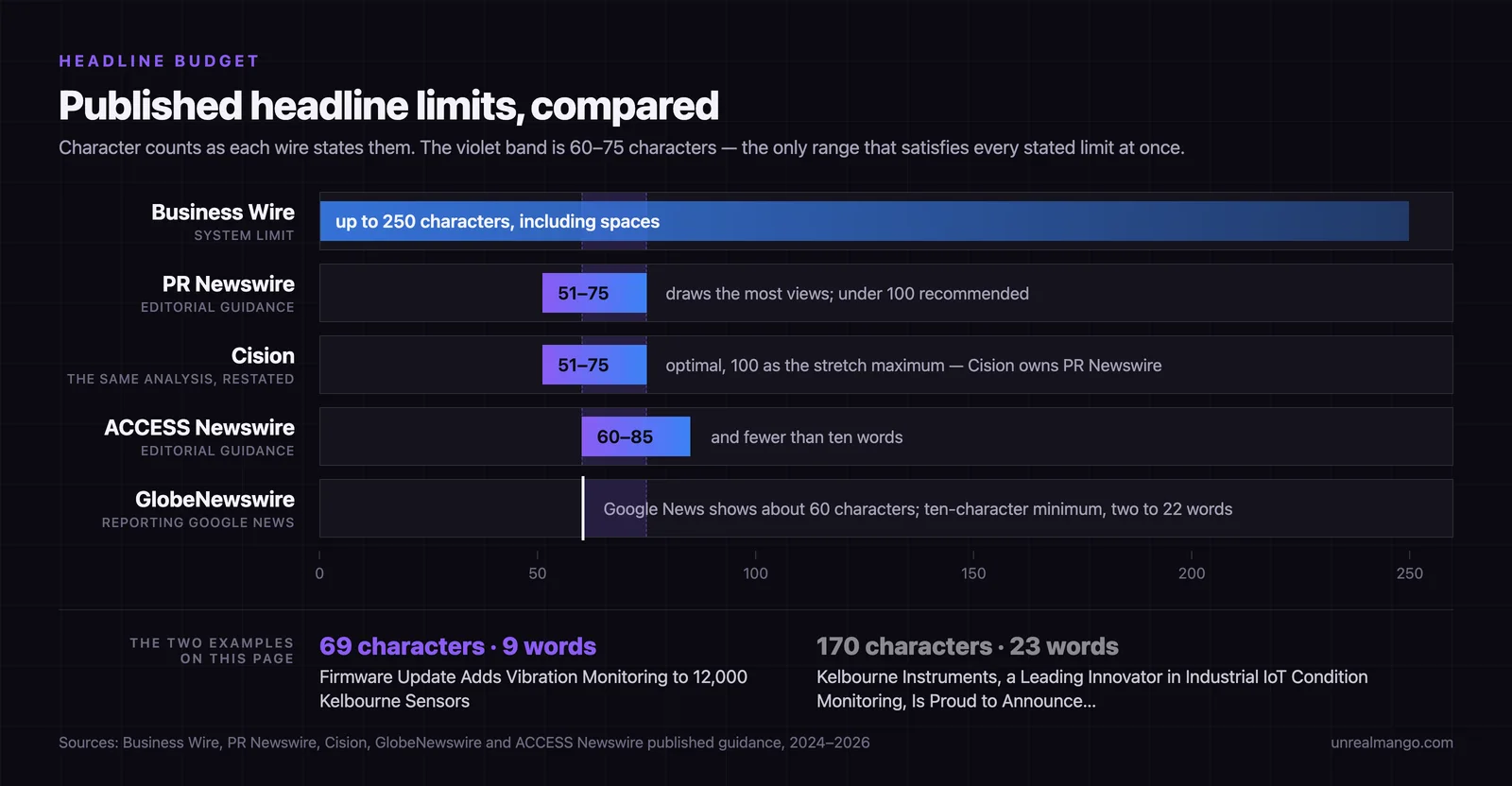
Headline limits compared across the major newswires
The single most common formatting mistake is writing one headline for every destination. The wires do not agree, and two pages on the same wire’s own site do not always agree either.
| Source | Published guidance | Status |
|---|---|---|
| Business Wire | 250 characters including spaces; no hyperlinks in the headline | A stated system limit, not a recommendation |
| PR Newswire | Under 100 characters; 51–75 characters draw the most views; title case | Its own 2024 analysis of distributed releases — though the same page also tells you to aim for 70 characters or fewer |
| Cision | 51–75 optimal, 100 as the stretch maximum | The same PR Newswire analysis restated. Cision owns PR Newswire, so this is one dataset cited twice, not two sources agreeing |
| GlobeNewswire | Ten-character minimum, two to 22 words, about 60 characters displayed | Google News’s specifications as GlobeNewswire reports them — and the guide adds that your headline may run longer than 60 |
| ACCESS Newswire | Fewer than ten words, 60 to 85 characters | Editorial guidance |
Overlap the ranges and one narrow band survives: 60 to 75 characters, title case, no link. It starts at ACCESS Newswire’s floor of 60 and stops at the top of the 51–75 band PR Newswire’s own release analysis identified, which puts it inside PR Newswire’s under-100 rule and far inside Business Wire’s 250-character ceiling. The 51–75 figure is not a style opinion — it is the range that maximised page views across the releases PR Newswire distributed.
One honest wrinkle: Google News displays only about 60 characters, so a 75-character headline is partly written for the wire’s own page rather than for the search result. GlobeNewswire reports that 60-character display figure and then says explicitly that your headline may run longer than it. Sixty to 75 is the range that keeps every stated rule; the first 60 characters are the ones that have to work alone.
GlobeNewswire adds two specifications the others do not. It puts the optimum at three to six longer keyword phrases across the release, built from three- and four-word units, and it caps links at roughly one per 100 words on the grounds that more reads as spam. On a 400-word release that permits four links, headline excluded.
Dateline in AP style, and where the wires break their own rule
The dateline is where AP style and wire practice visibly diverge, and it is worth knowing which one you are actually following.
AP’s own convention is straightforward. The city goes in capitals, the state in upper and lowercase using AP’s abbreviations rather than postal codes — Mich., not MI. Eight states are never abbreviated at all: Alaska, Hawaii, Idaho, Iowa, Maine, Ohio, Texas and Utah. A list of cities well known enough to stand alone without a state includes New York, Chicago, Los Angeles, Boston, Denver and Pittsburgh. Since 2014 AP has spelled out state names in the body of a story, while datelines kept their abbreviations — a split that catches people who learned one rule and applied it everywhere.
What the wires actually transmit is a different string, because each inserts its own transmission code:
- PR Newswire:
NEW YORK, Jan. 9, 2026 /PRNewswire/ -- - GlobeNewswire:
NEW YORK, April 28, 2025 (GLOBE NEWSWIRE) -- - ACCESS Newswire:
RALEIGH, NC / ACCESSWIRE / December 5, 2023 /
The third one is instructive. That dateline appears on ACCESS Newswire’s own article explaining how to format a dateline in AP style, and it breaks AP twice in one line: NC is a postal code where AP would write N.C., and December 5 should be Dec. 5 because a specific date follows. The lesson is not that the wire is careless. It is that the wire’s transmission format outranks AP inside the wire’s own system, so the AP-clean version is the one you write, and the wire’s code is what it adds on top.
Business Wire adds a rule of its own on which city to use: the dateline city is usually the company headquarters, an event release takes the event city, and it recommends against listing more than three dateline cities.
Executive quotes rank last of the nine things journalists ask for
The convention is at least two quotes — one from the company, one from a third party such as a customer or partner. That is the standard taught in strategic communication textbooks and it is a reasonable default. What it is not is what journalists say they want.
In Cision’s 2024 State of the Media survey of 3,016 journalists across 19 markets, fielded in January and February 2024, respondents were asked what PR professionals could do to make their job easier. Provide relevant quotes from executives or industry experts was chosen by 21% — last of nine options, behind include multimedia assets at 23% and far behind understand my target audience at 68%.
Two figures circulate on how release quotes get used in practice — that seven in ten journalists spend under a minute on a release, and that half of them find release-quote language unnatural. Both come from a Greentarget survey reported by PR Week; the underlying report is no longer publicly retrievable, so the sample size, the country and the year are unknown. Treat them as directional and cite them that way, or not at all.
The defensible conclusion is narrower than “quotes are pointless”. A quote earns its place when it carries something the body copy structurally cannot: an admission, a judgement, a decision and its reason. “We shipped the sensor with the accelerometer already inside it and never switched it on” is a fact in quotation marks. “We are incredibly excited about this milestone” is a sentence that would be deleted in any newsroom in the world, and 21% is what happens when most releases contain the second kind.
The multimedia block, and where the 6x figure comes from
Multimedia produces the widest gap in the whole dataset between what journalists ask for and what they use.
In the same Cision 2024 survey, only 30% named multimedia among the content types they want to receive — sixth of seven — and only 23% asked PR to include multimedia with pitches and releases. Asked what they had actually used in the previous year, 72% reported using a PR-supplied image, 34% a data visualisation or infographic and 33% a video. They do not request it and they use it anyway, which makes attaching an image the cheapest asymmetric bet in the format.
The number you will see quoted everywhere is different and needs handling. PR Newswire states that a release with one photo averages twice the engagement of a text-only release, and that multiple images can generate six times the engagement. That figure has a real dataset behind it — PR Newswire’s own analysis of more than 160,000 releases it distributed in 2020 — which puts it well above the usual unsourced claim. It also has four problems: engagement is never defined and is measured on PR Newswire’s own property; no methodology is published, so nothing controls for the fact that better-resourced announcements are also the ones with multimedia budgets; the data is from 2020 and is being republished in a 2025 guide; and the party publishing it sells multimedia distribution. Cite it as what it is — a distributor’s platform metric from 2020 — and the sentence survives scrutiny. Business Wire’s comparable claim of 50% higher engagement for interactive releases has no dataset, sample or year attached at all.
Practical version: one image, captioned descriptively enough to identify the product and the people in it, with a filename that reads like the story rather than like a camera export.
Boilerplate: 100 words that rarely reach the story
The boilerplate is the About-the-company paragraph at the foot of every release, identical across all of them. PR Newswire advises 100 words or less. No wire imposes a limit — the number is editorial advice, not a system constraint.
It is also, by the evidence, among the least-read blocks on the page. Nielsen Norman Group’s usability work with 40 journalists across three rounds of testing, using eyetracking alongside lab sessions and site visits, found journalists scanning rather than reading, fixating on bulleted lists and factual tables, and hardly reading concluding paragraphs at all. That research measured press pages and newsroom sections rather than attention inside a single release document — no published study measures that — but the direction is consistent with everything else here.
Which argues for treating the boilerplate as a reference card rather than a pitch. Four things belong in it: what the company does in one clause without adjectives, its size as a number, where it is, and when it started. The Kelbourne boilerplate above does all four in 35 words. What does not belong: mission statements, the word leading, and any claim a journalist would have to verify before quoting it.
Why releases end with ### when no wire requires it
Nothing on any major wire requires an end marker. Business Wire’s template guidance lists the required elements — headline, dateline city, announcement text, contact details — and no end marker appears among them. PR Newswire’s own live releases close with the boilerplate, a contact line and a SOURCE credit, with no ### anywhere on the page.
The convention is inherited. -30- traces to numeric telegraph codes, where 30 signalled the end of a transmission, carried into the Phillips Code developed for wire copy — though the origin is not formally documented and the standard reference says so outright. The origin of ### specifically is undocumented altogether, and the telegraph story attached to it is folk etymology repeated between blogs.
Keep it if the outlet you are sending to expects it. Recognise it as a courtesy signal to a human reader, not a technical requirement, and never let it be the thing you got right about a release.
AP style rules that decide how a release reads in a newsroom
PR Newswire states directly that AP style is the preferred standard in newsrooms, which is the whole argument for following it: a release already in house style is a release that costs less to use. The current edition is the AP Stylebook’s 58th, published as The Associated Press Stylebook: 2026-2028 on 28 May 2026.
Nine rules cover almost every error that actually appears in releases.
| Rule | What AP says | The error it catches |
|---|---|---|
| Numbers | Spell out one through nine, figures for 10 and above; always figures for ages, dates, times, money, percentages and dimensions | 5 pilot sites, twelve thousand units |
| Numbers opening a sentence | Spelled out, with years the exception | 46% of plants have… at the start of a sentence |
| Percent | The % sign with a numeral and no space, a change AP made in 2019; a leading zero below 1%, as in 0.6% | 12 percent |
| Months | Abbreviate Jan., Feb., Aug., Sept., Oct., Nov. and Dec. only when a specific date follows; March, April, May, June and July never abbreviate | Sep. 4, Aug 2026 |
| Dates | No st, nd, rd or th; set the year off with commas in a month-day-year phrase | August 6th, 2026 |
| States | AP abbreviations, not postal codes, and in datelines rather than body text; eight states never abbreviate | PITTSBURGH, PA |
| Formal titles | Capitalised only immediately before a name; lowercase after it or standing alone | said Ana Petrov, Chief Technology Officer |
| Company names | Inc. is part of the name and is not set off with commas | Kelbourne Instruments, Inc., today announced |
| Serial comma | Not used in a simple series — but AP explicitly permits it where clarity requires it | Applying either version as an absolute rule |
One more that costs nothing: a single space after a full stop, not two.
How the release gets in front of a journalist
The release is a document for everyone; the email carrying it is written for one person. That split decides what goes where. The release holds the on-the-record detail — the figures, the method, the attributable quotes, the contact. The email makes the argument for why this particular reporter should care, and it makes it in a form sized for one reader on one beat.
Sending a release with no covering argument leaves the argument unmade, and sending an argument with no release leaves the reporter with nothing to check. We covered the second half of the pair separately, with worked emails and the measured reply rates behind them, in media pitch examples.
Journalists themselves keep confirming that the document still matters. In Cision’s 2024 survey, news announcements and press releases were the content type most journalists wanted to receive, at 74% in the report’s own chart — Cision’s press release rounds the same finding to 72% — and 68% named press releases among the most useful sources for generating content or ideas. In the 2026 edition, based on 1,899 journalists surveyed in January and February 2026, 66% put PR-provided materials — releases, pitches and media kits together — among their top sources for story ideas, ahead of social media, competing outlets and AI tools.
Twelve checks to run before a release goes out
- The headline is 60 to 75 characters and fewer than ten words, in title case, with no hyperlink inside it, and it leads with the company name only if the name is itself the news.
- The subhead adds a second fact rather than paraphrasing the first.
- The dateline uses an AP state abbreviation or no state at all, and abbreviates the month only because a specific date follows.
- The lead answers who, what, when, where and why inside 55 words.
- At least three checkable numbers appear in the first 100 words, each with the unit and the basis it was measured on.
- Every claim that would need verifying is attributed to a named person, a named customer or a published source.
- There is one company quote carrying a fact the body cannot state, and where possible one third-party quote.
- Every body paragraph names its own subject instead of pointing back with the update, the trial or the share — assume each paragraph gets lifted alone.
- A multimedia line names at least one image, with a caption identifying what, who and where.
- The boilerplate is under 100 words and contains a number, a place and a year.
- The contact block gives a name, an email address and a phone number.
- Links number roughly one per 100 words, and none of them sits in the headline.
The thirteenth check is the one no checklist can run for you: whether anything in the document is news to somebody who does not work at your company. If the honest answer is no, the format cannot save it, and neither can the wire.
Earning coverage is the part that happens before any of this, and it is what our digital PR work is built around — finding the story a newsroom would want, then writing the document that lets them use it.
15 / Reader questions
Frequently asked questions
01What is a press release?
A press release is a document written for every newsroom at once, putting something on the record. It carries a headline, a dateline, a lead answering who, what, when, where and why, supporting detail, one or two quotes, a company boilerplate and a contact line. It is a source, not a story.
02What are the 5 W's in a press release?
Who, what, when, where and why — the five facts the lead paragraph has to deliver before the reader reaches the second sentence. PR Newswire's own writing guidance puts all five in the opening paragraph. Some versions add how, which usually belongs further down rather than in the lead.
03What is the correct format for a press release?
Headline, optional subhead, dateline, lead paragraph, body in inverted-pyramid order, one or two quotes, a boilerplate of roughly 100 words and a contact block. The wires disagree on the details — Business Wire allows headlines up to 250 characters, PR Newswire recommends under 100 — so format to the destination.
04How long should a press release be?
Most published guidance says 300 to 500 words, and 400 words is the base unit on the newswires' own rate cards. No journalist survey publishes a preferred length. GlobeNewswire's guidance is more useful than any word count: news engines examine roughly the first 100 words, so the weight goes at the top.
05What is a boilerplate in a press release?
The standing About-the-company paragraph at the foot of the release, identical on every release you send. PR Newswire advises keeping it to 100 words or less; no wire enforces a limit. It rarely reaches the published story. Its job is to save a journalist a search, not to persuade anyone.
06Do you still need ### at the end of a press release?
No newswire requires it. Business Wire's template guidance lists the required elements and no end marker appears among them, and PR Newswire's own releases close with the boilerplate, a contact line and a source credit. Its cousin -30- comes from telegraph practice; the origin of ### is undocumented.
07Should a press release be written in AP style?
Yes, if you want it to read like copy a newsroom can lift. PR Newswire states that AP style is the preferred standard in newsrooms. Four rules do most of the work in a release: numbers, the percent sign, month abbreviations and the capitalisation of formal titles.
08Can ChatGPT write a press release?
It can produce the shape, and teams already use it that way: 26% of communications professionals in PR Newswire's 2024 survey reported using generative AI for release content, 92% of them for headlines. Journalists are warier — 53% in Cision's 2026 survey objected to AI-generated releases and pitches.