Published
An SEO audit report template is a seven-section structure: verdict, scope, findings, priority list, expected effect, method and next steps. The template is not the valuable part — the ranked fix list is. Most published templates hand you an empty container and leave the ranking, which is the hard part, entirely to you.
How this was checked. On 2 August 2026 we pulled the nine organic results Google ranked in the United States for “seo audit report template”. Seven of them hand you an empty container — a project board, a task template, a blank document, a reporting dashboard. One is a filled sample PDF. One is a Pinterest board. Not one of them shows you how to put your findings in order once you have them, which is the only step that turns an audit into work that gets done.
Worth noting what that SERP also says about the format itself: a page published in December 2012 still sits on the first page for this query. The anatomy of an SEO audit report has barely moved in thirteen years. What changed is the volume of data you can pour into it — and that is exactly why prioritisation, not collection, is now the bottleneck.
What goes in an SEO audit report template
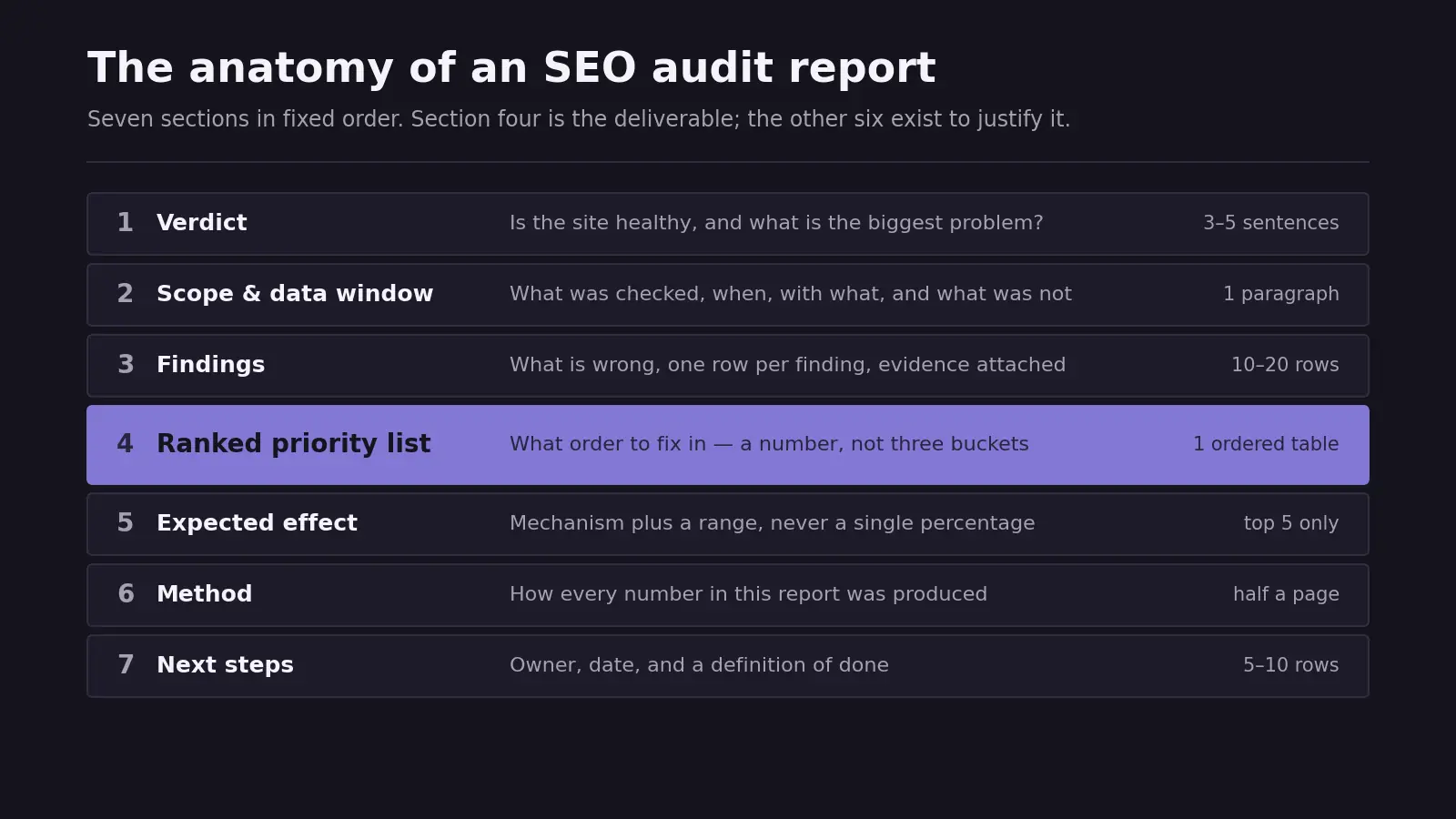
Seven sections, in this order. The order matters more than the wording, because it puts the decision on the first screen and the justification behind it.
| # | Section | The question it answers | Length budget | Who actually reads it |
|---|---|---|---|---|
| 1 | Headline verdict | Is the site healthy, and what is the single biggest problem? | 3–5 sentences | The owner or decision-maker |
| 2 | Scope and data window | What was checked, when, and with what | 1 paragraph + a list | Whoever disputes a finding in month three |
| 3 | Findings | What is wrong, with evidence attached | 1 row per finding | The person doing the fix |
| 4 | Ranked priority list | What order to fix things in | 1 table, 10–20 rows | The owner and the developer together |
| 5 | Expected effect | What changes if this ships, as a range | 1 line per top-five finding | The owner |
| 6 | Method | How every number in the report was produced | Half a page | The next person to audit this site |
| 7 | Next steps | Who does what, by when | 5–10 rows | Everyone |
If a block of content does not feed one of those seven, it belongs in an appendix or nowhere. Screenshot galleries of tool dashboards, glossary sections explaining what a canonical tag is, and twelve pages of raw crawl export are the three most common ways a report gets long without getting more useful.
The seven sections of an SEO audit report, and what each one is for
1. Headline verdict
Three to five sentences at the very top, before any table. State the condition of the site, name the single largest constraint, and say what it would take to lift it. A verdict that opens with “there are several areas of opportunity” has told the reader nothing and cost them thirty seconds.
2. Scope and data window
The section nobody writes and everybody needs six weeks later, when a finding is challenged. Record what was crawled and how deep, which date range the Search Console and analytics figures cover, which pages were excluded, and what could not be checked. If the crawl ran before a release, say so. The mechanics of collecting all of this properly are a job in themselves — the running order is in our technical SEO audit checklist.
3. Findings
One row per finding, never one row per URL. “312 category pages share a single title tag” is a finding; 312 rows of URLs is an appendix. Each row carries the problem, the number of URLs affected, the evidence (a crawl field, a Search Console figure, a log line) and where to see it for yourself.
4. Ranked priority list
The heart of the report, and the section covered below in detail. It is a single ordered table. Not three buckets. Not a colour scale. An order.
5. Expected effect
One line for each of the top five findings, expressed as a mechanism plus a range, never as a single flattering percentage. Rules for writing these honestly are further down.
6. Method
Half a page listing the tools, the crawl settings, the date ranges and the scoring convention used in section four. This is what makes the report auditable rather than assertable — and it is the difference between a document a client can act on and one they have to trust blindly.
7. Next steps
Rows with an owner, a date and a definition of done. “Fix robots.txt” is not a next step. “Remove the /products/ disallow line, redeploy, request re-crawl of the top 200 product URLs — dev, by 19 August” is.
How to prioritise audit findings so the report produces an order
High, Medium and Low give you three buckets, and then eleven things end up in the High bucket and nobody knows what to do on Monday. Score instead, and the report ranks itself.
Severity tiers — blocking, bleeding, cosmetic — are the first cut, and they tell you which findings are urgent. Scoring is the second cut: it orders findings within a tier, which is precisely where “everything here is urgent” otherwise hands the decision to whoever opens the document first.
Priority = (Impact × Confidence) ÷ Effort, where each input is scored 1 to 5.
- Impact — how much of the indexable estate this touches, weighted toward pages that make money. A problem on 79% of URLs scores 5; a problem on the blog archive scores 1.
- Confidence — how sure you are that fixing it changes anything. This is the column that gets skipped, and skipping it is how “add more content” ends up above “unblock the product catalogue”.
- Effort — engineering days, not your days. A one-line change in a config file scores 1. A template rebuild scores 5.
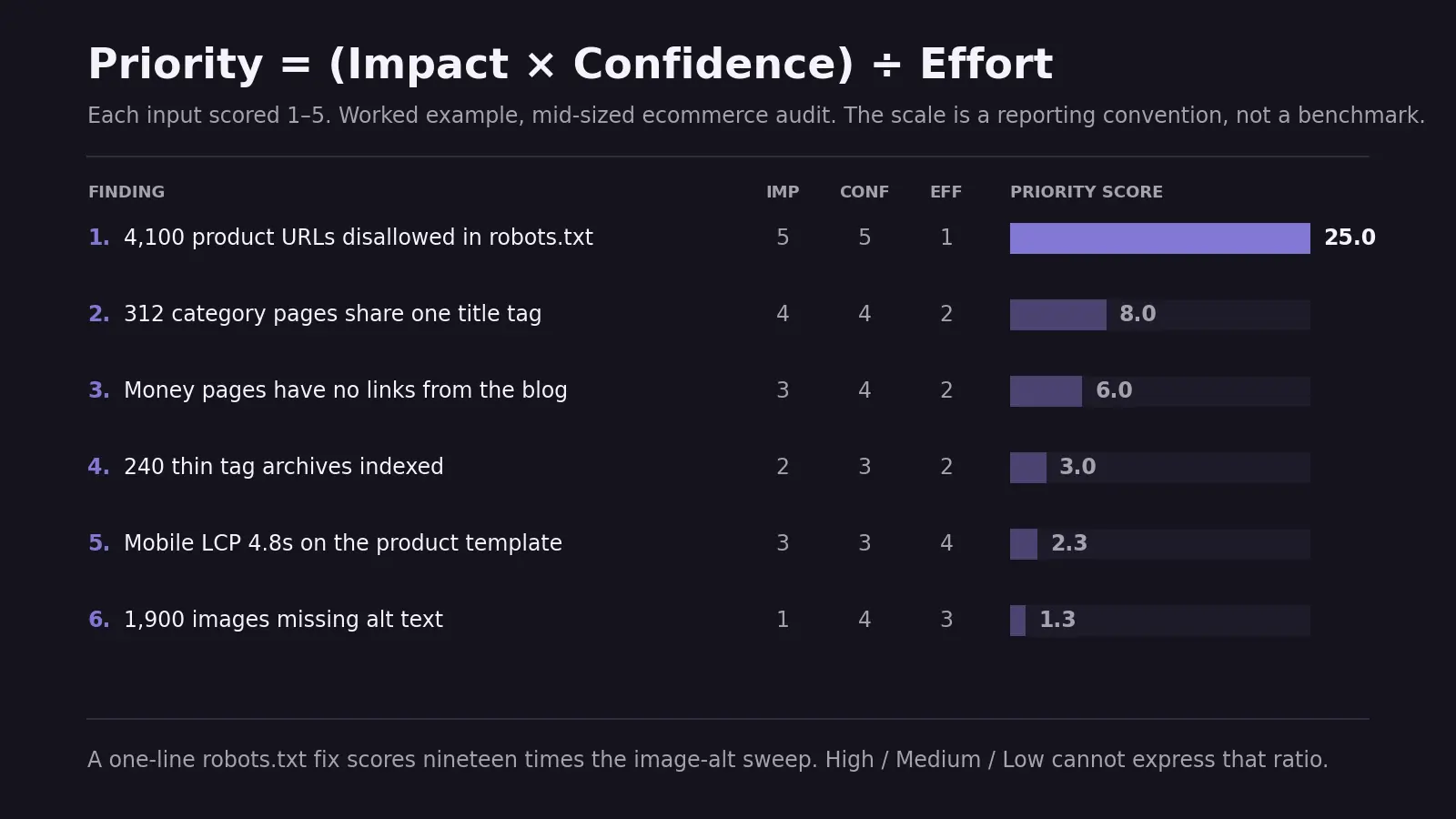
A worked example from a mid-sized ecommerce audit, with the arithmetic left visible so the client can argue with the inputs rather than the conclusion:
| Finding | Impact | Confidence | Effort | Priority | Order |
|---|---|---|---|---|---|
| 4,100 product URLs disallowed in robots.txt | 5 | 5 | 1 | 25.0 | 1 |
| 312 category pages share one title tag | 4 | 4 | 2 | 8.0 | 2 |
| Money pages have no internal links from the blog | 3 | 4 | 2 | 6.0 | 3 |
| 240 thin tag archives indexed | 2 | 3 | 2 | 3.0 | 4 |
| Mobile LCP 4.8s on the product template | 3 | 3 | 4 | 2.3 | 5 |
| 1,900 images missing alt text | 1 | 4 | 3 | 1.3 | 6 |
Two things this table does that a High/Medium/Low column cannot. It puts a one-line robots.txt fix nineteen times above an image-alt sweep, which is roughly the real ratio and nothing like the impression a colour-coded list gives. And it makes the disagreement productive: a client who thinks page speed matters more argues about the Effort score of 4, which is a conversation with a resolution.
One honest qualifier. The 1–5 scale is a convention, not a benchmark. The absolute numbers mean nothing outside the report they appear in; what matters is that every finding was scored on the same three axes by the same person on the same day. State that in the method section rather than letting the numbers look more objective than they are.
Stating expected impact in an SEO audit report without inventing numbers
The fastest way to lose a client in month four is to promise a percentage in month one. Three rules keep the section useful and survivable.
Name the mechanism, not the outcome. Unblocking 4,100 URLs makes them eligible to be indexed. Eligibility is certain; ranking is not. Write the certain part as fact and the uncertain part as a range.
Give the range a real floor. If the honest floor is zero, write zero. A range of “5–15%” where the floor is invented reads as confident and behaves as a liability.
Attach the method to every number. Any figure without a source beside it will be read as a guess, and eventually it will be right.
| What reports usually say | Why it fails | What to write instead |
|---|---|---|
| “+30% organic traffic within three months” | No mechanism, no method, cannot be falsified | “4,100 product URLs are currently ineligible for indexing. Unblocking makes them eligible; how many earn traffic depends on demand per SKU. Comparable fixes surface in impressions within 6–10 weeks.” |
| “Improves user experience” | Not measurable, so not actionable | “Mobile LCP on the product template is 4.8s against Google’s 2.5s threshold, and 61% of sessions are mobile.” |
| “Critical issue” | Severity with no axis behind it | “Affects 4,100 of 5,200 indexable URLs — 79% of the crawlable estate.” |
SEO audit report template: the copy-paste skeleton
Copy this into a document, fill the brackets, delete nothing. It is the seven sections above with the prompts left in.
# SEO audit — [client] — [date]

## Verdict
[Site condition in one sentence.] The largest constraint is [problem],
which affects [N] of [total] indexable URLs. Fixing it requires
[effort estimate]. Nothing else in this report outranks it.

## Scope and data window
Crawled: [N] URLs, [tool], depth [N], [date]
Search Console: [start] to [end]
Analytics: [start] to [end]
Excluded: [subdomains, staging, parameters]
Not checked: [what you could not access, and why]

## Findings
| # | Finding | URLs affected | Evidence | Where to see it |
|---|---------|---------------|----------|-----------------|

## Priority
Priority = (Impact × Confidence) ÷ Effort, each scored 1–5.
| Finding | Impact | Confidence | Effort | Priority | Order |
|---------|--------|------------|--------|----------|-------|

## Expected effect (top five only)
1. [Finding] — mechanism: [what becomes possible].
   Range: [floor] to [ceiling]. Basis: [method]. Visible in: [weeks].

## Method
Tools and versions: [ ]
Crawl settings: [ ]
Scoring convention: 1–5 on impact, confidence, effort; scored [date] by [name].
Known limits: [ ]

## Next steps
| Action | Owner | Due | Done means |
|--------|-------|-----|------------|
SEO audit report format: doc, spreadsheet, slides or dashboard
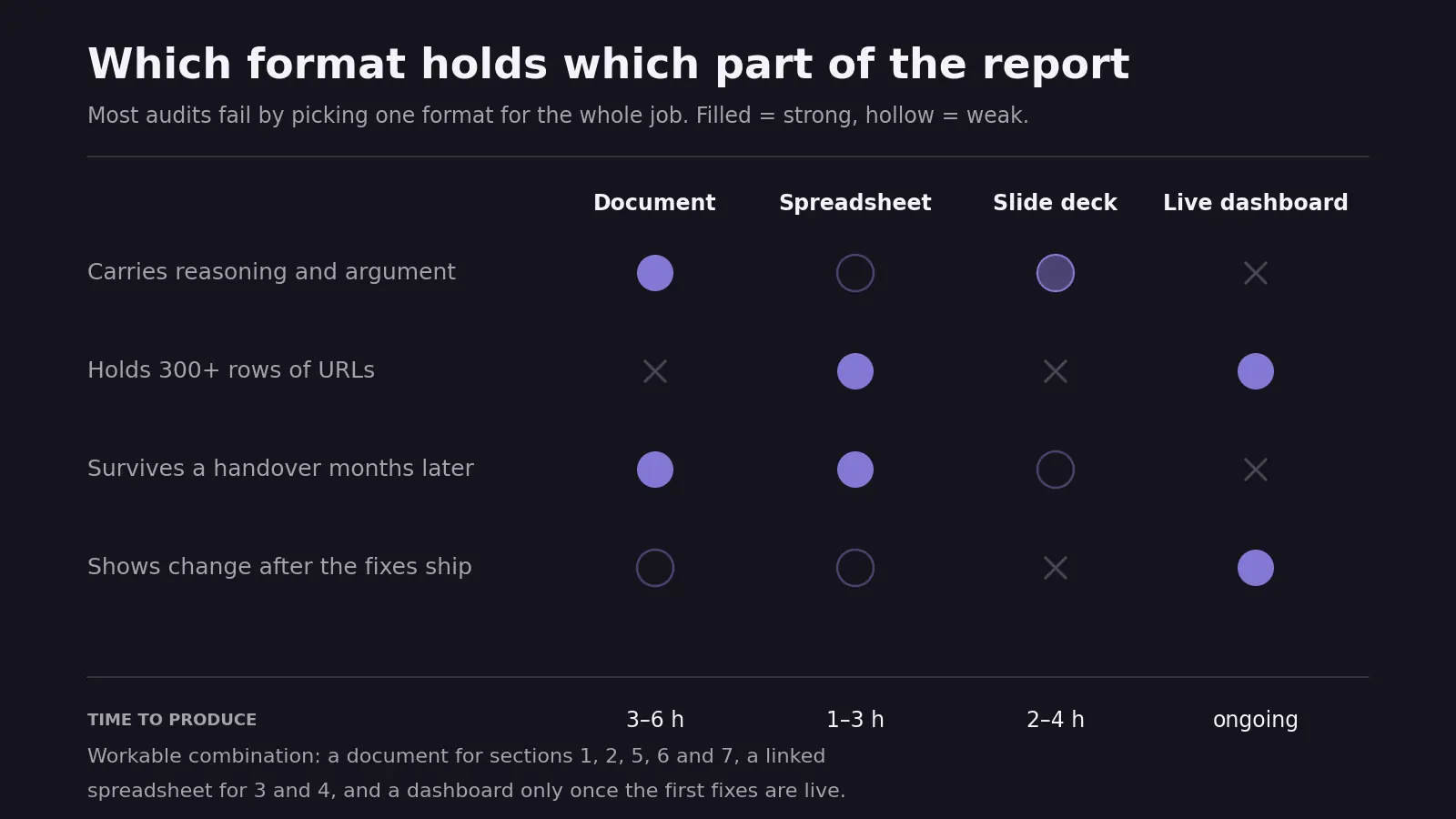
Most reports fail because they pick one format for the whole job. The verdict needs prose, the findings need rows, and the tracking needs a live view. Use each where it is strong.
| Format | Strong at | Falls apart when | Time to produce | Survives a handover? |
|---|---|---|---|---|
| Document (PDF or Doc) | Verdict, reasoning, method | You paste 300 rows of URLs into it | 3–6 hours | Yes — it is self-contained |
| Spreadsheet | Findings, priority scores, filtering | It has to argue a case or persuade | 1–3 hours | Yes, if the columns are labelled |
| Slide deck | Presenting the verdict live | It becomes the deliverable rather than the visual aid | 2–4 hours | Poorly — slides lose the reasoning |
| Live dashboard | Tracking after the fixes ship | Used as the audit itself; it shows state, not diagnosis | Ongoing | Only while the connection lives |
The workable combination for most engagements is a document that carries sections one, two, five, six and seven, a linked spreadsheet holding sections three and four, and a dashboard that only appears after the first fixes are live. A dashboard delivered as the audit is the most common substitution in this market, and it is a category error: a dashboard reports state, an audit explains cause.
Where SEO audit report samples go wrong
Five failure modes, in the order they cost the most.
- Findings without an order. Every issue is flagged, nothing is ranked, and the client picks the cheapest item on the list. This single failure wastes more audit budget than the other four combined.
- Tool output pasted in raw. A crawler’s export is a data source, not a finding. If a section could have been produced without a human reading it, the client could have run the tool themselves.
- Severity labels with no axis. “Critical” means nothing until it is attached to a count, a percentage or a revenue path.
- No scope statement. Six weeks later nobody can say whether the crawl ran before or after the release, and the whole report becomes unarguable in both directions.
- Written for another SEO. Canonicalisation, hreflang and crawl budget appear without translation, the reader stops on page two, and the fixes never get scheduled.
The five-minute test an SEO audit report has to pass
Before sending, hand the report to someone who does not work in search. Give them five minutes and ask three questions: what is the biggest problem here, what happens first, and what will change if we do it. If they can answer all three from the first two pages, the report works. If they cannot answer any of them, the problem is structure, not their attention — move the verdict and the ranked list to the front and try again.
That test is also the cleanest way to judge a report someone else produced. An audit is not a document that proves the auditor looked carefully. It is a document that makes the next four weeks of work obvious to a person who has other things to worry about.
We run audits this way as part of our SEO work — verdict first, one ranked list, every number carrying its method. If you would rather do it yourself, the skeleton above is the whole structure; the judgement in the priority column is the part worth spending your time on.
09 / Reader questions
Frequently asked questions
01How do you write an SEO audit report?
Write the verdict first, then the evidence. Open with a three-sentence answer to whether the site is healthy and what the single biggest problem is, then state scope and dates, then the findings table, then one ranked priority list. Everything else in the report exists to support that ranked list.
02What is an audit report in SEO?
An SEO audit report is the document that turns a site inspection into a decision: what is broken, in what order it should be fixed, and what each fix is expected to change. The inspection produces findings; the report produces an order of work. A report without an order is a findings dump.
03What should an SEO audit report include?
Seven sections: headline verdict, scope and data window, findings with evidence, a ranked priority list, expected effect stated as a range, the method behind every number, and next steps with owners and dates. Anything that does not feed one of those seven belongs in an appendix or nowhere.
04How long should an SEO audit report be?
Eight to fifteen pages for most sites, with the first page carrying the verdict and the ranked list. Length tracks the number of distinct findings, not the size of the site — a 50,000-URL store with four systemic problems produces a shorter report than a 200-page site with twenty scattered ones.
05What format should an SEO audit report be in — PDF, Excel or a dashboard?
Use a document for the verdict and reasoning, a spreadsheet for the findings and priority tables, and a dashboard only for tracking after the fixes ship. Most reports fail by picking one: a spreadsheet cannot argue a case, and a slide deck cannot hold 300 rows of URLs.
06Is a free SEO audit report template good enough?
A free template is fine for the container and useless for the hard part. Every free template gives you section headings; none of them ranks your findings, because ranking requires judgement about your business. Take the structure, then do the prioritisation and impact work yourself.
07Can ChatGPT write an SEO audit report?
A language model can draft the narrative and normalise the wording once you supply the crawl, the Search Console export and the log data. It cannot decide priority, because priority depends on margin, capacity and what the business is trying to sell. Treat it as a drafting tool, not an auditor.