Published · Updated
B-roll is the supplemental footage cut over your main shot — hands, the room, the product, the process — while the interview audio keeps running underneath. In a two-minute corporate video it covers about 45% of the timeline. At roughly three seconds a clip, that is 18 distinct shots to plan, film and pay for.
How this was checked. For this query in the United States on 10 August 2026, Google answers with an AI Overview, a People Also Ask block, a video pack and a perspectives block alongside seven organic results: Reddit, Wikipedia, Adobe, No Film School, Boords, TechSmith and Merriam-Webster. We opened four of them in full — Adobe, No Film School, Boords, TechSmith. Only one gives a ratio: TechSmith, capture four to six times the length of the finished video. Adobe gives a per-shot duration and nothing else. None of the four converts either number into a shot count, an hour count on the shoot day, or the point at which a shot list stops fitting the booking. The arithmetic below is our own planning model with its assumptions stated in the open, not a measured industry statistic; where an external rule exists, it is named.
A-roll carries the sound, B-roll carries the proof
A-roll is the footage the story’s audio comes from: the founder on camera, the presenter, the customer answering a question. B-roll is everything laid over that audio so the viewer sees what is being described. The two names are literal history — early editors ran a second reel, labelled B, alongside the A reel; the standard account of the term, the one Adobe also tells, has that second reel covering the splices where the A reel was cut. Merriam-Webster still defines B-roll as recorded video of subjects or locations used to provide supplementary material.
Inside that supplementary material, two words get used interchangeably and should not be. A cutaway leaves the scene entirely: the speaker mentions the factory, you cut to the factory. An insert stays inside the scene and moves closer: the speaker is holding the device, you cut to their thumb on its button. Both are B-roll, but a cutaway buys you a jump in time or place, while an insert only buys you a change of size. When an edit feels stuck, it usually has plenty of inserts and no cutaways.
Three things get called B-roll and are not:
- A second camera on the same interview. Same moment, same sound, a different lens. In our work that counts as a second A-roll angle, and it solves a different problem: it hides cuts in the answer rather than showing what the answer is about.
- Stock footage, by default. A library clip becomes B-roll at the moment it is cut against your A-roll. Sitting in a folder it is an asset, not coverage, and it cannot be your building.
- Anything filmed to fill time. If a shot does not answer a specific line, viewers read it as padding, and it is the first thing a client asks to remove.
Five families of B-roll footage on a corporate set
Almost every corporate shot list is a mix of the same five families, and each one does a different job in the edit. Sorting your list this way is what stops you arriving with 20 versions of the same wide shot.
| Family | What it looks like | What it does in the edit |
|---|---|---|
| Establishing | Building exterior, street, the room as a whole | Tells the viewer where they are, once, in about three seconds |
| Process | Hands working, a machine running, a whiteboard being filled | Compresses time — the only family that can make ten minutes read as four seconds |
| Detail | Product close-up, a screen, a label, a signature | Proves the specific claim in the line above it |
| People | Colleagues talking, a reaction, someone walking in | Puts humans in a film about a company, and covers the ugliest cuts |
| Texture | Light through a window, materials, movement, steam | Buys rhythm between the other four, and rescues a cut with nothing else to sit on |
The families are not equally cheap. Establishing and texture shots need nobody’s diary. Process and people shots need a specific person to be in a specific place doing a specific thing, which is why they are the shots that quietly get dropped on the day and quietly get missed in the edit.
How much B-roll a finished minute needs, counted in shots
“Minutes of B-roll” is the wrong unit, because you never lay one long clip. You lay a lot of short ones, and each one has to be found, framed and lit separately. The unit that predicts work is the number of distinct shots, and it comes out of three numbers:
Distinct shots = finished length × B-roll coverage ÷ average clip length on screen
Coverage is the share of the timeline where B-roll is visible. Average clip length on screen is about three seconds in corporate work — long enough to read, short enough that the piece keeps moving. Hold those and the shot count falls out of the format:
| Video type | Finished length | B-roll coverage | Seconds of B-roll | Distinct shots |
|---|---|---|---|---|
| Founder Q&A or webinar clip | 3:00 | 25% | 45 s | 15 |
| Talking-head brand film | 2:00 | 45% | 54 s | 18 |
| Customer story | 2:00 | 55% | 66 s | 22 |
| Product or process explainer | 1:30 | 75% | 67.5 s | 23 (22.5, rounded up) |
| Event recap | 1:00 | 90% | 54 s | 18 |
Our planning model, not an industry measurement. Coverage and average clip length are the two assumptions; change either and every row moves with it.
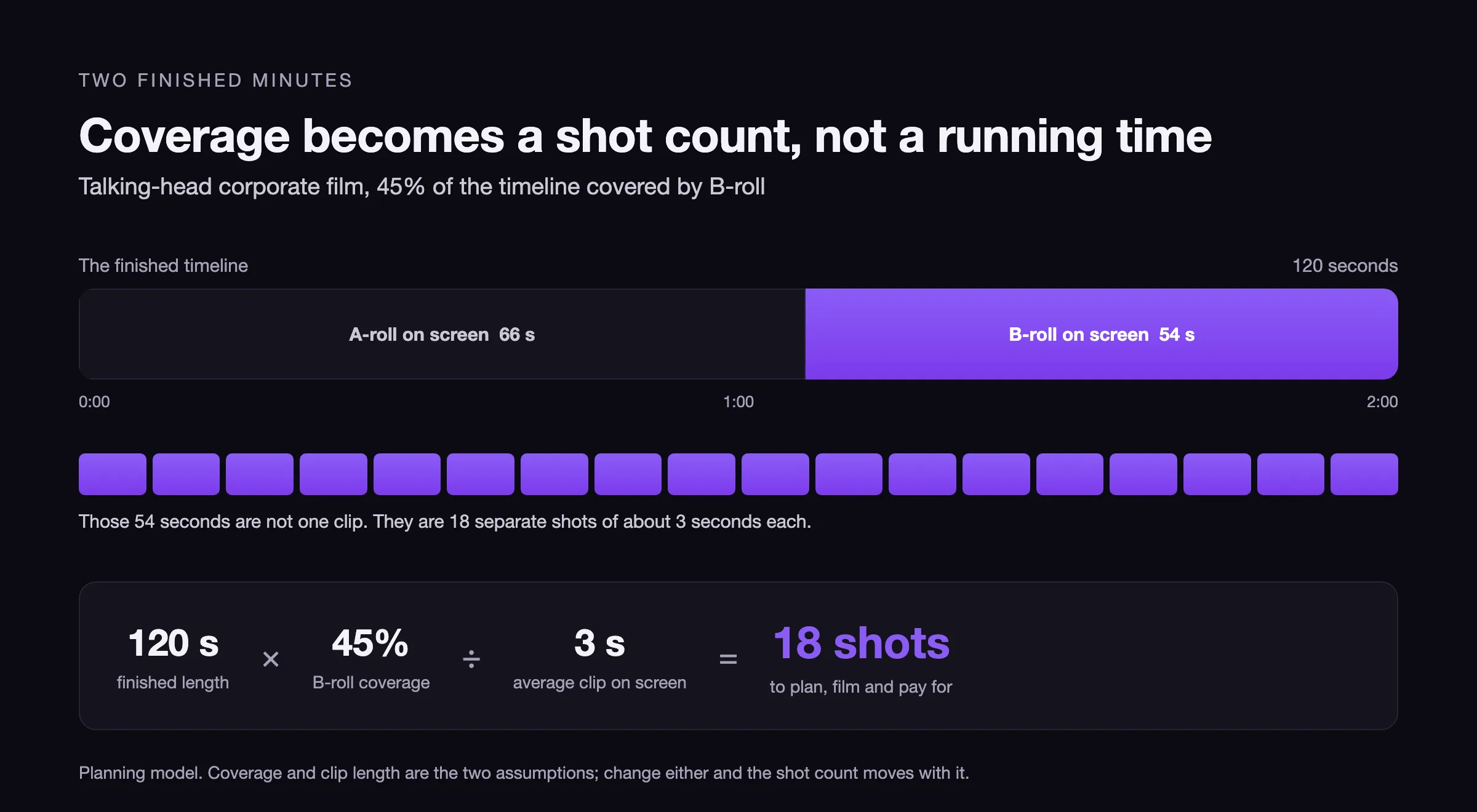
Two things in that table surprise people. The first is that a one-minute event recap and a two-minute brand film need the same 18 shots — coverage rises as the running time falls, so the work does not shrink with the duration. The second is that the longest video on the list needs the fewest shots, because a Q&A leans on the person talking and only cuts away to keep the eye awake.
The count assumes each shot is used once. Reuse is the first place the number drops, and in our edits it has a low ceiling: the second appearance of the same frame is noticeable, and the third reads as a mistake. Planning around one shot in five coming back is realistic. Planning around half of them is how a film ends up looking like a screensaver.
Card minutes: two ratios that answer different questions
Once you know the shot count, the footage total follows from how each shot is recorded. TechSmith’s guidance is to hold a B-roll clip for at least 10 to 15 seconds on short videos; Adobe’s version of the same rule is to count to ten in your head before stopping. Two takes at that length is 20 to 30 seconds of card per usable shot, so 18 shots put six to nine minutes of B-roll on the card for 54 seconds that reach the cut. That is a B-roll shooting ratio between roughly 6.7:1 and 10:1.
That number is not comparable to the shooting ratio you will find quoted elsewhere. Wikipedia’s 6:1 to 10:1 for productions shooting on film stock counts every frame exposed on the whole project, interview included — measured that way, the same two-minute film runs closer to 14:1, because 20 minutes of conversation for 66 seconds on screen is already 18:1 before a single cutaway exists. That is also why the often-quoted “capture four to six times the length of the video” holds only when the A-roll is tightly scripted and delivered in a few takes. Documentary work often exceeds 100:1, and unscripted talking is a large part of why; animation stays close to 1:1, because frames are too expensive to make and then discard.
So keep the two apart. The B-roll ratio (about 7:1 to 10:1) tells you how long the camera has to be recording on the day. The total ratio tells you how much storage and how much editing time to expect, and it is dominated by however long people talked. Budgeting the shoot from the total ratio is how crews end up with an enormous card and eleven usable cutaways.
What the shot count does to the length of the shoot day
A B-roll shot is not the two seconds of recording. It is the move, the frame, the exposure check, and then two takes. On a corporate location that runs four to six minutes per shot when everything is in one room and nobody else is needed — call it 10 to 15 shots an hour. As soon as a shot requires a person to do something specific, or a light to be moved, it drops to six to eight an hour.
Eighteen shots therefore take somewhere between 72 minutes and three hours of the day. Against a standard eight-hour booking that fits, though the slow end of the range uses the whole window:
| Day block | Full day (8 h) | Half day (4 h) |
|---|---|---|
| Load-in, lighting, sound check | 60–90 min | 60 min |
| Interview or presenter block | 90–120 min | 90 min |
| Break | 30–45 min | — |
| Wrap and load-out | 30–45 min | 30 min |
| Left for B-roll | 3–4.5 hours | about 1 hour |
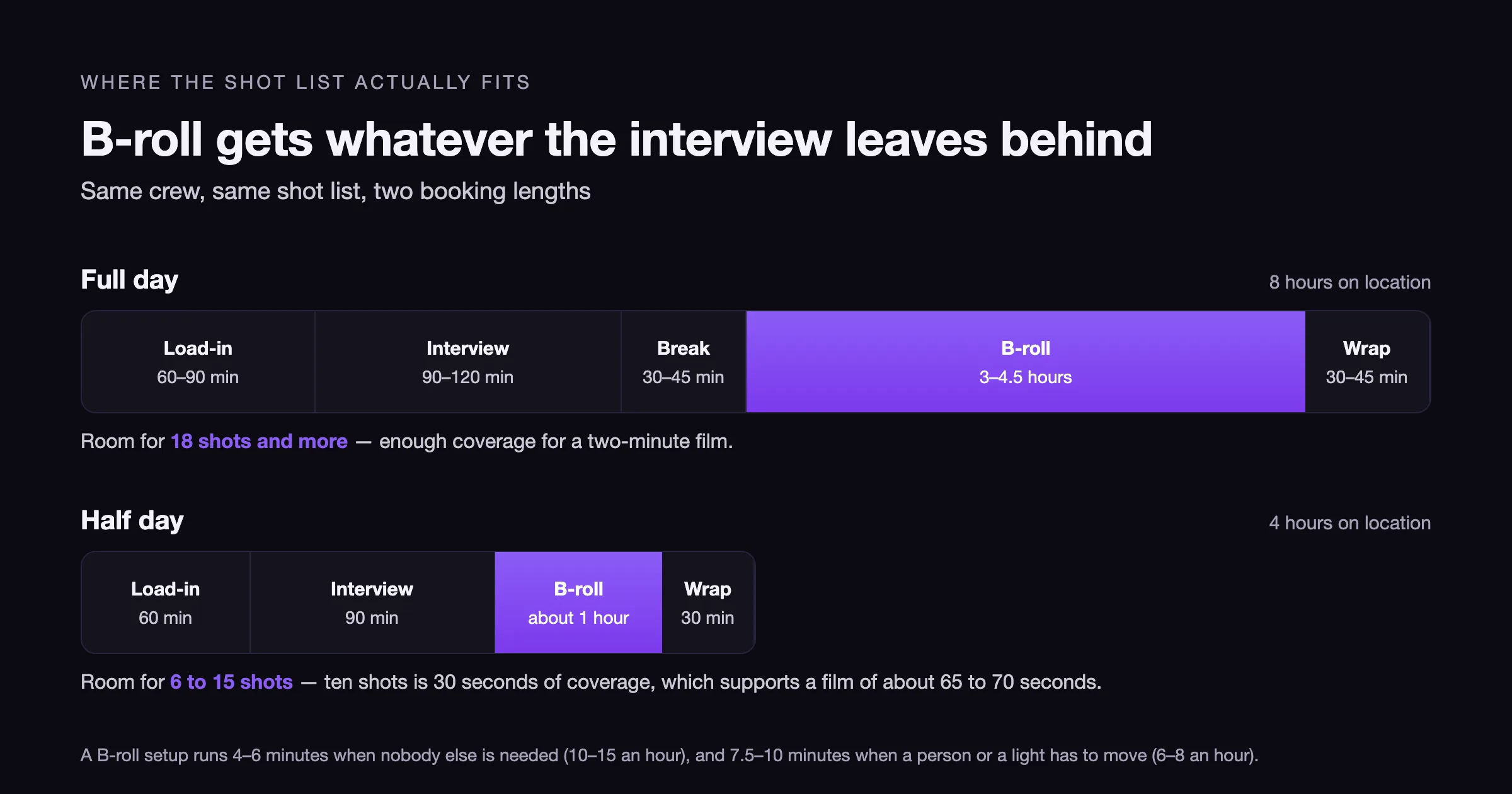
That last row is the number worth carrying into a planning meeting. One hour of B-roll capture is 10 to 15 shots in the easy band and six to eight in the hard one. Ten shots is 30 seconds of coverage, which at 45% coverage supports a finished film of about 65 to 70 seconds. That is the realistic middle of a half-day shoot with an interview in it: a film of roughly one minute, stretching towards 1:40 if every shot is an easy one and shrinking to 40 seconds if none of them are. A two-minute film out of a half day means cutting the interview short or accepting stock for half the coverage.
Add a second location and the arithmetic moves again, but not through shooting time — through the 30 to 60 minutes of dead time it takes to pack, travel and re-light. At the rates above, that is five to ten shots gone.
Where B-roll actually lands in a video estimate
Crew time is sold in blocks, not per shot, and that single fact explains most of the confusion about what B-roll costs. Shot number 19 is free. Shot number 40 is free. The shot that pushes past the block is not free at all, because it does not cost one shot — it costs a half-day, and the half-day is the smallest unit most studios will sell you.
Four things move the number, and shot count is only one of them:
- Locations. Each additional site is dead time before it is shooting time. The estimate feels the travel, not the frames.
- Whether people are in the shots. Booking three colleagues for a 40-minute window is a scheduling problem that lands on the client’s side, and it is the most common reason a day overruns.
- Whether the lighting moves. A film shot in existing light and a film with a lamp repositioned per setup are different days at the same shot count.
- How many formats the edit has to deliver. A vertical cut is not simply a crop when the subject is at the edge of a 16:9 frame; shots meant for both need framing decisions made on the day rather than in the edit.
The item people underestimate is the missing shot. When the edit reaches a line with nothing to lay over it, the fix is not “one more shot” — it is a call-out with a minimum booking, travel, and everyone’s diary again. That is why the shot list is worth an hour before the shoot: it is the cheapest hour in the whole production. The same logic applies when choosing the format in the first place, which is what 2D or 3D animation is really a decision about — where the effort sits, and when it gets spent.
The corporate B-roll shot list, and how to fill it before the day
A shot list is not a wish list of nice frames. It is a mapping from lines of script to things a camera has to be pointed at, and three columns do most of the work: who has to be present, whether the light moves, and which line this shot answers. Fill those and the day plans itself in the order that keeps people waiting the least. The script itself is what drives every decision on the list, because each shot exists to answer or illustrate a specific line.
Here is the core of the list we use for a two-minute corporate film, cut down to the 12 shots that carry most of the coverage. The full 24-shot version, including the columns for who is needed, whether the light has to move and what each shot answers, is a spreadsheet you can download and edit:
Download the corporate B-roll shot list (CSV, 24 shots)
| # | Family | Shot | Framing | Record, per take |
|---|---|---|---|---|
| 1 | Establishing | Building exterior with signage | Wide, static, from across the street | 15 s |
| 2 | Establishing | Entrance, someone walking in | Wide, static, let them exit frame | 15 s |
| 3 | Establishing | The main room, working | Wide, slow pan left to right | 20 s |
| 4 | Process | Hands on keyboard, over the shoulder | Medium, static | 15 s |
| 5 | Process | The core task being performed | Medium, static, repeat the action twice | 20 s |
| 6 | Process | Whiteboard or screen being filled | Medium-close, slow push in | 15 s |
| 7 | Detail | Product or tool, hero angle | Close, static, shallow depth | 15 s |
| 8 | Detail | Screen showing the actual output | Close, static, screen legible | 15 s |
| 9 | People | Two colleagues talking, no audio needed | Medium, static, over the shoulder | 20 s |
| 10 | People | Reaction — a nod, a laugh, a look up | Close, static | 15 s |
| 11 | Texture | Light through a window, plants, materials | Close, static or slow drift | 10 s |
| 12 | Texture | Movement through the space — a walk-through | Medium, handheld follow | 20 s |
The record column is one take. Shoot two of every shot, so a 15-second row is 30 seconds on the card — that is where the six to nine minutes in the section above comes from.
Two habits make that list survive contact with the day. Record more than feels necessary on every take and keep the frame still through all of it: an editor can shorten a long stable clip and can do nothing with a four-second wobble. And shoot each setup in two sizes — one wide enough to read the context, one close enough to read the detail — because two sizes of the same subject cut together, and two identical wides do not.
B-roll for social cuts, where the A-roll disappears
The word travels beyond film sets. On Instagram, TikTok and in every CapCut tutorial, B-roll means the ambient clips creators film to lay under a voiceover or a trending sound: the coffee, the laptop, the order being packed. Mechanically it is the same footage doing the same job. Structurally it is the opposite arrangement — there is often no interview to support, so the supporting footage becomes the entire video, and it carries the story on its own.
That inversion has one practical consequence for a corporate shoot. A 30-second social cut is essentially all coverage, so it does not reuse the film’s B-roll so much as consume it: the same 18 shots can support the two-minute film, or one 30-second cut with a handful left over. Two social cuts on their own already need 20 distinct shots, more than the film itself. If vertical versions are part of the deliverable, they are shots to add to the list on the day, not a crop to decide afterwards.
When stock footage is the right patch, and when it shows
Stock is genuinely the correct answer for a category of shot: aerials of a city you are not in, weather, generic technology, anything a camera on your day could not reach. Free and paid libraries both cover that ground, and using them there is not a compromise.
It shows in exactly one place — the shots that were supposed to be evidence. Your building, your people, your product in a real pair of hands, your process actually happening. Those are the shots the viewer uses to decide whether the company in the film is a real company, and a library clip of a different office with different light says only that somebody had a budget for a library clip. The rule of thumb is simple enough to apply while filling the list: if a shot proves a claim, film it; if a shot sets a mood, buy it.
That split is also the honest answer to “how much does B-roll add to the price”. It adds hours, and hours come in blocks, and the blocks are set by the shot list you wrote before anyone arrived. Everything we plan on a shoot is built backwards from that list — the number of shots, the number of setups, the number of people whose diaries have to line up. If you want that planning done with you rather than handed to you as a quote, that is what our video production work is.
10 / Reader questions
Frequently asked questions
01What is considered B-roll?
B-roll is any footage that is not the main shot carrying the story's sound — the hands, the room, the product, the walk down a corridor. In an interview piece the A-roll is the person talking; everything laid over the top of that audio is B-roll, whether it was filmed on the same day or a year earlier.
02What are examples of B-roll footage?
Corporate B-roll falls into five families: establishing shots of the building or street, process shots of work being done, detail shots of a product or a screen, people shots of colleagues talking and reacting, and texture shots of light, materials and movement. A two-minute film normally draws on all five.
03How much B-roll do I need for a two-minute video?
About 18 distinct shots. A talking-head corporate video covers roughly 45% of its timeline with B-roll, which is 54 seconds out of 120, and each clip sits on screen for about three seconds. Recording two takes of 10 to 15 seconds per shot puts six to nine minutes of B-roll on the card.
04How long should each B-roll clip be?
Record 10 to 15 seconds on every take, and hold the frame still through all of it, even though only two to four seconds will survive the edit. TechSmith gives the same 10 to 15 seconds for short videos; Adobe's version is to count to ten before you stop recording. Takes that are too short are the most common reason an editor asks for a reshoot.
05What is B-roll in social media?
On Instagram and TikTok, B-roll usually means the ambient day-in-the-life clips creators film to lay under a voiceover or a trending audio: coffee being poured, a laptop opening, an order being packed. The editing logic is the same as in film, but there is often no A-roll at all — the B-roll is the whole video.
06What does B-roll mean in slang?
There is no separate slang meaning. The loose social-media usage is the film term stretched: when a creator says they are filming B-roll, they mean unstructured supporting clips of their day with no interview or piece to camera behind them. The word itself came from physical film, where a second reel labelled B ran alongside the A reel.
07Is stock footage B-roll?
Stock clips can be used as B-roll, and for generic subjects — skylines, weather, abstract technology — they routinely are. What they cannot cover is anything specific to you: your building, your people, your product in someone's hands. A film that leans on stock for those shots ends up being about no one in particular.