Published
Choose 2D when the brief produces one video about an idea, and 3D when it produces a library of outputs about an object. 2D runs $3,000–$12,000 per finished minute and 4–6 weeks; 3D runs $8,000–$30,000 and 8–12 weeks. The rest is detail, and the expensive detail is what happens on deliverable two.
Almost everything written about this question answers a different one. The pages that rank explain what the two formats are — flat drawings on X and Y against models in a space with a Z axis — which is useful if you are deciding what to study and useless if you are deciding what to commission. Nobody buys an animation because it has a Z axis. They buy it because something has to be explained, and they have a number in their head and a date in their calendar.
How this was checked. For this query in the United States on 7 August 2026, Google returned an AI Overview, an image pack, a video pack, a forum block and six organic results. Two are animation schools, one is a lesson page, one is a tool vendor’s hub, one is a training studio’s video post, and the top result is a Reddit thread titled “Is 3D animation easier to make than 2D animation?” Every one of them is written for someone who wants to make animation. Not one publishes a per-use-case decision table, a cost band per finished minute, or what the second video costs. The price bands below come from published US agency rate guides sampled the same week; they are ranges those studios quote, not quotes for your project. The worked example is a model, and every figure in it is derived from the two split tables so you can check the arithmetic yourself.
The question that decides the format: how many deliverables come out of the brief
Count outputs, not videos. That single move settles most of these arguments before anyone opens a moodboard.
A 2D pipeline bills you for motion. Almost everything you pay for is work applied to one timeline, and it exists only inside that timeline. A 3D pipeline bills you for an asset first and motion second. The model, its materials and its lighting are built before a frame is animated, and once they exist they can be pointed at any output: a different shot, a different ratio, a still, a rotation, a cutaway, a new colourway.
So the honest decision rule is not “2D for budget, 3D for premium”. It is:
- One video, and the subject is an idea, a process, a workflow or a screen — 2D. There is no object to amortise, so the 3D asset cost buys nothing.
- One video, and the subject is a physical object — still usually 2D, if the video really is the only deliverable.
- A video plus stills, angles, ratios, exploded views, or a year of re-cuts of the same object — 3D. This is the case where the asset earns its cost, and the only case.
The use-case matrix: eight briefs and the format each one defaults to
| The brief | Default | Why | What flips it |
|---|---|---|---|
| SaaS or process explainer | 2D | The subject is a sequence of ideas, and there is nothing physical to show | The product is hardware, or the story happens inside a machine |
| Performance ad creative, many variants | 2D | The unit cost that decides the budget is the variant, not the master | You already own the 3D models from earlier work |
| Physical product demo: how it works | 3D | Cutaways, exploded views and material detail at macro scale | The video is the only deliverable, or the product is simple and the story is the workflow around it |
| A product that does not exist yet | 3D | There is nothing to film and nothing to photograph | Nothing. This one does not flip |
| Animated logo, sting or title sequence | 2D | It is typography and shape moving in a plane | The mark itself is dimensional, metallic or has to rotate |
| App and interface motion | 2D | An interface is flat by definition | The app drives a physical device you also have to show |
| Trade show or retail loop | 3D | One asset feeds every screen size and every ratio in the venue | The budget covers exactly one screen and one edit |
| Equipment or process safety training | 3D | Spatial relationships between parts are the content | The process is administrative rather than physical |
Two rows carry most of the money. The performance-ad row is the one people get wrong most expensively: a brief that ends in thirty variants is a brief about variant cost, and 3D loads every variant with a render queue. If those variants are going out as paid media, the creative line sits on top of the media line, and the media line is rarely the small one — we broke that side down in what Google Ads actually costs.
The product-demo row is the one people get wrong most often in the other direction: they commission a flat explainer of a machine, and then spend the next year commissioning illustrations of the same machine from angles the explainer never drew.
What a finished minute costs in 2D and in 3D
Across published US agency rate guides sampled in August 2026, 2D business animation is quoted between roughly $1,500 and $20,000 per finished minute, and 3D between roughly $5,000 and $50,000. Those outer edges are real but they are not your project: the bottom is template-driven work with stock assets, the top is film and broadcast. Strip both ends and the band most commercial briefs land in is $3,000–$12,000 per finished minute for 2D and $8,000–$30,000 for 3D.
Two qualifiers, because a number without them is a trap. First, “per finished minute” is a comparison unit, not a billing unit — a 30-second piece does not cost half of a 60-second piece, because script, style development and sound have fixed floors. Second, the band is set far more by shot count and character work than by duration. A 90-second piece with four scenes is cheaper than a 45-second piece with fourteen.
For the rest of this article, one brief is priced both ways at mid-band: $9,000 for the 2D version and $22,000 for the 3D version of the same 60-second piece. The 3D premium on video one is $13,000, which makes the 3D price 2.4 times the 2D price.
Where the money sits inside a 2D budget versus a 3D budget
The bands above tell you the total. The split below is what actually decides everything that follows, because it says which parts of the bill you can avoid paying twice.
2D, 60 seconds, $9,000
| Stage | Share | Cost | Carries over to the next video? |
|---|---|---|---|
| Script and storyboard | 20% | $1,800 | No |
| Design: style frames, characters, icon set | 30% | $2,700 | Mostly — about 60% carries over |
| Animation | 40% | $3,600 | No |
| Sound design and mix | 10% | $900 | No |
3D, 60 seconds, $22,000
| Stage | Share | Cost | Carries over to the next video? |
|---|---|---|---|
| Script and previz | 10% | $2,200 | No |
| Modelling, texturing, look development | 40% | $8,800 | Yes — about 85% carries over |
| Environment and lighting build | 15% | $3,300 | About half carries over |
| Animation | 20% | $4,400 | No |
| Rendering and compositing | 10% | $2,200 | No |
| Sound design and mix | 5% | $1,100 | No |
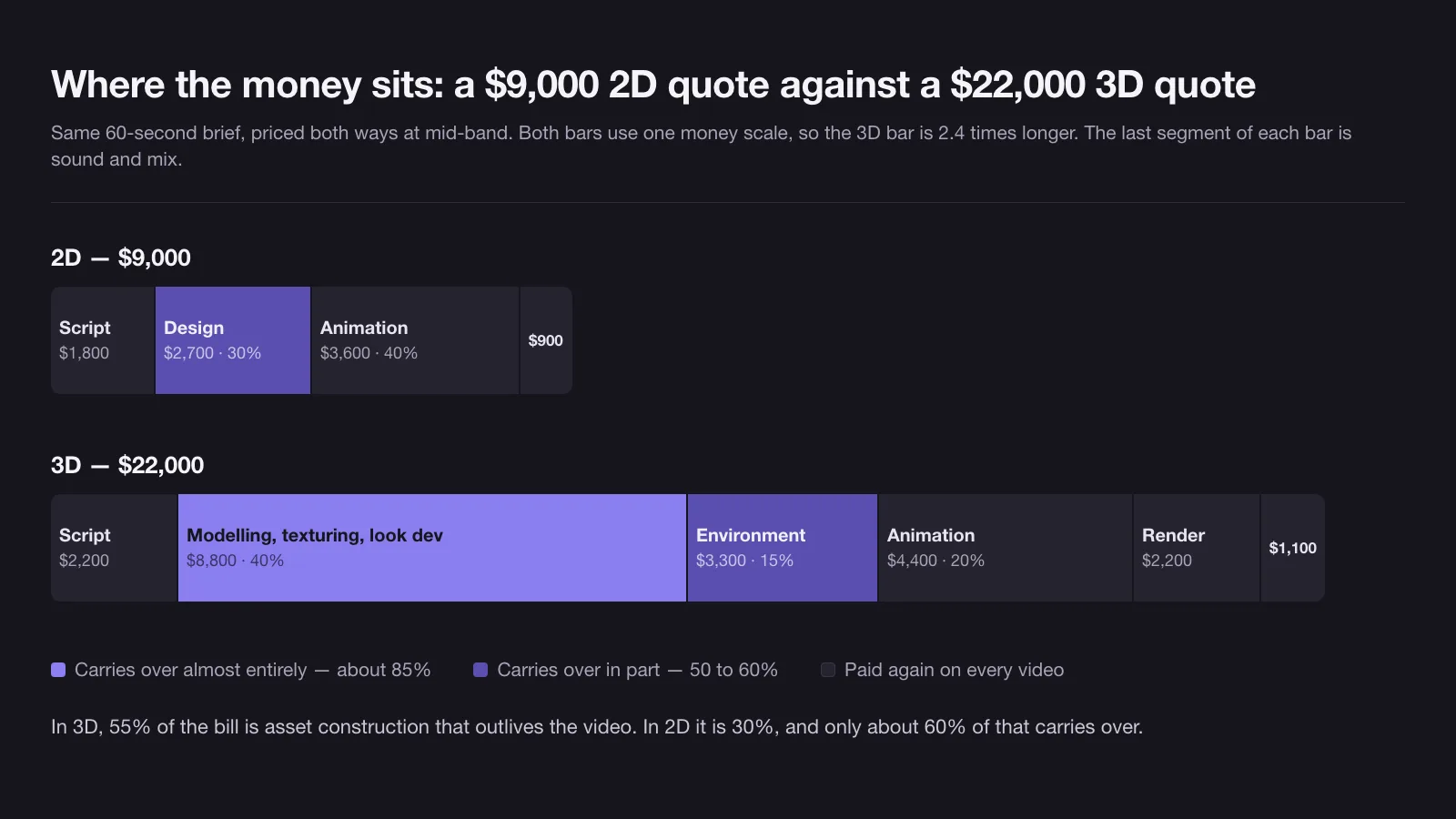
The shape is the point. In 2D, 70% of the bill is script, animation and sound, and all three are consumed by the video you are making. In 3D, 55% of the bill is asset construction that outlives the video. That is the whole mechanical difference between the formats as a purchase, and it is why our 2D animation and motion design briefs and our 3D animation briefs get scoped in completely different orders.
The reuse curve: what the second video costs in each format
Apply the carry-over column to a second video in the same style, on a new topic, for the same brand.
2D, video two: script $1,800 (full) + design $1,080 (40% of $2,700) + animation $3,600 (full) + sound $900 (full) = $7,380, or 82% of the first.
3D, video two: script $2,200 (full) + modelling $1,320 (15% of $8,800) + environment $1,650 (half of $3,300) + animation $4,400 (full) + rendering $2,200 (full) + sound $1,100 (full) = $12,870, or 59% of the first.
| Video 1 | Video 2 | Video 3 | Three-video total | |
|---|---|---|---|---|
| 2D | $9,000 | $7,380 | $7,380 | $23,760 |
| 3D | $22,000 | $12,870 | $12,870 | $47,740 |
| 3D as a multiple of 2D | 2.4x | 1.7x | 1.7x | 2.0x |
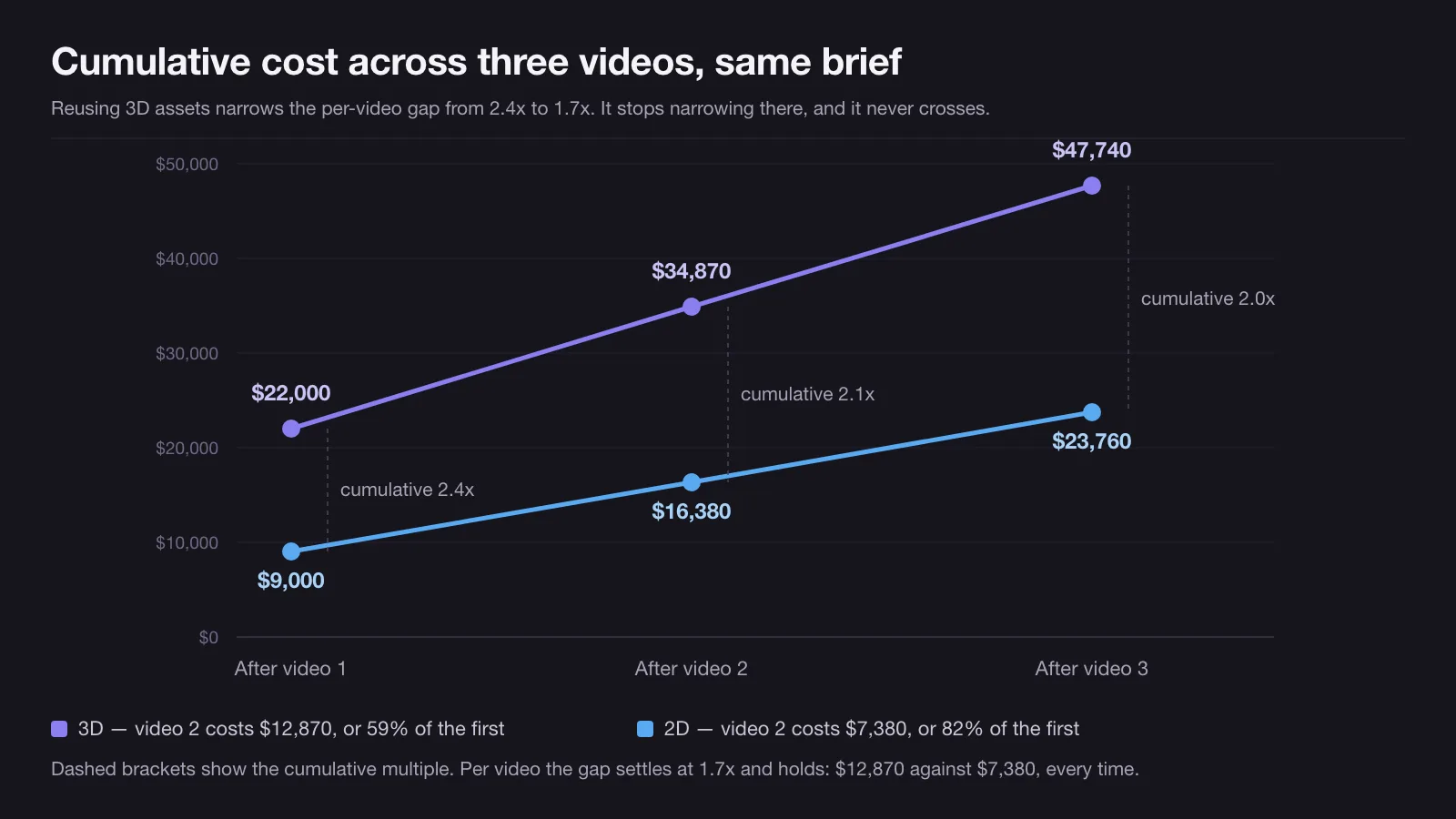
Here is the part that gets sold to you wrongly, so read it slowly: 3D never becomes the cheaper format. The per-video gap narrows from 2.4x to 1.7x and then stops narrowing, because the stages that repeat — animation, rendering, sound, script — repeat at full price forever. Run the same model out to ten videos and 3D is still 1.8 times the cumulative 2D bill.
If a proposal tells you that 3D “pays for itself by the second or third video”, ask to see that arithmetic on the same split table. It does not survive it.
3D repays the model in stills and angles, not in a cheaper second video
The reuse argument is real. It is just aimed at the wrong output. What a finished 3D asset gives you cheaply is not more video — it is everything that is not video, produced from an object you have already paid to build.
| Deliverable from the same subject | In 3D | In 2D |
|---|---|---|
| A product still at a new angle | A render pass; hours | A new illustration; days |
| A 360-degree turntable | One camera move, one render | Every frame of the rotation redrawn |
| Vertical and square versions with re-framed camera | Re-frame and re-render, no re-animation | Re-composition, often partial redraw |
| An exploded or cutaway view | Move the parts that already exist | A new illustration from scratch |
| A new colourway or material finish | Swap the shader | Redraw every affected element |
| A print or spec-sheet diagram | A render at print resolution | A separate commission |
So the test is not “how many videos will we make?” It is: write down every visual deliverable this object needs over the next twelve months. If the list is one video, take 2D and keep the $13,000. If the list is a video plus a still library, a spin, three ratios, two colourways and a diagram for the spec sheet, the premium stops being a premium and starts being the cheapest way to buy the rest of the list.
There is no universal count at which it flips, and anyone who gives you one is guessing. Count your own list.
One condition makes all of this real or fictional: whether you own the models. If the contract leaves the studio holding the source assets, the entire reuse column above belongs to them, not to you, and the second video is quoted at whatever they choose. Settle asset ownership in the first conversation, not the last.
How long each format takes, brief to final cut
| Deliverable | 2D | 3D |
|---|---|---|
| First 60–90 second piece, from a blank brief | 4–6 weeks | 8–12 weeks |
| Second piece, same style or same models | 3–4 weeks | 4–6 weeks |
| A 15–30 second cutdown from an approved piece | 2–4 days | 3–5 days |
| A changed shot after final approval | Hours to a day | A day, plus a re-render pass |
| Rush under two weeks | Possible; published guides put the premium at 25–50% | Rarely possible from a blank brief at all |
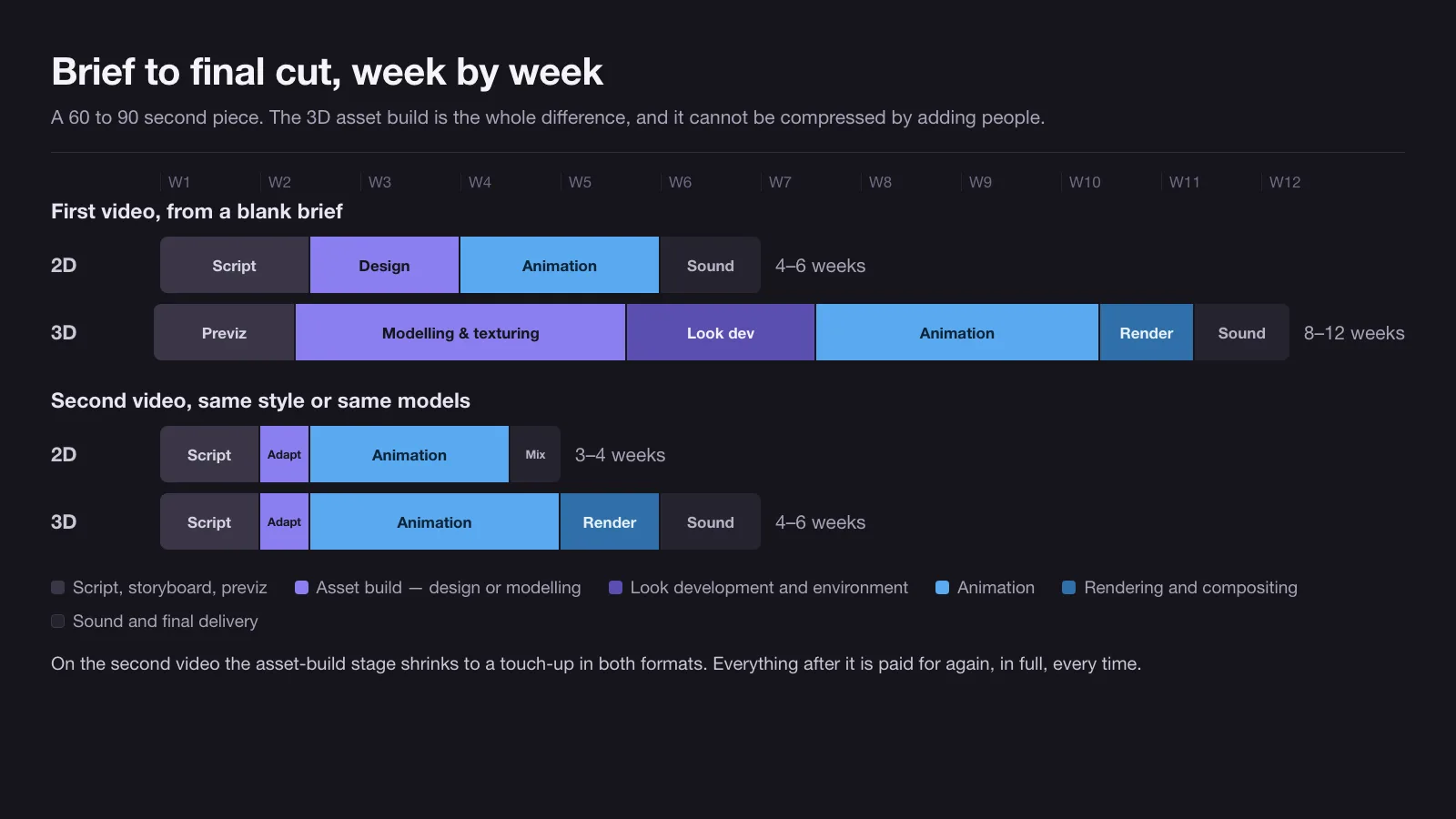
Two lines here decide real campaigns. The first-piece row is why 3D dies in briefs with a launch date attached: five to six weeks of that runway is asset construction, and it cannot be compressed by adding people, because texturing cannot start before modelling finishes and look development cannot start before texturing does. The changed shot row is why 3D revision rounds have to be capped earlier: in 2D a note lands the same afternoon, in 3D the same note re-enters a render queue.
If the launch date is fixed and inside eight weeks, the format decision has already been made for you.
Mixing 2D and 3D in one video, and when that is the cheap answer
For product work, the hybrid is often the correct answer rather than a compromise: the object is modelled and rendered in 3D, and every explanatory layer over it stays 2D. Callouts, dimension lines, data, arrows, interface panels and all type live in a flat layer composited on top.
Three things get cheaper at once. The explanatory layer never has to be modelled or lit. Changes to it never trigger a re-render, so late copy edits cost an afternoon instead of a night in the queue. And localisation stops being a production problem: text that lives in a 2D layer is re-typeset per language, while text baked into a 3D scene is a re-render per language.
The rule worth writing into the brief: no word of copy is ever modelled. Even in a fully 3D piece, keep every word in a flat layer. It is the single cheapest clause in an animation contract.
The reverse hybrid also works — a 2D master with one 3D hero shot, where the object appears once, in the moment it needs to be believed, and everything else stays flat.
Three briefs where the obvious format is the wrong one
A hardware brand asking for 3D to explain its pricing model. The company makes an object, so 3D feels native. But the subject of this video is tiers and thresholds, and nobody needs to see the device rotate to understand a price break. The modelling budget buys screen time for something the viewer already accepts. Correct answer: 2D, with a single product still.
A software company that ships a physical device. Sensors, kiosks, card readers and dongles get briefed as 2D “because we’re a software company”. But the device is the one thing customers cannot picture and the one thing that arrives in a box. Correct answer: hybrid — 3D for the device, 2D for the dashboard.
A 90-second product film quoted in 2D, when the same object also needs a catalogue, a website hero image and a spec-sheet diagram. The still deliverables are invisible in the video quote because they belong to different budget lines and often different suppliers. Priced together, the illustrations cost more than the 3D premium did, and they still cannot be re-angled later. Correct answer: 3D, scoped as an asset build with a video as its first output.
The pattern under all three: the format follows the subject and the deliverable list, never the industry the buyer happens to be in.
Costs that appear after the format is locked
Per-minute bands cover production. These usually sit outside them, and they are where a comfortable quote turns into an uncomfortable invoice.
- Voiceover and music licensing. Priced per territory and per term. A licence bought for “web” does not cover the broadcast cut, and a two-year term expires while the video is still on your homepage.
- Localisation. Cheap in 2D, expensive in 3D, and free in neither. See the no-modelled-copy rule above.
- Aspect-ratio versions. Rarely included by default. Ask whether 9:16 and 1:1 are re-framed or merely letterboxed, because the difference is visible and only one of them is animation work.
- Revision rounds beyond the quoted number. Check what counts as a round, and whether a note that changes the storyboard resets the stage.
- Source files and asset ownership. The one that decides whether the reuse curve above is yours or the studio’s.
- Sound design as a separate line. Sometimes bundled, sometimes not, and the difference on a 60-second piece is roughly the 5–10% share in the split tables above.
None of this is unique to animation. It is the same gap between the quoted number and the year-one number that shows up on every large creative purchase — we measured it line by line for site projects in what a website redesign actually costs.
Ask for the format decision to be written down with its reason before anyone starts designing. One sentence is enough: this brief produces N deliverables from one subject, so we are building an asset / we are building a timeline. Every argument later in the project resolves against that sentence.
11 / Reader questions
Frequently asked questions
01Which is better, 2D or 3D animation?
Neither is better in general, and the choice is not about how they look. 2D wins when the subject is an idea, a process or an interface and the brief produces one video. 3D wins when the subject is a physical object and the brief produces a library of outputs from it.
02Is 3D animation more expensive than 2D?
Yes, and it stays more expensive. Published US rate guides span roughly $1,500 to $20,000 per finished minute for 2D and $5,000 to $50,000 for 3D; strip the template and broadcast ends and most commercial briefs land at $3,000 to $12,000 and $8,000 to $30,000. Reusing 3D models narrows the per-video gap from about 2.4x to 1.7x, but it never closes it.
03Is 3D animation faster than 2D?
No. A first 60 to 90 second 3D piece typically runs 8 to 12 weeks against 4 to 6 weeks for the 2D equivalent, because modelling, texturing and look development all happen before a single frame is animated. 3D only gets faster once those assets already exist.
04Can 2D and 3D animation be combined in one video?
Yes, and for product work it is often the cheapest correct answer. The object is built and rendered in 3D; every explanatory layer over it, such as callouts, data, arrows, interface and type, stays 2D. The explanatory layer never has to be modelled, rendered or re-rendered.
05How long does an animated explainer take to produce?
Budget 4 to 6 weeks for a 60 to 90 second 2D explainer from a blank brief, and 8 to 12 weeks for the 3D equivalent. A second piece in the same style, or from the same 3D models, runs 3 to 4 weeks and 4 to 6 weeks respectively.
06How can you tell whether a video is 2D or 3D?
Watch the camera, not the drawing style. If the viewpoint orbits an object and the highlights and shadows travel across its surface as it turns, it is 3D. If the camera only pans, zooms or cuts and the shading stays fixed to the artwork, it is 2D, however dimensional the shading looks.