
Published
An investor pitch deck is a document of roughly twelve sections — purpose, problem, solution, why now, market, competition, product, business model, traction, team, financials, the ask — spread over 18 to 20 pages. Its job is to earn a meeting, not to close a round. Measured across DocSend’s fundraising data, it is read in two to four minutes, by one person, alone.
How this was checked. For this query in the United States on 10 August 2026, Google returns an AI Overview that lists ten slides above nine organic results — six guides, a template gallery, a glossary entry and a Reddit thread — and every one of them answers with a version of the same list. None of them tells you how many seconds each section actually receives, that time on a slide can be a bad sign, or which section separates decks that raised from decks that did not. The section-level timings below come from DocSend’s fundraising research; each figure carries the stage it was measured at, because pre-seed and seed behave differently and the deck-level numbers moved between 2015 and 2024.
The twelve sections of an investor deck, and how long each one gets
The list itself is not contested. Sequoia Capital’s own outline, still published on its site, runs company purpose, problem, solution, why now, market potential, competition, business model, team, financials, vision. Everyone else’s list is that list with vision dropped and product, traction and the ask added.
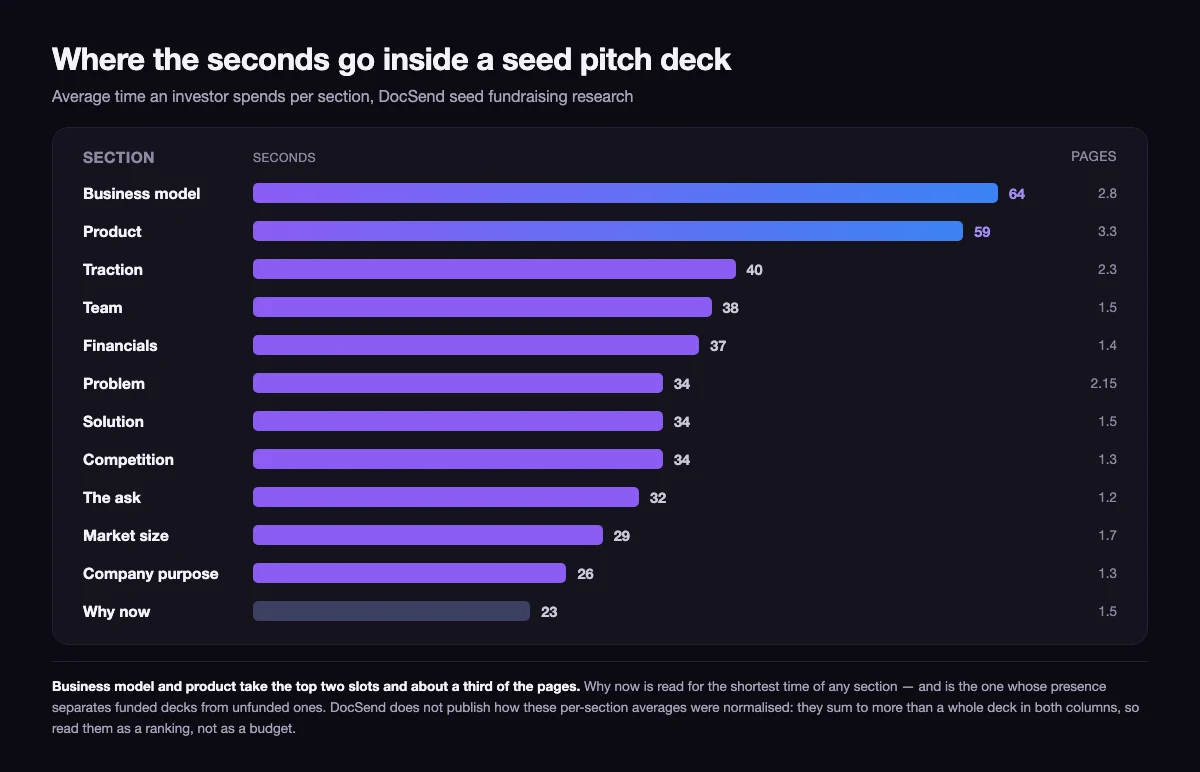
What differs between decks is not the sections but the weight. DocSend’s seed research measured how long investors spent inside each section of a seed deck, and how many pages founders gave it:
| Section | Seconds, seed | Pages, average | The one question it has to answer |
|---|---|---|---|
| Business model | 64 | 2.8 | Who pays, how much, how often |
| Product | 59 | 3.3 | What the thing does when you use it |
| Traction | 40 | 2.3 | What has already happened without money |
| Team | 38 | 1.5 | Why these people finish this |
| Financials | 37 | 1.4 | What the money turns into |
| Problem | 34 | 2.15 | Whose pain, and what it costs them today |
| Solution | 34 | 1.5 | The mechanism that removes that cost |
| Competition | 34 | 1.3 | What the buyer uses instead of you |
| The ask | 32 | 1.2 | How much, for how long, to reach what |
| Market size | 29 | 1.7 | How many buyers, at what price |
| Company purpose | 26 | 1.3 | What this company is, in one sentence |
| Why now | 23 | 1.5 | What changed, and when |
At pre-seed only the top two hold. Business model runs 83 seconds and product 77, but competition jumps to third at 55 seconds while traction falls to tenth at 37, across an 18-page deck. Business model and product lead at both stages, and together they take about a third of the pages founders write.
One qualifier, because it matters. These per-section figures do not add up to a deck, in either column. Summed, the seed seconds come to seven and a half minutes, while DocSend puts total review time for those same seed decks at 3 minutes 44 seconds, and only 58% of decks are viewed all the way to the end. The pages column sums to about 22 against an observed seed deck of 19.5 pages. DocSend does not publish how these per-section averages were normalised, so read the table as a ranking of relative attention and typical section weight, not as a stopwatch or a page budget you can allocate.
Attention is not approval: where dwell time means the opposite
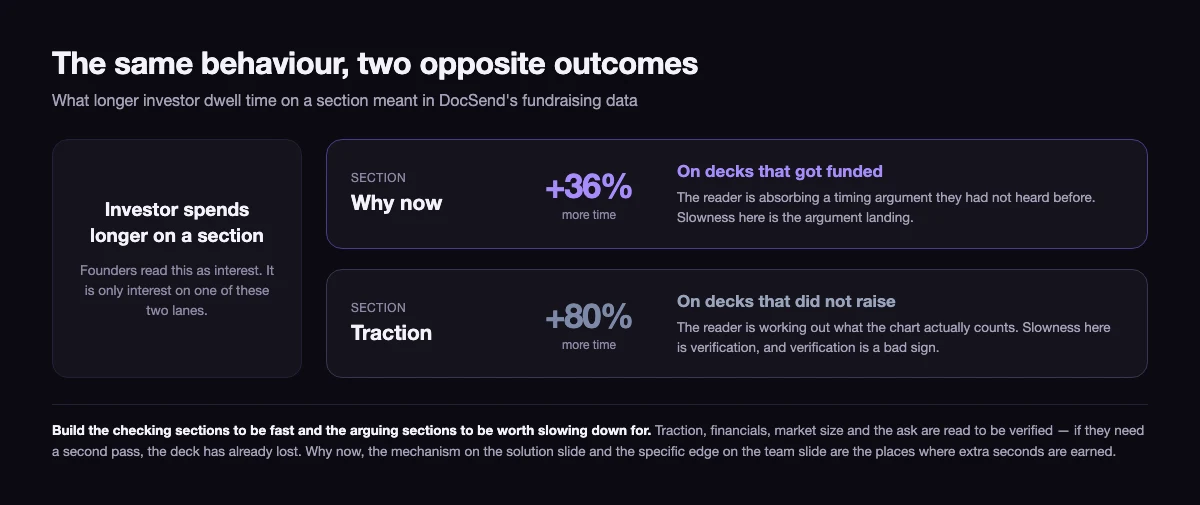
Founders read “investors spent longer on this slide” as a compliment. In DocSend’s data it points in two different directions depending on which slide it is, and this is the single most useful thing in the numbers.
On the why now section, investors spent 36% more time on decks that ultimately got funded. On traction, they spent 80% more time on companies that did not successfully raise. Same behaviour, opposite outcome.
The mechanism is not mysterious once you separate two reasons a reader slows down. One is interest: the argument is new, so it takes a moment to absorb. The other is verification: the chart does not say what it appears to say, so the reader goes back to work out what is being counted. A timing argument earns the first. A cumulative revenue curve with no axis labels earns the second.
That gives a practical build rule. Sections that should be fast are the ones where the reader is checking, not learning: traction, financials, market size, the ask. If someone has to reread them, you have lost, whatever the dwell time says. Sections that can afford to be slow are the ones carrying an argument they have not heard: why now, the mechanism on your solution slide, the specific edge on the team slide.
Slide by slide: the line that kills each one
Lists of what to include are everywhere. What follows is the other side: the formulation that, in each section, makes a reader stop arguing with you and start closing the file.
| Section | The line that kills it | What replaces it |
|---|---|---|
| Company purpose | “Our mission is to empower…” | One declarative sentence naming what you do and for whom. Sequoia’s instruction is literally a single sentence |
| Problem | “The $400bn industry is broken and outdated” | A named buyer, what they do today instead, and what that workaround costs them per month |
| Solution | A feature list, or “AI-powered platform for…” | The one mechanism that removes the cost you just named. Features belong on the product pages |
| Why now | “The market is growing fast” | The change, its date, and why this was not buildable three years ago |
| Market size | A top-down “$X billion TAM” lifted from a report | Buyers you can count, times a price you already charge, with the source of the buyer count |
| Competition | “We have no direct competitors”, or a 2×2 with you alone in the top right | Incumbents plus the real default — a spreadsheet, an agency, doing nothing — and one axis where you lose |
| Product | A guided tour of every screen | Three screens in the order a user meets them, each captioned with what the user achieved |
| Business model | Pricing with no unit attached | Price per unit, who signs, how often they pay again. This gets the most attention of any section |
| Traction | A cumulative chart, or “500k impressions” | The same defined metric over consecutive periods, and the definition next to it |
| Team | Titles, logos, and “passionate about” | For each founder: the specific thing they did before that this company needs |
| Financials | A hockey stick with the assumptions off-slide | Three drivers, their current values, and what each has to reach |
| The ask | “Raising $2M” | Amount, months of runway, and the one milestone that money is meant to prove |
Two of these deserve their own section, because people search for them separately and because both are usually written last, at midnight, by someone who has stopped thinking.
The why now slide: the least-read section that separates funded from unfunded
Why now is the section investors spend the least time inside — 23 seconds at seed. It is also the one whose presence tracks most clearly with outcome. In DocSend’s 2020 fundraising data, a why now section appeared in 54% of successful decks and 38% of unsuccessful ones. By the seed report covering the second half of 2022 and the first half of 2023, VC time spent on that section had risen 65% year over year, in a period when total deck review time fell about 20%.
A short read is not the same as a cheap one. Twenty-three seconds is what it takes to check whether a claim is real. The reason so many why now slides are empty is that they answer a different question — how big the market is, or how fast it is growing — when the question is what changed.
DocSend’s own test for the slide is the best one published: ask whether it would also have been true five years ago, and whether it will still be true in five years. Answer yes to either and it is not a timing argument. Market growth passes both tests, which is exactly why it fails as a why now.
Real timing arguments come in a small number of shapes, and naming the shape forces the specifics:
- A capability crossed a price or performance threshold. Not “AI is advancing” but the date a specific capability became affordable enough for your unit economics to work.
- A rule changed. A regulation, standard or platform policy with a commencement date, and the population it now applies to.
- Behaviour shifted permanently. A change in how buyers work that has survived long enough to be a baseline rather than a spike.
- A dependency arrived. Infrastructure, a distribution channel or a data source that did not exist for the previous cohort that tried this.
Each of those can be stated with a date and a number. If yours cannot, the timing claim is decoration, and the twenty-three seconds are being spent finding that out.
The team slide: what makes an investor stop reading
The team section is close to universal — DocSend records team sections in almost every pre-seed and seed deck it measured, and in its 2019 seed analysis the team slide was the only element that every successful deck contained. On successful pre-seed decks it takes about 15% of total deck time, and it is written with about 80 words against roughly 50 on other slides. It is the wordiest slide in the document and, in most decks, the one carrying the least information per word.
What kills it is a formulation, not a layout. Three appear over and over:
Titles instead of evidence. “CTO”, “Head of Growth” and “Co-founder” describe the org chart of a company that does not exist yet. The reader is trying to establish one thing: whether this specific group has already done the hard part of this specific problem. A title cannot answer that. A sentence like “built and ran the payments integration for 4,000 merchants at [company]” can, and it is shorter than the bio it replaces.
Passion where a track record should be. “Passionate about fixing healthcare” is a sentence available to everyone reading the deck, including the investor. It occupies the position where a differentiator was expected and hands back nothing, which is worse than leaving the line blank.
Advisors used as ballast. A row of well-known faces under a heading that does not say what they actually do makes the reader ask how much time these people really give — a question you cannot answer from inside a PDF. If an advisor has committed real hours, say the hours. If not, the logos cost you credibility on the slide that exists to establish it.
The same discipline applies to gaps. A missing function stated openly (“no in-house sales yet; the ask covers the first two hires”) reads as a plan. The same gap left for the reader to notice reads as something you either did not see or hoped they would not.
How many slides: the three rules people will quote at you
Three widely repeated answers exist, and they disagree because they describe different objects.
| Rule | Says | What it actually describes |
|---|---|---|
| Kawasaki’s 10/20/30 | Ten slides, twenty minutes, thirty-point font | A deck you present out loud in a room, with you there to answer |
| Sequoia’s outline | Ten sections, one per topic | The argument’s structure, not its page count |
| DocSend’s observed decks | 18 to 20 pages, about twelve sections | What founders actually send, measured after the fact |
There is no contradiction to resolve. Twelve sections spread over 18 to 20 pages is the normal state of affairs, because product, problem and business model each routinely need two to three pages. The count that matters is not slides but arguments: one page should advance exactly one, and a page that advances none should be deleted no matter how good it looks.
Kawasaki’s thirty-point font rule has aged better than his slide count. It is a proxy for word count, and it survives the move from stage to inbox intact.
Your deck is read, not presented — and that changes the build
Every published measurement of how long an investor spends on a deck lands in single-digit minutes. DocSend’s 2015 study of more than 200 decks, run with Harvard’s Tom Eisenmann, put it at 3 minutes 44 seconds, and DocSend still publishes that figure as the seed average. Its separate tracker of deck interactions, which covers all decks rather than seed alone, ran between 2 minutes 30 and 2 minutes 18 through 2023 and 2024. Over the same stretch the number of investors a founder contacts went up — from 48 in 2022 to 66 in 2023 in DocSend’s seed data.
More recipients, a few minutes each. Three consequences follow, and they are build decisions rather than design taste:
- Every page has to work without narration. The version you present and the version you send are not the same file. If a page only makes sense when you talk over it, the sent version needs a caption that says the thing you would have said.
- Order is doing more work than it used to. With 42% of decks never read to the end, anything that only appears on page 17 may as well not be in the document. If traction is your strongest argument, it does not wait its turn.
- The deck has to survive being forwarded. It reaches the partner who did not meet you, with no covering note. Getting a document to argue for itself in front of a stranger is the same problem as writing a pitch a journalist will act on — one reader, no follow-up question, a decision made in seconds.
None of this is an argument for a prettier deck. It is an argument for a deck built as a document, where the sequence carries the reasoning and the visual work exists to make each claim land in one glance rather than to decorate it. That is what presentation design is for, and it is a different job from making slides look expensive.
A sales deck is built on a different spine — it argues that a buyer should purchase something now, not that an investor should fund a company — and the sections do not map across, so borrowing structure between the two is where most repurposed decks go wrong.
Sources
Figures cited above come from DocSend’s fundraising research: the 2015 study of 200+ decks conducted with Prof. Tom Eisenmann of Harvard Business School and reported by TechCrunch in June 2015; DocSend’s undated seed and pre-seed pitch deck analyses, which supply the per-section timings, page counts and inclusion rates; DocSend’s separate write-up of the pre-seed team slide, source of the 15% and the word counts; DocSend’s 2020 Startup Index, source of the why now comparison; DocSend’s seed report of 7 December 2023, covering 170 seed decks from the second half of 2022 and first half of 2023; and DocSend’s Pitch Deck Metrics tracker, whose published entries run from 2022 to September 2024. The slide outline is Sequoia Capital’s published business plan template. The 10/20/30 rule is Guy Kawasaki’s, published on his own site and last updated in October 2021.
09 / Reader questions
Frequently asked questions
01What do I include in a pitch deck?
Twelve sections cover an early-stage investor deck: company purpose, problem, solution, why now, market size, competition, product, business model, traction, team, financials and the ask. Sequoia Capital's own template runs to ten sections, nine of them on this list, and closes with vision instead of a separate ask. Most seed decks run 18 to 20 pages because several sections take more than one page.
02What is the 10/20/30 rule for a pitch deck?
Guy Kawasaki's rule, published on his own site and last updated in October 2021, says a pitch should have ten slides, last no more than twenty minutes, and contain no font smaller than thirty points. It describes a deck you present out loud in a room. A deck sent by email is read in a few minutes without you, so the ten-slide limit rarely survives contact with a document that has to explain itself.
03Is a pitch deck just a PowerPoint?
A pitch deck is a specific document, not a file format. It argues one thing — that this company is worth funding now — in a fixed sequence a reader can follow alone. The file can be PowerPoint, Keynote, Google Slides or a PDF, and PDF is what usually gets sent because it renders the same everywhere and cannot be edited by the recipient.
04What should you avoid in a pitch deck?
Avoid an industry-level problem with no named victim, a top-down market size with no bottom-up path to it, a competition slide where you win on axes you chose, cumulative charts on traction, and a team slide made of titles. Each of these reads as an answer that avoids a question, and the reader has no way to ask you a follow-up.
05What is the purpose of a pitch deck?
The purpose of a pitch deck is to get the next meeting, not to close the round. It gives an investor enough to decide whether to spend an hour with you, which is why it is optimised for a first read of two to four minutes rather than for completeness. Diligence documents come later and answer different questions.
06How many slides should a pitch deck have?
Eighteen to twenty pages is the observed norm for pre-seed and seed decks in DocSend's fundraising research, spread across roughly twelve sections. That is higher than the ten-slide rules because product, problem and business model routinely take two to three pages each. Page count matters far less than whether every page carries an argument.
07What is a why now slide in a pitch deck?
A why now slide explains what changed recently that makes this company possible or necessary today, when it was not three years ago. It appeared in 54% of successful decks in DocSend's 2020 fundraising data against 38% of unsuccessful ones, and it is the section founders most often leave as a restatement of market growth.