Published
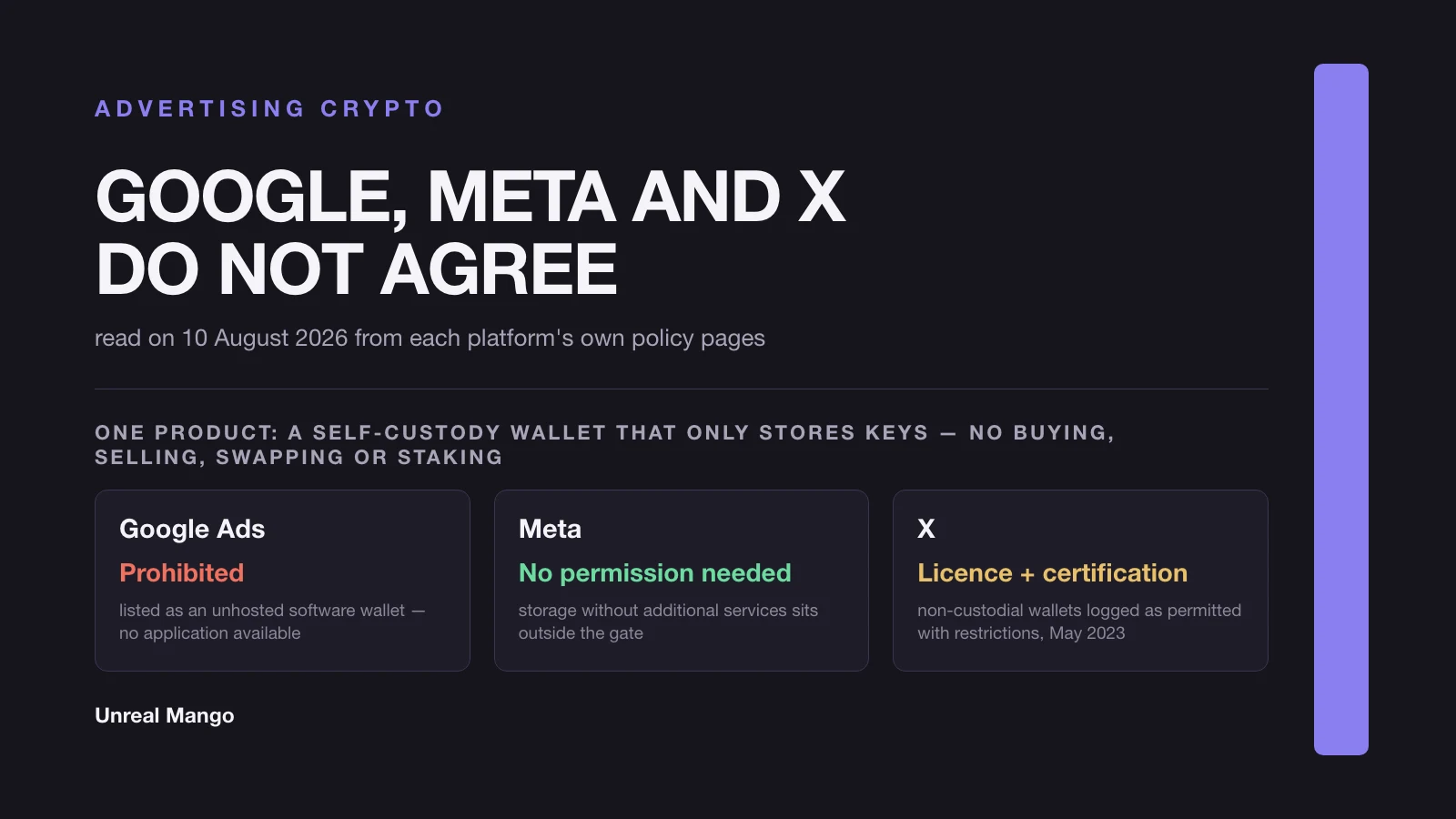
Google, Meta and X each publish a crypto advertising policy, and they do not agree. The same self-custody wallet is prohibited on Google, needs no permission on Meta, and is licence-gated on X. Before writing a single ad, the question worth answering is which platform will run your specific product at all.
How this was checked. Every rule below was read from the platforms’ own policy pages on 10 August 2026: Google’s Cryptocurrencies and related products policy plus its August 2026 and July 2026 change-log entries, Meta’s Cryptocurrency Products and Services standard in the Transparency Centre together with its Financial and Insurance Products and Services standard, and X’s Financial services ads policy, its Cryptocurrency Advertising Terms and Conditions, and its Ads Policy Update Log. Dates are given for every rule that carries one, because two of the three platforms changed their crypto text in 2026. For this query in the United States on the same day, Google’s first page was dominated by crypto ad networks selling inventory, with a single policy article and a People Also Ask entry asking whether advertising crypto is legal at all. That policy article compares the three platforms in prose. It carries no per-country licence table, no product-by-product grid, and no date. Those three things are what this page adds.
The same product, three different answers
Read across a row and you get the shortest useful answer in this whole category: your product does not have one status, it has three. “Not named” means the platform’s policy does not address that product, which is a different risk from a prohibition and is worth tracking separately.
| Product | Google Ads | Meta | X |
|---|---|---|---|
| Custodial exchange or trading platform | Application approved + licensed provider | Written permission + licence | Certification + country licence |
| Wallet that also buys, sells, swaps or stakes | Application approved + licensed provider | Written permission + licence | Certification + country licence |
| Self-custody wallet that only stores keys | Prohibited as an unhosted software wallet | No permission needed | Certification + country licence |
| Hardware wallet | Application approved, no licence required | No permission needed | Certification + country licence |
| Mining hardware | Allowed, no application | No permission needed | Prohibited |
| Mining software | Not named | Written permission + licence | Prohibited |
| DeFi lending, dApps, decentralised exchanges | Prohibited — DeFi trading protocols, crypto loans and unregulated dApps are named | Lending and borrowing need written permission | Certification + country licence |
| ICO, IEO, IDO and token liquidity pools | Prohibited for ICOs, Initial DEX offerings and token liquidity pools; IEO not named | Prohibited — ICOs are banned outright under Meta’s financial standard | Prohibited for ICO, IEO and IDExO |
| Crypto Contracts for Difference | Not named as CFDs; caught by the blanket ban on “the purchase, sale, or trade of cryptocurrencies or related products” | Prohibited under Meta’s financial standard | Certification + country licence |
| Affiliate, aggregator and comparison sites | Prohibited | Written permission + licence | Not named under the crypto section; financial aggregators permitted in five countries only |
| Trading signals and investment advice | Prohibited | Investment solicitation needs written permission | Permitted with restrictions under financial services |
| NFTs and NFT marketplaces | Marketplaces not named; NFT games allowed, NFT wagering and NFT-rewarding social casino games prohibited | No permission needed | Permitted, no licensing requirement |
| Crypto tax tooling | Allowed, no application | No permission needed | Certification + country licence for tax calculators |
| Education and news | Allowed as education, with conditions | No permission needed | Permitted as educational content, no licensing requirement |
Three rows in that grid are worth reading twice, because each of them sends the same business to a different platform.
The self-custody wallet. Google’s prohibited list names “unhosted software wallets” alongside ICOs and token liquidity pools — flat prohibition, no application available. Meta’s no-permission list names wallets “that allow people to store cryptocurrency but don’t offer additional services, such as buying, selling, swapping or staking”. X went the third way and logged non-custodial wallet services as permitted with restrictions in May 2023. Note the two different tests behind those three answers: Google and X sort wallets by custody, Meta sorts them by the services attached, so a custodial storage-only wallet lands in Google’s application queue rather than in its prohibited list. A hardware wallet, meanwhile, is the one product Google will certify without asking for a licence at all.
Mining. Google allows mining hardware outright and does not name mining software anywhere in the policy. Meta allows the rigs and gates the software behind written permission. X prohibits the category as a whole, in language that leaves no room: “Cryptocurrency mining including hardware and software services associated with mining.”
The affiliate site. Google prohibits ad destinations “that aggregate or compare issuers of cryptocurrencies or related products”, naming trading signals, investment advice and broker-review affiliate sites. Meta puts affiliate and aggregator sites inside the written-permission category instead — the same business model, one platform’s outright ban and another’s paperwork. X does not rule on crypto affiliates in its crypto section at all; its nearest clause covers financial aggregators generally and permits them only in Australia, France, Japan, South Korea and the United States.
Google: an application, a licence, and a closed list of countries
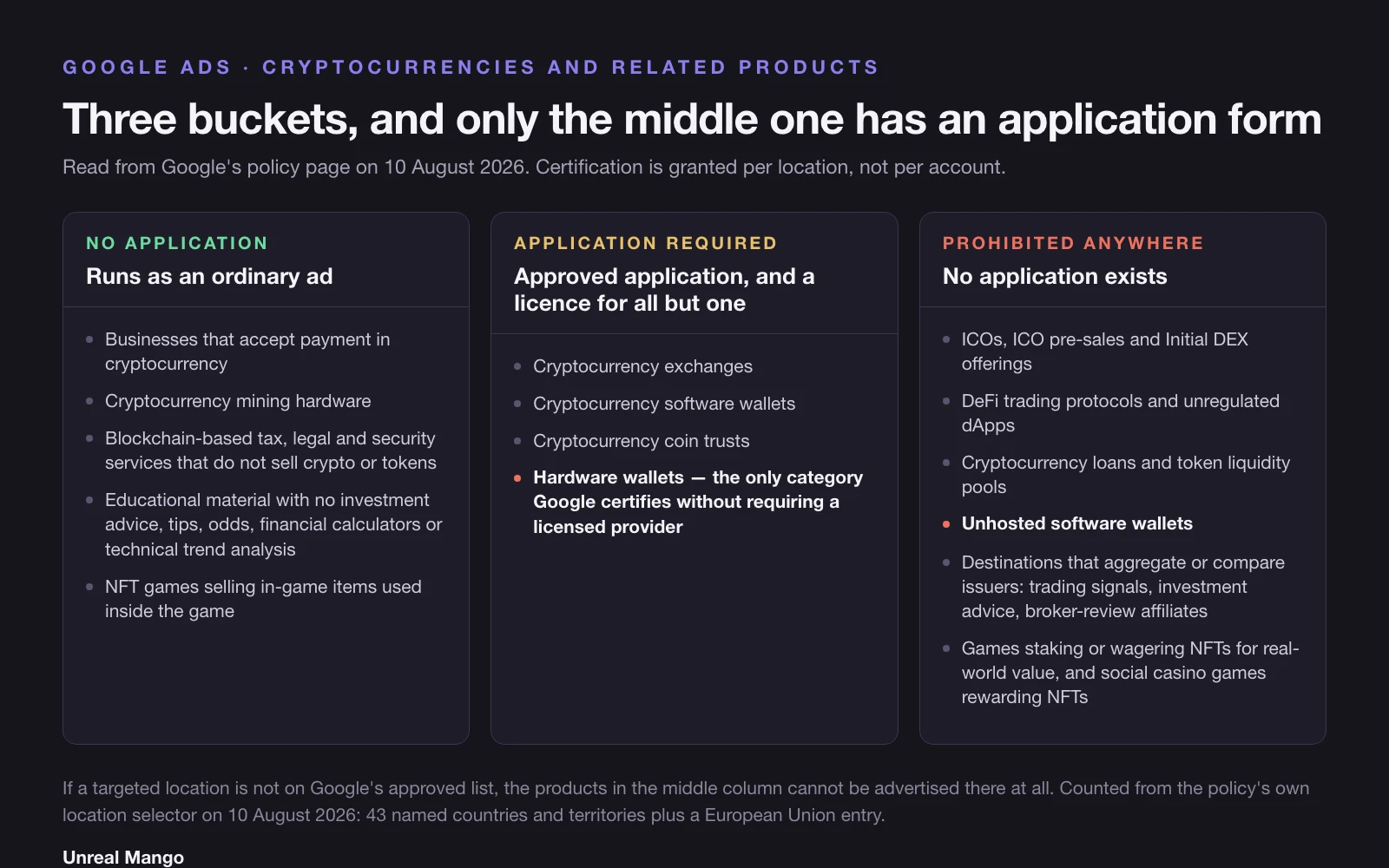
Google splits crypto into three buckets and the boundaries are unusually explicit.
Runs with no application at all: businesses that accept payment in cryptocurrency; mining hardware; tax, legal and security services and platforms that use blockchain but do not market or sell cryptocurrencies or tokens; and educational material, on the condition that it does not offer “investment advice, tips, odds, financial calculators, or technical trend analysis”. NFT games where players buy in-game items that are consumed or used in the game are allowed here too.
Needs an approved application: cryptocurrency exchanges, cryptocurrency software wallets, cryptocurrency coin trusts, and hardware wallets designed only to hold private keys.
Prohibited regardless of where you are: initial coin offerings, DeFi trading protocols, and the purchase, sale or trade of cryptocurrencies, with ICO pre-sales, Initial DEX offerings, cryptocurrency loans, token liquidity pools, unhosted software wallets and unregulated dApps given as examples. Also prohibited: destinations that aggregate or compare issuers, games where NFTs are wagered or staked for anything of real-world value, and social casino games that reward NFTs.
Three mechanics around that structure matter more than the lists themselves.
Certification is per location, not per account. Google’s own instruction is to submit a separate application for each location or group of locations, and since June 2026 those applications are filed inside the Google Ads account — Admin, then Policy, then Account, then Apply for certification — rather than through the Help Center, where they used to live.
The country list is a hard boundary, not a hint. Google states that if a targeted location is not on its list, the products cannot be advertised there and that it does not support advertising in non-approved markets. Counted from the policy’s own location selector on 10 August 2026, that list runs to 43 named countries and territories plus a European Union entry. Australia, Singapore, India, Brazil and New Zealand are not on it in any form. Denmark and Spain have no tab of their own but are covered inside the European Union entry.
Enforcement carries a written warning, which is unusual enough to be worth knowing. The policy states that violations will not lead to immediate account suspension without prior warning, and that a warning will be issued at least seven days before any suspension.
Meta: written permission, and a licence list of 27 jurisdictions
Meta’s structure is simpler and its bar is a document. Advertisers submit “a recognized regulatory license or registration” and obtain written permission through the Authorizations and Verifications tab in Meta Business Suite. The mechanics of Meta’s permission flow, and its habit of gating a whole account rather than a single creative, are the same ones that govern regulated healthcare advertising on the platform; this section covers only what is specific to crypto.
Written permission is required for five things: exchanges and trading platforms, including spot, margin and futures trading; crypto borrowing or lending; wallets that offer additional services such as buying, selling, swapping or staking; mining software; and crypto investment solicitation, which Meta defines to include affiliate and aggregator sites that collect links to partners offering investment opportunities.
Written permission is not required for tax services aimed at crypto companies, events, education or news about crypto and blockchain that do not offer crypto products, blockchain technology news, storage-only wallets, mining hardware such as GPU rigs, blockchain products that are not a virtual currency — Meta names NFTs explicitly here — and crypto products that cannot be used to buy, sell or trade.
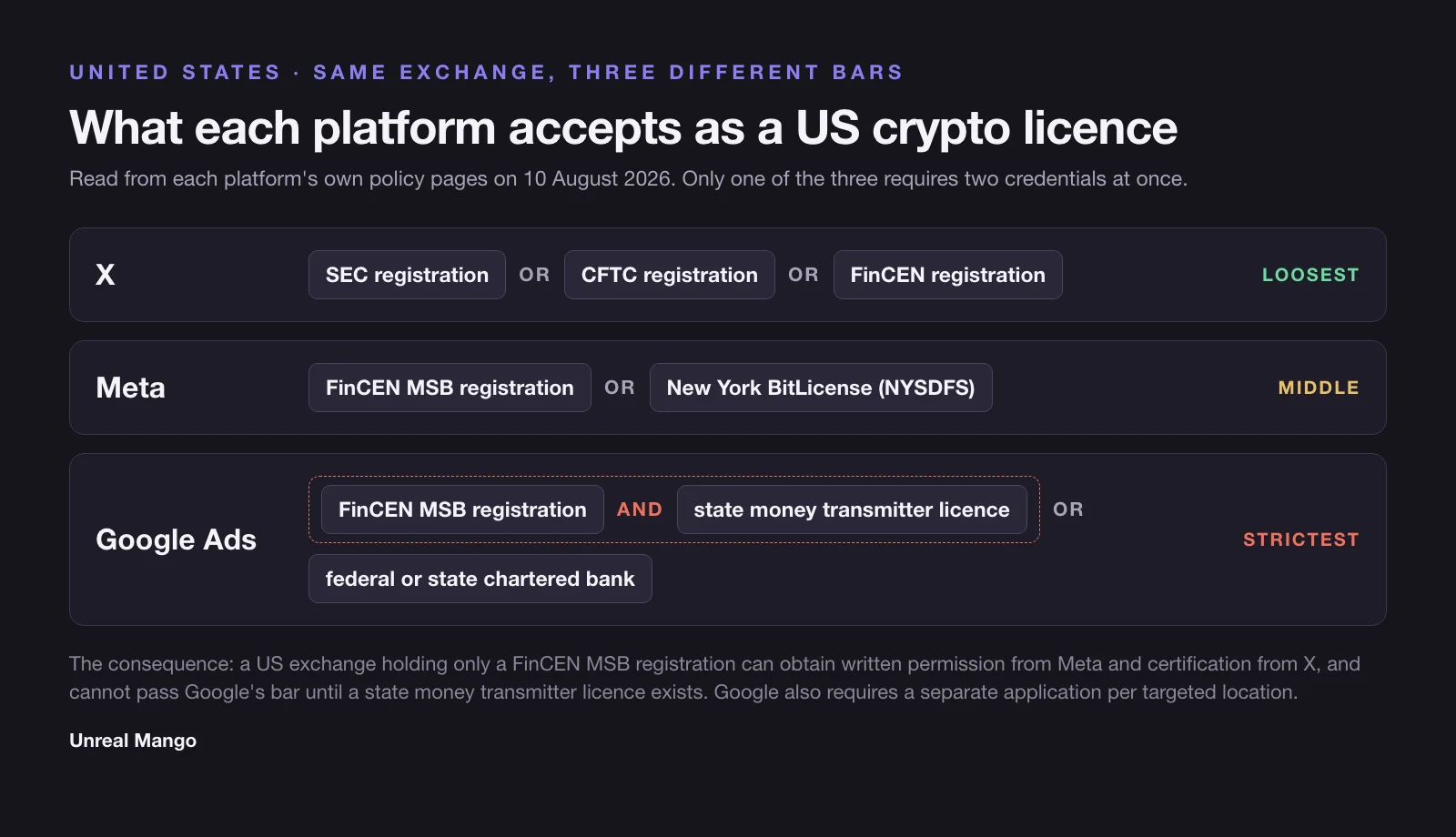
The licence list is where Meta becomes concrete, and it is more useful than any prose summary of it. Meta names an acceptable licence or registration for 27 jurisdictions, and the wording of the United States entry is the single most consequential line on the page for an American exchange: Meta accepts a FinCEN MSB registration or a New York BitLicense. Google, for the same country, requires FinCEN registration and a state money transmitter licence, or else a federal or state chartered bank entity.
That difference is not academic. A US exchange holding only a FinCEN MSB registration can obtain Meta’s written permission and cannot pass Google’s bar. The same asymmetry runs geographically: Australia, Singapore, Malaysia and Gibraltar all appear on Meta’s licence list and none of them is an approved location for Google.
One more thing about Meta is easy to miss and expensive to miss: the crypto rules are spread across two standards, not one. Meta’s Financial and Insurance Products and Services standard carries a “Deceptive and Misleading Financial Instruments” section that prohibits outright, with no permission route, ads promoting initial coin offerings, Contract for Difference trading, binary options and penny auctions. An advertiser who reads only the Cryptocurrency Products and Services page will not find those bans, and will file an authorisation request for a token sale that Meta was never going to approve. The comparison worth holding on to: crypto CFDs are a licensable product on X and a flat prohibition on Meta.
The change log on Meta’s crypto standard is printed at the top of the page and currently shows, most recent first, “Today” plus 15 April 2026, 12 November 2025, 18 July 2024 and 24 March 2023. What the licence list itself says matters more than the dates, and it matters in the next section.
X: the widest product list, the oldest rulebook
X is the only one of the three that will license the DeFi stack. Its permitted-with-restrictions list covers exchanges, wallets, crypto kiosks and ATMs, crypto credit and debit cards, staking, crypto Contracts for Difference, tax calculators, and “decentralized crypto borrowing / lending, DeFi insurance, DApps, and Decentralized exchanges” — a set Google refuses under its bans on DeFi trading protocols, crypto loans and unregulated dApps.
Its prohibitions are narrow by comparison: ICOs, IEOs and initial decentralised exchange offerings, and cryptocurrency mining including hardware and software. Smart contracts and educational content about blockchain, crypto and DeFi run with no licensing requirement. NFTs, NFT marketplaces and the tooling around them — minting, management tools, engines — are permitted with no licensing requirement, though the certification step below still applies and India requires conformance with ASCI’s Virtual Digital Assets guidelines.
Four things about X’s process differ from the other two.
Certification is per category, not per account. X states that a new certification request must be submitted for each category of content under the policy, giving the example that approval for NFTs does not extend to cryptocurrency products or services.
Seven countries are carved out of crypto specifically. X’s financial services list runs to 83 named countries and territories, and then removes Belgium, Greece, Qatar, Russia, Singapore, Slovenia and Ukraine from cryptocurrency and DeFi advertising alone. Singapore is the one to notice: a MAS licence is an accepted credential on Meta’s list and buys nothing on X.
Some countries require a signed attestation with copy rules inside it. X’s Cryptocurrency Advertising Terms and Conditions carry country-specific advertiser attestations for India, Indonesia, Italy, Mexico, Nigeria, South Africa and Vietnam. Several of them constrain the creative directly: the attestations for Italy, Nigeria and South Africa each require that “the ads do not promise users ‘returns,’ ‘profits,’ or ‘gains’” and that ads carry disclaimers informing consumers about the risks of investing, and India’s imposes the same two rules on crypto exchange platforms. That is a creative rule living in a legal document rather than in the ads policy, which is why it tends to be discovered after a rejection rather than before one.
The commercial terms are asymmetric and worth reading before signing. The same document states that no binding agreement exists until X notifies the advertiser that the application has been accepted, that X may remove a crypto advertisement on formal request from a competent authority with no obligation to compensate or return funds, and that X reserves the right to stop accepting crypto advertising as part of the programme at any time.
Set against that breadth is a date. X’s public Ads Policy Update Log records no change to its cryptocurrency rules since September 2024, when South Africa was added. The most recent Financial Products and Services entry, from May 2026, concerns financial aggregators rather than crypto. Google shipped a crypto policy change in July 2026 and another in August 2026; Meta’s crypto standard carries a logged revision in April 2026. Breadth and currency are not the same property.
The licence you hold decides the countries you can buy
This is the table that determines a media plan, and no two platforms fill it in the same way. Entries are the credential each platform names for that market, read on 10 August 2026.
| Market | Google Ads | Meta | X |
|---|---|---|---|
| United States | FinCEN MSB and state money transmitter, or a federal/state chartered bank | FinCEN MSB registration or NY BitLicense | SEC or CFTC or FinCEN registration |
| United Kingdom | FCA registration | FCA authorisation | FCA registration or authorisation; crypto derivatives prohibited |
| EU member states | MiCA CASP authorisation, one route for all 27 | National registrations, named per country: BaFin, CSSF, MFSA, DCB, Banco de España and others | National registrations, named per country: BaFin, DNB, Bank of Portugal, Danish FSA and others |
| France | MiCA CASP only, since 1 July 2026 | AMF Digital Asset Service Provider registration or licence | AMF Digital Asset Service Provider registration or licence |
| Iceland, Liechtenstein, Norway | MiCA CASP, added August 2026 | Norway only: Finanstilsynet registration | Norway only: Finanstilsynet registration |
| Canada | FINTRAC MSB registration | FINTRAC MSB registration | FINTRAC MSB, or Securities Dealer or Marketplace Platform |
| Japan | FSA crypto asset exchange service provider registration | FSA Crypto-Asset Exchange Service Provider registration | FSA CAESP licence |
| Switzerland | FINMA licence for the advertised activity | FINMA Fintech Licence registration | FINMA licence |
| Australia | Not an approved location | AUSTRAC registration, or AFSL / Australian Markets Licence from ASIC | AUSTRAC enrolment and registration; AFSL or exemption-list status (X lists both without saying whether they are cumulative) |
| Singapore | Not an approved location | MAS licence under the Payment Services Act for DPT services | Excluded from crypto and DeFi advertising |
| India | Not an approved location | Not on Meta’s licence list | ASCI Virtual Digital Assets guidelines plus signed attestation |
| Brazil | Not an approved location | Not on Meta’s licence list | Targetable; blockchain games of chance prohibited |
Two readings of that table are more useful than the cells themselves.
The United States row is a strictness ladder, and it runs in the order X, Meta, Google. X accepts registration with any one of three federal bodies. Meta accepts one federal registration or one state licence. Google is the only platform requiring two credentials at once, and the state money transmitter half of it is the part that takes months.
The rest of the world row is a coverage ladder running the other way. X reaches markets Google has never opened — Brazil, India, most of Latin America — and Meta reaches Australia, Singapore, Malaysia and Gibraltar, which Google does not list. An exchange holding only an Australian licence has a Meta plan and an X plan and no Google plan at all. A Singapore-only licensee has a Meta plan and nothing else: Google does not list Singapore, and X removes it from crypto and DeFi advertising specifically.
France, July 2026: one licence expired on one platform and not on the others
The clearest evidence that these three rulebooks drift apart independently is a single French credential.
Google published a change-log entry on 1 July 2026 stating that from that date it would no longer accept the AMF’s Digital Asset Service Provider registration for advertising cryptocurrency exchanges and wallets, and that advertisers must instead be authorised as a Crypto-Asset Service Provider under MiCA. The entry attributes the change to the expiry of France’s transitional period set out in Google’s April 2025 EU update.
As of 10 August 2026, Meta’s crypto standard still lists France as “Digital Asset Service Provider registration or license, Issuer: Autorité des Marchés Financiers (AMF)”, and X’s country-specific crypto policy still says the advertiser holds “a Digital Asset Service Provider registration or license from the Autorité des marchés financiers”. Both entries were still live forty days after Google stopped accepting the same credential.
The practical version: a French advertiser holding only a DASP registration is currently accepted on two platforms and rejected on the third, for a credential that a national regulator has already superseded. This is the normal state of affairs in this category rather than an anomaly, and it is the reason a compliance sheet built once and filed away is worse than useless.
What runs with no licence at all
If the licence is not in hand yet, or the market is not on anyone’s approved list, a narrow band of the category is still buyable without one. The first three rows below run on all three platforms; the rest run on two of the three, and one of them is a flat prohibition on X. Mapping it precisely is worth the effort, because this is where most pre-licence crypto brands should be spending.
| Content type | Status, platform by platform |
|---|---|
| Educational content about blockchain and crypto | Runs on Google, Meta and X with no application or licence |
| Blockchain and crypto news | Named explicitly by Meta; falls inside educational content on Google and X |
| Events and conferences that do not sell crypto products | Explicit on Meta; falls inside education on Google and X |
| Mining hardware | Free on Google and Meta; prohibited on X |
| Crypto tax and legal services | Google names tax and legal services; Meta names tax services only; tax calculators need certification on X |
| Businesses that accept crypto as payment | Explicit on Google; not named by Meta or X |
The one condition to respect is Google’s, because it is the narrowest and the easiest to trip. Educational material is allowed only while it does not offer “investment advice, tips, odds, financial calculators, or technical trend analysis”. A market-commentary blog with a price chart and a projection is not education under that sentence, and the destination is judged as much as the ad. Meta’s version of the same line is that events, education and news qualify “as long as they don’t offer cryptocurrency products or services”.
None of this is a workaround for a missing licence. It is a different funnel with a different job: audience and search demand built before the certified account exists, so that the certified account has something to convert. That sequencing is most of what we actually do on crypto and blockchain accounts, and it is a far better use of a pre-licence quarter than fighting rejections.
Reading a crypto policy at the source, not at second hand
Every rule on this page is dated because every rule on this page will move. Three of the three platforms publish a change record, and reading those directly takes minutes.
- Read the change log before the policy. Google’s Advertising Policies Help Center carries an Upcoming and recent changes section; crypto entries there in 2026 alone cover the EEA expansion and the French licence swap. Meta’s Transparency Centre prints a change log at the top of each standard — the crypto standard currently shows “Today” plus 15 April 2026, 12 November 2025, 18 July 2024 and 24 March 2023, while the financial standard next to it keeps its own log of eight entries, four of which have no counterpart on the crypto page. X publishes an Ads Policy Update Log grouped by year and month.
- Check your own country tab, not the summary. Google’s page changes its content depending on the location selected. The August 2026 EEA wording appears under Iceland, Liechtenstein and Norway; the European Union entry still describes the 27 member states. Reading the wrong tab produces a confidently wrong answer.
- Re-verify the licence, not just the policy. The French case moved because a national transitional period expired, not because a platform changed its mind. National regulators set the clock; the platforms follow at different speeds.
- Treat “not named” as unresolved, not as permitted. Google does not mention mining software. X does not rule on crypto affiliate sites in its crypto section, and the nearest clause it does have — financial aggregators, permitted in five countries — is not obviously the same thing. Silence in a policy is a category that has not been ruled on, and it is usually resolved by a rejection rather than by an update.
- Read the neighbouring standard, not just the crypto one. Meta’s flat bans on initial coin offerings and Contract for Difference trading are not on its cryptocurrency page at all; they sit in the Financial and Insurance Products and Services standard next door.
- Assume the approval is per something. Per location on Google, per category on X, per licence document on Meta. Nobody grants a blanket crypto approval, and budgets planned as though they do end up stranded.
Once an account is certified, the reporting problem arrives immediately behind the policy one, because crypto advertisers rarely get clean browser-side attribution; that is a server-side tracking question rather than a policy one.
Where this guide stops
Everything above describes what three advertising platforms will accept. It is not investment advice, not an assessment of any project, token or exchange, and not a legal opinion. Platform approval and legal compliance are separate tests: X’s own terms make the advertiser warrant that its ads comply with all applicable laws and carry every disclaimer those laws require, and Google states plainly that advertisers must do their own research on local regulations for any location they target. National advertising regulators, financial promotion regimes and consumer-protection rules apply whether or not a creative was approved. Read an approval as a platform decision, and nothing more.
10 / Reader questions
Frequently asked questions
01Is it legal to advertise crypto?
In most large markets yes, but legality is not the gate you hit first. Google, Meta and X each run their own crypto policy on top of national law, and all three require an approval step before a licensed exchange or wallet can buy a single impression. A product can be perfectly legal in a country and still be unbuyable there because the platform has not opened that location.
02Can you advertise crypto on Facebook and Instagram?
Yes, with prior written permission from Meta. Exchanges and trading platforms, crypto borrowing or lending, wallets that also buy, sell, swap or stake, mining software, and affiliate or aggregator sites all need it. Permission is requested in the Authorizations and Verifications tab of Meta Business Suite and requires a regulatory licence from Meta's published list of 27 jurisdictions.
03Can you advertise crypto on Google Ads without a licence?
Only outside the gated categories. Google runs crypto education, mining hardware, blockchain-based tax, legal and security services, businesses that accept crypto as payment, and NFT games without any application. Exchanges, software wallets, coin trusts and hardware wallets need an approved application, and everything except hardware wallets also needs you to be a licensed provider.
04Does Google Ads crypto certification cover every country?
No. Certification is granted per location, and Google's policy says to submit a separate application for each location or group of locations you want to target. Google also lists the countries and territories that are eligible at all; if your market is not on that list, the product cannot be advertised there, certified or not.
05Can you advertise crypto on X (Twitter)?
Yes, for a wider product set than Google allows, once you hold the country licence X names and X has certified you. X permits exchanges, wallets, kiosks and ATMs, crypto cards, staking, crypto CFDs, tax calculators and DeFi lending, insurance, dApps and decentralised exchanges. Certification is per content category, so NFT approval does not extend to cryptocurrency.
06Are NFT ads treated the same as crypto ads?
No, and the gap is wide. X permits NFTs and NFT marketplaces with no licensing requirement, and Meta states that blockchain products that are not a virtual currency, naming NFTs, need no written permission. Google is narrower: NFT games are allowed, but games where NFTs are staked or wagered for real-world value are prohibited outright.
07Can you advertise crypto mining?
It depends which platform and whether you mean hardware or software. Google allows mining hardware with no application. Meta allows mining hardware with no permission but requires written permission for mining software. X prohibits cryptocurrency mining outright, explicitly including hardware and software services associated with mining.