Published
Meta does not run one health advertising rule. A clinic ad is checked against four separate standards. The one that rejects the most clinic copy says nothing about medicine at all — it bans implying you know something about the viewer. Two others never reach the copy: they decide whether the category may run.
How this was checked. Every rule below was read from Meta’s Transparency Centre and developer documentation on 10 August 2026, and each section names the standard it comes from. For this query in the United States on the same day, Google returned an AI Overview, a People Also Ask block, a video pack, and an organic set where the top three results are Meta’s own policy pages and the rest are agency service pages. Those Meta pages are accurate and separate: none of them cross-references the others, and none maps a rejection back to the wording that caused it. That map is what this page adds.
Four standards decide whether a health ad runs
Two of them only ever judge the asset. The other two can stop a category before anyone reads the copy — and Drugs and pharmaceuticals does both, depending on the product.
| Standard | What it judges | Where it bites |
|---|---|---|
| Health and Wellness | Claims and imagery in weight, cosmetic, supplement, sexual and reproductive ads | The creative, plus a mandatory 18+ floor on the ad set |
| Privacy violations and personal attributes | Whether the copy asserts or implies something about the person seeing it | The creative |
| Drugs and pharmaceuticals | Prescription medicines and CBD are account-gated; over-the-counter medicines and hemp carry rules but no gate | The account for the gated two, the creative for the rest |
| Drug and alcohol addiction treatment | Rehab, hotlines, mutual support groups and recovery apps in the United States | The account, before delivery |
The practical consequence is that identical-looking rejections have different fixes. A claim or personal attributes rejection is a rewrite. An age rejection is a targeting change. A prescription, addiction treatment or CBD rejection usually means certification — and the exceptions there are narrow and written into the standards themselves, which is why the sections below quote them.
The before-and-after rule that changed under everyone’s feet
The most repeated piece of advice in this niche is that Meta bans before-and-after imagery. Read the current Health and Wellness standard and that is not what it says.
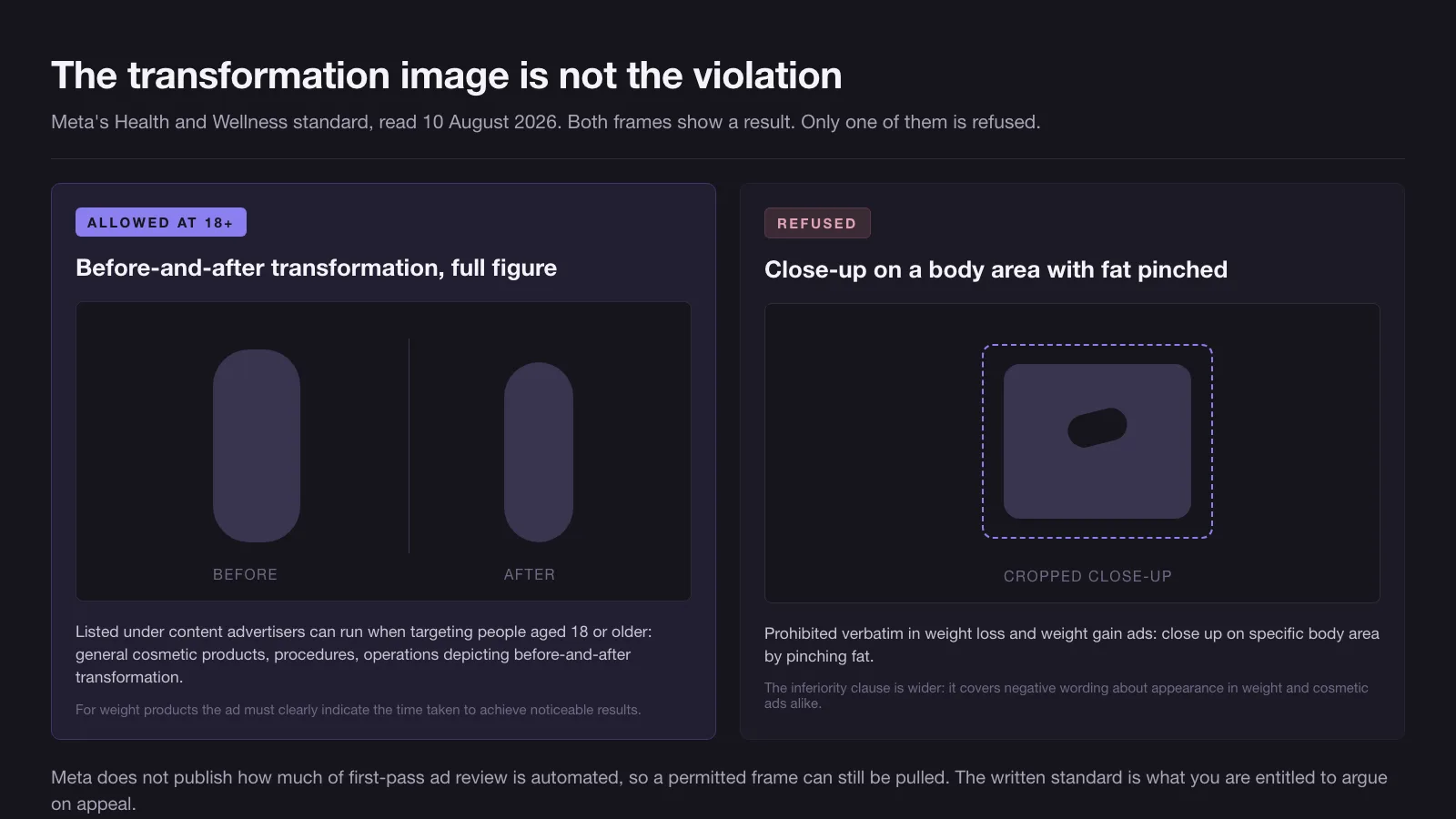
Under the content advertisers can run when targeting people aged 18 or older, the standard lists cosmetic products, procedures and surgeries by name, including breast augmentation, abdominoplasty, rhinoplasty, dermal fillers, chemical peels and micropigmentation, and then adds a separate line for “general cosmetic products, procedures, operations depicting before-and-after transformation”. For dietary weight loss or weight gain products, the same section allows an ad to “illustrate people using the product or the service and the impact of using it”, on the condition that it clearly indicates the time taken to achieve noticeable results.
What is prohibited sits immediately next to it, and each clause has its own scope:
- In weight loss, weight gain or cosmetic ads: statements of inferiority about physical appearance, defined as terms, descriptions or questions that are negative and attack an individual’s appearance, specific body parts or hygiene.
- In weight loss or weight gain ads specifically: a close-up on a specific body area with fat being pinched, and claims that results can be achieved solely by using wearable products.
- Regardless of category: promoting skin whitening or bleaching products that cause permanent skin colour change.
So the transformation image is not the violation. The framing around it usually is: a pinch shot instead of a full figure, a headline built out of what is wrong with the reader’s body, or a result promised inside a fixed window with nothing qualifying it.
Two caveats worth stating plainly. Meta’s change log for this standard lists revisions on 26 December 2024 and 22 July 2026, so the text quoted here is a snapshot dated 10 August 2026 and needs re-reading before any campaign is built on it. And Meta’s policy pages describe a review team of more than 15,000 people without saying how much of first-pass ad review is automated; either way, the written standard describes what you are entitled to argue on appeal, not what a first-pass decision will be.
“Do you have diabetes?” and the personal attributes trap
This is the standard that catches clinics hardest, because the offending sentence usually reads like ordinary empathetic marketing.
Meta’s Privacy violations and personal attributes standard prohibits ads that assert or imply personal attributes, and its list is long: race, ethnicity, religion, beliefs, age, sexual orientation or practices, gender identity, disability, physical or mental health including medical conditions, vulnerable financial status, voting status, membership in a trade union, criminal record and name. Specifically, ads cannot share or ask for a person’s attributes, imply that the advertiser is aware of them, or imply knowledge of medical information about a user or their family.
The line is grammatical, not clinical. You may name a condition. You may not attribute it to the reader. Meta publishes allowed and refused strings under each attribute heading; lined up side by side they are the cheapest QA checklist available for a health advertiser:
| Refused | Allowed | Attribute |
|---|---|---|
| “Do you have diabetes?” | “New diabetes treatment available” | Physical or mental health |
| “Depression getting you down? Get help now.” | “Depression counselling” | Physical or mental health |
| “Ready to upgrade your skin to look younger?” | “Our new lotion and creams fight wrinkles like never before!” | Age |
| “Are you 18 years old?” | “Meet seniors” | Age |
| “Questioning your gender identity?” | “A monthly meet-up for trans persons and trans allies” | Gender identity |
One example on Meta’s page is worth knowing about before you build a rule on it. The string “Don’t wait!! Get your spouse treated for cancer today with help from our medical experts” appears twice: as a refused example under physical or mental health, and as an allowed example under vulnerable financial status. The health listing is plainly the intended one — the sentence implies knowledge of a family member’s condition — but the page contradicts itself, so treat family-condition copy as refused and do not cite the second listing at anyone.
The same standard sets out what is still available. Ads can carry a passing reference to a personal attribute including gender, age groups or age ranges; they can use “you” and “your” as long as no attribute is attached; and they can make public service announcements about health issues, provided they stop short of asserting that someone or their family has a condition. Meta’s own summary of the fix is one sentence long: ads should focus on the benefits of the product or service being advertised.
Health claims Meta refuses in any wording
Six prohibitions in the Health and Wellness standard apply regardless of how a sentence is constructed or who is credited with saying it. They fall into four families.
Cure claims on eleven named conditions. Ads cannot claim to cure, heal or eliminate any of an exhaustive list: diabetes, herpes, thyroid, psoriasis, Ebola, cancer, autism, Alzheimer’s, Parkinson’s, motor neurone disease and HIV. The standard states explicitly that this applies to claims from health professionals and health organisations, so a clinician’s credentials are not an exemption. It also carves out the workable alternative: the prohibition “does not apply to claims about treating or managing symptoms of these conditions”.
Clickbait in a health, weight loss or weight gain context. Sensational language with exaggerated or extreme claims, and promises of specific outcomes within a set time frame without disclaimers or qualifiers.
Appearance-based prohibitions in weight or cosmetic ads. Negative terms, descriptions or questions aimed at someone’s appearance, body parts or hygiene; and, in weight loss or weight gain ads, a close-up on a specific body area with fat being pinched.
Attribution to the wrong thing. In weight ads, claims that results can be achieved solely by using wearable products; and, as a product ban rather than a claim ban, promoting skin whitening or bleaching products that cause permanent skin colour change.
Note the asymmetry between the first two families. “Cures diabetes” fails on the condition list. “Clears your skin in 14 days, guaranteed” fails as clickbait: a specific outcome inside a set time frame with nothing qualifying it. Stating a timeframe is not itself the problem — for dietary weight products the standard requires it. Selling it as a guarantee is. Both are content rejections, and both are fixable in a rewrite.
The categories that need permission before the first impression
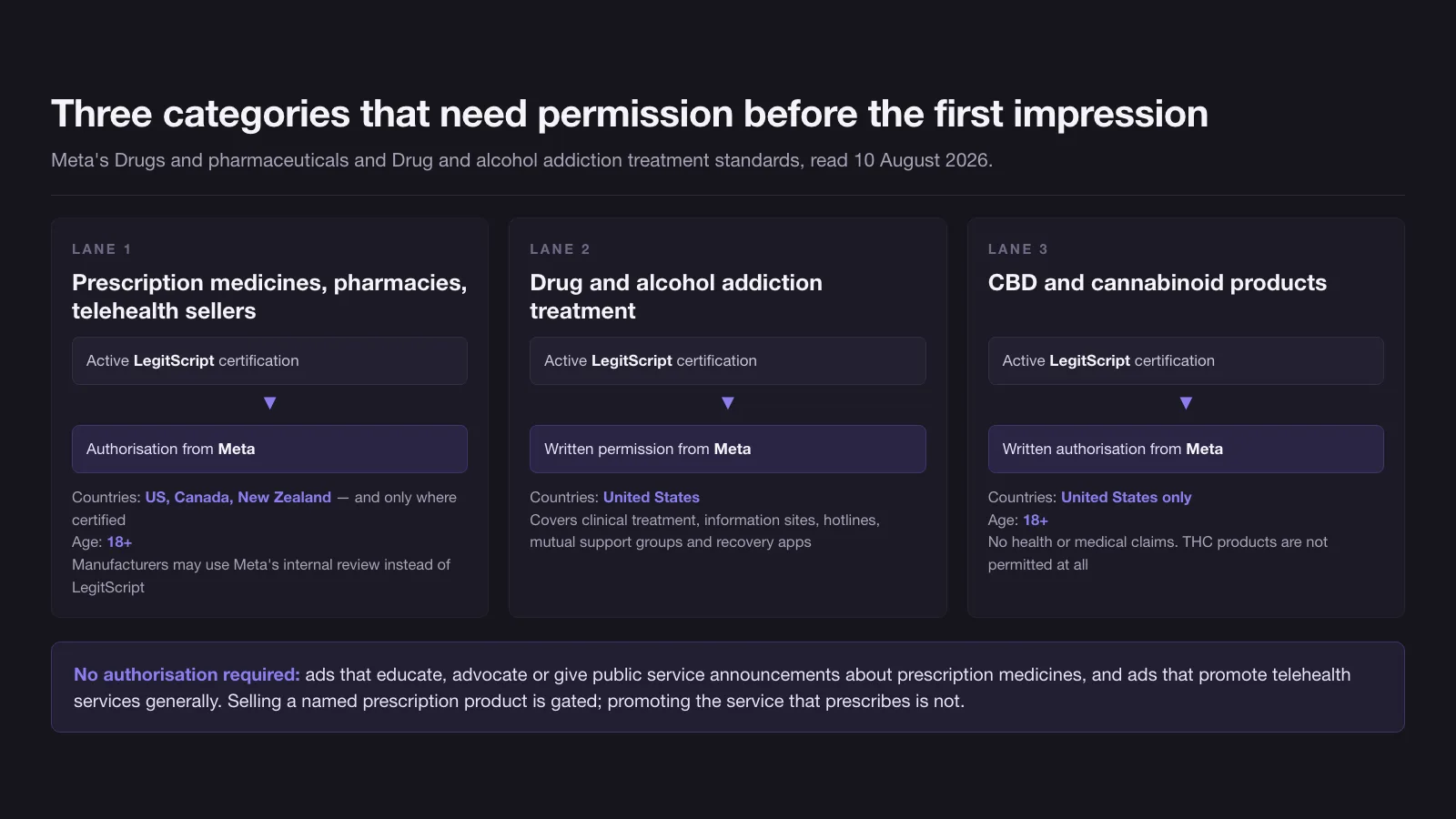
Three of the categories below fail before review, and the route through is certification or, for pharmaceutical manufacturers, Meta’s internal review. Over-the-counter medicines and hemp are listed with them because advertisers routinely assume they are gated when they are not. THC is listed because no gate exists for it at any price.
| Category | Gate | Countries | Age |
|---|---|---|---|
| Prescription medicines, online pharmacies and telehealth sellers | Active LegitScript certification, authorisation from Meta, Meta’s prescription onboarding, and a disclaimer to consult a licensed health professional or obtain a valid prescription | United States, Canada or New Zealand, and only where certified | 18+ |
| Prescription medicines, pharmaceutical manufacturers | Either the LegitScript route or Meta’s internal review process, which does not require LegitScript | Same as above | 18+ |
| Over-the-counter medicines | No Meta authorisation named; compliance with local laws, industry codes, licences and approvals | Per applicable local law | 18+ minimum |
| Drug and alcohol addiction treatment | LegitScript certification and written permission from Meta | United States | — |
| CBD and cannabinoid products at no more than 0.3% THC | LegitScript certification and written authorisation from Meta; no health or medical claims permitted | United States only | 18+ |
| Hemp products with no CBD and no more than 0.3% THC | No Meta authorisation required; compliance with local laws, industry codes, guidelines and licences still applies | Canada, Mexico, United States | — |
| THC and psychoactive cannabis products | Not permitted at all | — | — |
Two details in that table are worth more than the rest of it.
The first is the carve-out that most telehealth businesses never find: Meta states that advertisers do not need written authorisation to run ads that educate, advocate or give public service announcements about prescription medicines, or that promote telehealth services generally. Selling a named prescription product is gated. Promoting the service that prescribes is not, and that distinction is a rewrite rather than a certification.
The second is how wide the addiction treatment definition runs, and how narrow its one exemption is. The gate covers in-person clinical treatment, websites that merely provide information about in-person treatment, addiction hotlines, mutual support groups and online treatment including recovery apps. A support group with no clinical service and no money changing hands still sits behind the same LegitScript gate as a residential facility. The only ad type Meta lets through this standard without permission is physical rehabilitation, such as kinesthesiology — so unlike the prescription standard, there is no educational or awareness route around it.
Targeting: an 18-plus floor, and the health interests that disappeared in 2022
The age floor is a policy requirement, not a suggestion, and it applies to the ad set rather than the creative. Under the Health and Wellness standard it covers dietary, health, weight loss and weight gain products and services; cosmetic products, procedures and surgeries; and adult products and reproductive health. The Drugs and pharmaceuticals standard adds prescription medicines, over-the-counter medicines and CBD.
The same standard lists what the age floor does not reach, and this list is where a lot of health-adjacent advertisers discover they were restricting themselves for nothing: products and services marketed for general well-being such as fitness services, equipment and health clubs; general food products including protein products; non-permanent cosmetic and beauty products such as creams, make-up, hair products and digital editing apps; dental products such as teeth whitening; women’s reproductive health products such as menstruation tracking apps; sex education presented informationally, provided there is no sexualised or suggestive content and the focus stays on health; educational material about family planning without direct promotion of the services; women’s hygiene products; and lingerie, swimwear and undergarments that do not violate Meta’s adult nudity and sexual activity policy.
Interest targeting by condition is gone and is not coming back. On 8 December 2021 Meta announced the removal of detailed targeting options relating to “causes, organizations, or public figures that relate to health, race or ethnicity, political affiliation, religion, or sexual orientation”, giving Lung cancer awareness, World Diabetes Day and Chemotherapy as its health examples. The options were removed on 19 January 2022, and after 17 March 2022 impacted campaigns could no longer be edited at any level.
One myth is worth killing here because it costs clinics real reach. Health is not a special ad category. Meta’s marketing API defines those categories as housing, employment, credit and issues, elections or politics, later joined by financial products and services. A clinic campaign therefore does not inherit the automatic targeting lockdown that a housing or employment campaign does, and does not need to be declared as one. What constrains an ordinary practice is the 18-plus floor and the removed interests — unless it also sits in one of the gated categories above, which add their own country limits on top.
What you may send back to Meta about a patient is a separate question governed by Meta’s business tools terms rather than by the advertising standards, and the plumbing side of it belongs with server-side event tracking rather than here.
Rejection-to-rewrite map
Ten failures that show up repeatedly, with the standard that produced each one and a version that satisfies it. The refused and allowed strings in rows two and three are Meta’s published examples verbatim; row one extends Meta’s example with a clinic call to action.
| What got pulled | Standard | What runs instead |
|---|---|---|
| “Do you have diabetes? Our clinic can help.” | Personal attributes | “New diabetes treatment available” plus the clinic name |
| “Depression getting you down? Get help now.” | Personal attributes | “Depression counselling” |
| “Ready to upgrade your skin to look younger?” | Personal attributes, age | “Our new lotion and creams fight wrinkles like never before!” |
| “Cures psoriasis in 30 days, guaranteed” | Health and Wellness: cure claim on a listed condition, plus an unqualified timeframe promise | Copy about treating or managing psoriasis symptoms, with no cure verb and no guarantee attached to the window |
| “Doctor-approved cure for Alzheimer’s” | Health and Wellness: the cure list applies to claims from health professionals | Symptom-management framing; the credential does not unlock the claim |
| Close-up of a hand pinching abdominal fat in a weight loss ad | Health and Wellness | A full-figure image of someone using the service, with the time taken to reach the result stated |
| Cosmetic before-and-after with the audience left at 13+ | Health and Wellness age requirement | Same creative, ad set minimum age moved to 18 |
| Telehealth ad naming and selling a prescription product, no certification | Drugs and pharmaceuticals | Either promote the telehealth service generally, which needs no authorisation, or certify with LegitScript and obtain Meta’s authorisation first |
| United States rehab centre, no LegitScript certificate | Drug and alcohol addiction treatment | Certification, then written permission from Meta; no creative change helps until both exist |
| CBD ad claiming it relieves arthritis pain | Drugs and pharmaceuticals: CBD ads must not make health or medical claims | Certified CBD ad, United States only, 18+, product description without medical claims |
Triage a rejection in four questions
Meta’s rejection notice usually names a standard, but the notice itself is not documented in the Transparency Centre, so it is a hint rather than a verdict. Where it is ambiguous, work down this order, because the expensive answer is at the top and the cheap ones are at the bottom.
- Is the category gated? Prescription medicines, addiction treatment and CBD need certification plus Meta’s authorisation, with pharmaceutical manufacturers able to substitute Meta’s internal review for LegitScript. Without the paperwork, the only rewrites that help are the ones Meta names in the Drugs and pharmaceuticals standard: general telehealth promotion, and educational, advocacy or public service content about prescription medicines or CBD. Addiction treatment has no equivalent route — information-only sites, hotlines and support groups are all inside the gate.
- Is the age floor set? Weight, cosmetic, supplement, reproductive, prescription, over-the-counter and CBD ad sets all need a minimum age of 18.
- Does the copy address the reader as a patient? Any second-person construction that asserts or implies the reader has the condition, the body concern or the age fails; a passing reference to an age range or gender does not. Convert the assertion into a description of the service.
- Does a claim verb appear near a listed condition? Cure, heal and eliminate are refused on eleven named conditions; treating and managing symptoms are not.
Running that order matters. A clinic that answers question three first will rewrite good copy repeatedly while a question-one problem keeps the ad off the platform. Choosing an agency for a regulated vertical is largely a question of whether it runs the check in that order, which is the argument behind how we structure healthcare and wellness accounts.
Once the ad is eligible, the remaining rejections tend to be mechanical rather than legal: a caption cropped out of the safe zone, a frame that fails on one placement and passes on another. Those live with placement specifications, not with policy.
Platform rules are not the only rules
Everything above describes what Meta accepts. It is not medical guidance, and it is not law. Meta itself points past its own standards on over-the-counter medicines, requiring compliance with “all applicable local laws, required or established industry codes, guidelines, licences and approvals” on top of the advertising policy. Professional-body codes, national advertising regulators and privacy regimes apply independently of whether a creative is approved, and an ad can clear Meta’s review and still be non-compliant somewhere else. Treat approval as a platform outcome, not a legal opinion.
10 / Reader questions
Frequently asked questions
01Can doctors advertise on Facebook?
Yes. Meta has no ban on clinics, practices or individual clinicians advertising, and healthcare is not a restricted business in itself. What is restricted is specific content and specific sub-categories: claims about curing named conditions, copy that implies the viewer has a condition, and anything touching prescription medicines, addiction treatment or CBD, which need certification and authorisation first.
02Are before-and-after photos allowed in Facebook ads?
For cosmetic products and procedures, Meta's Health and Wellness standard lists ads depicting before-and-after transformation among the content advertisers can run when the audience is set to 18 or older. Two nearby clauses catch people: no statements of inferiority about appearance in weight or cosmetic ads, and, in weight loss or weight gain ads specifically, no close-up of a body area with fat being pinched.
03Do you need permission from Meta to advertise prescription drugs?
Yes. Online pharmacies and telehealth providers must be actively certified with LegitScript and then obtain authorisation from Meta; pharmaceutical manufacturers can instead apply through Meta's internal review process, which does not require LegitScript. Certified advertisers may only target the United States, Canada or New Zealand, only countries where they hold certification, and only people aged 18 or older.
04Is healthcare a Special Ad Category on Facebook?
No. Meta's special ad categories are housing, employment, credit and issues, elections or politics, plus the financial products and services category Meta added afterwards. Health and medical services are not on that list, so clinic campaigns do not inherit the automatic targeting restrictions that a housing or employment campaign does.
05Can you target Facebook ads by medical condition?
No. Meta announced on 8 December 2021 that it was removing detailed targeting options relating to causes, organisations or public figures connected to health, naming Lung cancer awareness, World Diabetes Day and Chemotherapy as examples. The options came out of the system on 19 January 2022, and impacted campaigns could no longer be edited after 17 March 2022.
06Why do clinic ads get rejected for personal attributes?
Because the copy addresses the reader as someone who has a condition rather than describing the service. Meta's own examples make the line explicit: New diabetes treatment available is allowed, Do you have diabetes? is not. The rule covers implying knowledge of medical information about a person or their family, whatever the intent behind the phrasing.