Published
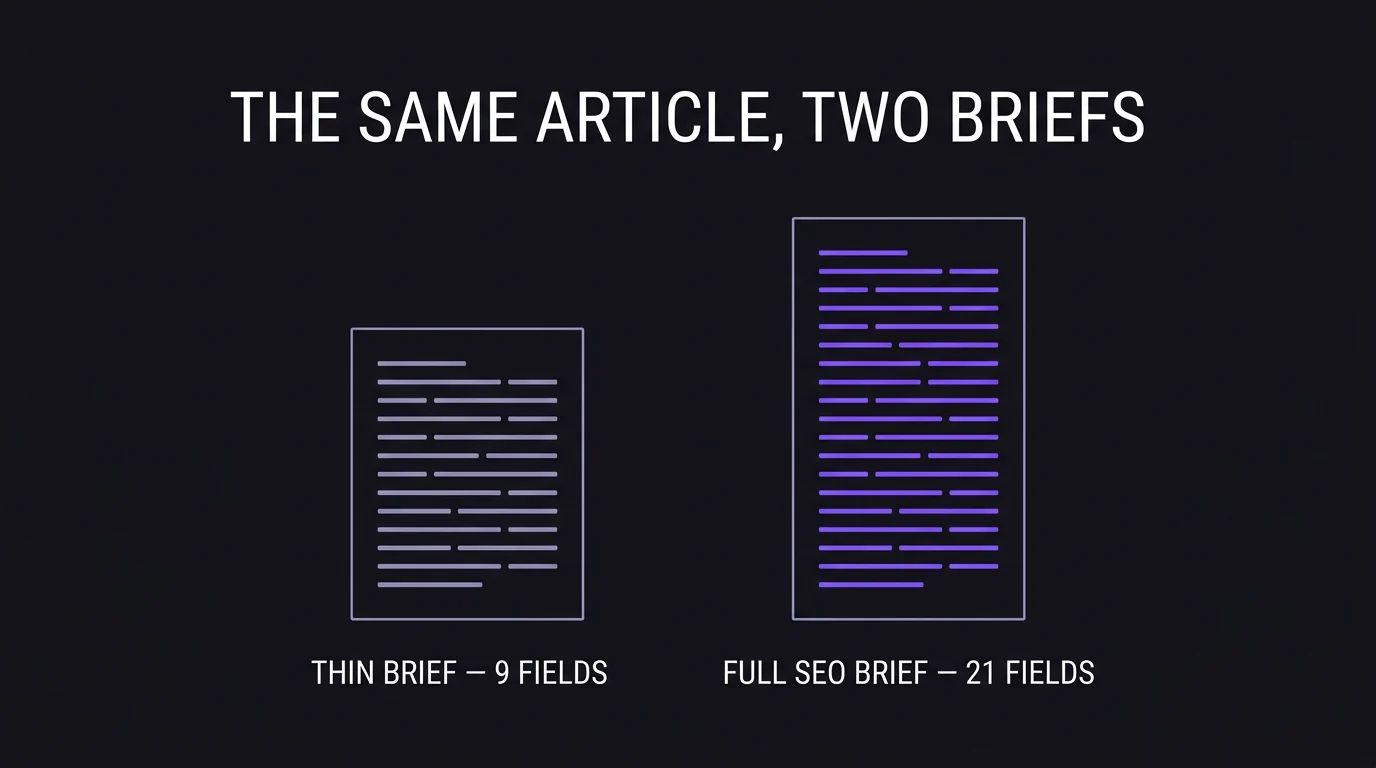
A content brief is the written spec a writer works from: topic, reader, angle, required structure and the definition of done. Its length is not fixed. A staff writer needs about nine fields. An outside writer needs about twenty-one: the same spec, plus everything the first one carries in their head, plus the production details nobody states in-house.
How this was checked. Every organic result and the AI Overview that Google served in the United States for “content brief” on 2 August 2026 presents a single brief structure — one template, one anatomy, one checklist of components. Not one distinguishes between briefing someone who works inside your business and briefing someone who has never seen your product. The AI Overview names five parts: overview, audience, SEO data, structure, style.
Worth noting what sits beside those results. Google’s discussions panel for the same query surfaces two forum threads: one on r/content_marketing titled “The brief is where most content dies before the writer even starts”, and one on r/freelanceWriters that is a writer venting about the briefs they receive. The ranking articles are all templates. The conversation is all about templates failing. That gap is what this piece is about.
Content brief vs creative brief, outline and style guide
A content brief is the specification for one written deliverable. It is confused with four neighbours, and each confusion produces a different failure.
- Not a creative brief. A creative brief covers a campaign and the message it carries across ads, video, design and copy. A content brief covers one article, and goes down to the level of headings and word counts. Use a creative brief to brief a campaign and you get a coherent campaign; use one to brief an article and the writer still has to invent the structure.
- Not an outline. An outline is one field inside a brief. A brief that is only an outline tells the writer what order to say things in but never what the piece is for, so it comes back structurally correct and pointless.
- Not a style guide. A style guide is the standing rules that apply to everything you publish. A brief carries only what is specific to this piece. Pasting the style guide into every brief buries the four lines that actually matter.
- Not a design brief. That one specs a visual deliverable for a designer, and its fields are formats, dimensions and usage rights rather than headings and keywords.
Brief length is set by the writer, not by the article
This is the field that decides everything else, and no template asks it: how much of your context is already inside the writer’s head?
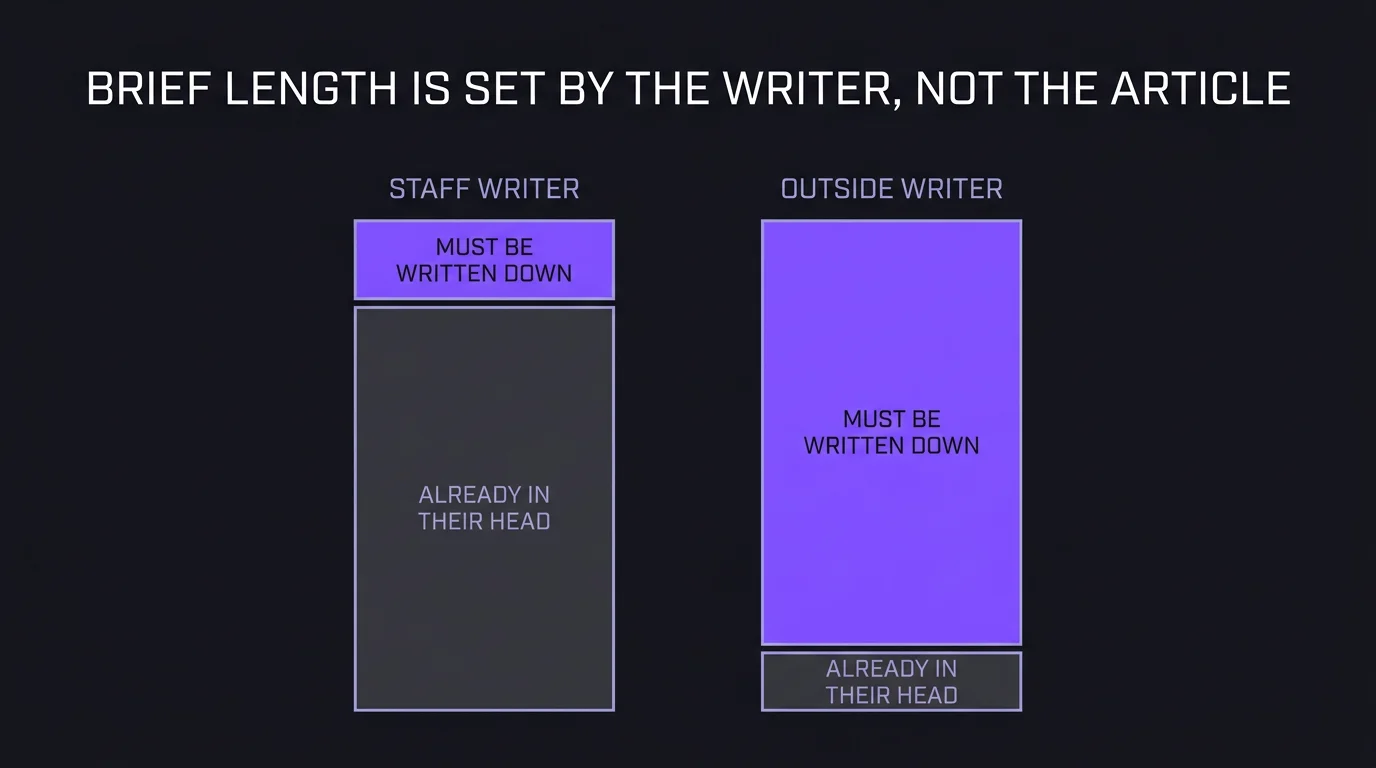
A staff writer six months into the job carries the brand voice, the audience, the product’s real limitations and the last few things you published. None of that has to be written down. A contract writer on their first assignment carries none of it, and every unwritten assumption becomes a guess that surfaces in round two of revisions.
| What the brief has to carry | Staff writer, six months in | Contract writer, first piece |
|---|---|---|
| Brand voice and banned phrasing | In their head | Must be written |
| Who the reader is and what they already know | In their head | Must be written |
| What the product actually does and does not do | In their head | Must be written |
| What you have already published on the topic | In their head | Must be written |
| The angle for this specific piece | Must be written | Must be written |
| Required sections and their order | Must be written | Must be written |
| Target length and why | Must be written | Must be written |
| Primary and secondary search terms | Must be written | Must be written |
| Internal links, anchors and placement | Must be written | Must be written |
| Definition of done | Must be written | Must be written |
Four rows flip when the writer changes. Those four are why the two templates below exist at all, and why a single “comprehensive” template is either bloated for one writer or thin for the other.
The same test applies to a draft produced with a language model. The model holds none of your context either, so it needs the long version — with one addition: name the sources it is allowed to use, because that is the field it will otherwise fill in on its own.
The thin content brief: nine fields for a writer who knows the product
One page. If it takes longer than fifteen minutes to fill in, you are writing the article instead of briefing it.
1.  Working title
2.  Target reader, and the moment they search for this
3.  The one question this piece answers
4.  Angle — what we say that the ranking pages do not
5.  Required H2 sections, in order
6.  Target length: range, and the reason for the range
7.  Internal links: URL, anchor text, which section
8.  Call to action, and the page it points at
9.  Deadline, revision rounds included, definition of done
Fields 3 and 4 are the ones people skip, and they are the ones that carry the value. “The one question this piece answers” forces you to admit whether you have a topic or just a keyword. The angle forces you to say what makes this version worth publishing when eight pages already rank.
The full SEO content brief: twenty-one fields for an outside writer
Two to three pages, grouped into five blocks so the writer can read the top and start, rather than reading all of it before anything makes sense.
ASSIGNMENT
1.  Working title
2.  Deliverable and format (article, landing copy, comparison page)
3.  Why we are publishing this now, and where it sits in the funnel
4.  Publication date

READER AND VOICE
5.  Who the reader is, in one sentence with a job title
6.  What they already know — so we do not explain it to them
7.  What they are afraid of getting wrong
8.  Voice rules: three lines, with an example sentence
9.  Words and claims we never use

SEARCH
10. Primary keyword, with volume and difficulty
11. Secondary keywords, and which section each one belongs in
12. Search intent, in one sentence
13. The top three ranking pages, and what each one does
14. The gap: what none of them covers

STRUCTURE AND SPEC
15. Required H2 sections, in order
16. Target length: range, with the reason
17. Required entities — the named things the piece must mention
18. Sources allowed, and sources banned
19. Internal links and CTA: URL, anchor text, placement, page the CTA points at

DELIVERY
20. Images, tables or data the piece needs, and who produces them
21. Deadline, revision rounds included, definition of done
Fields 6 and 7 are the two that none of the ranking templates carries, and the two that generate the most clarifying questions when we commission a piece ourselves. Without field 6 you get four paragraphs explaining what a content brief is to an audience of content managers. Without field 7 you get a piece that answers the question but never addresses the reason someone is searching at 11pm.
Three content brief fields nobody fills in properly
These three appear in almost every published template and are almost always written in a way that transfers no information.
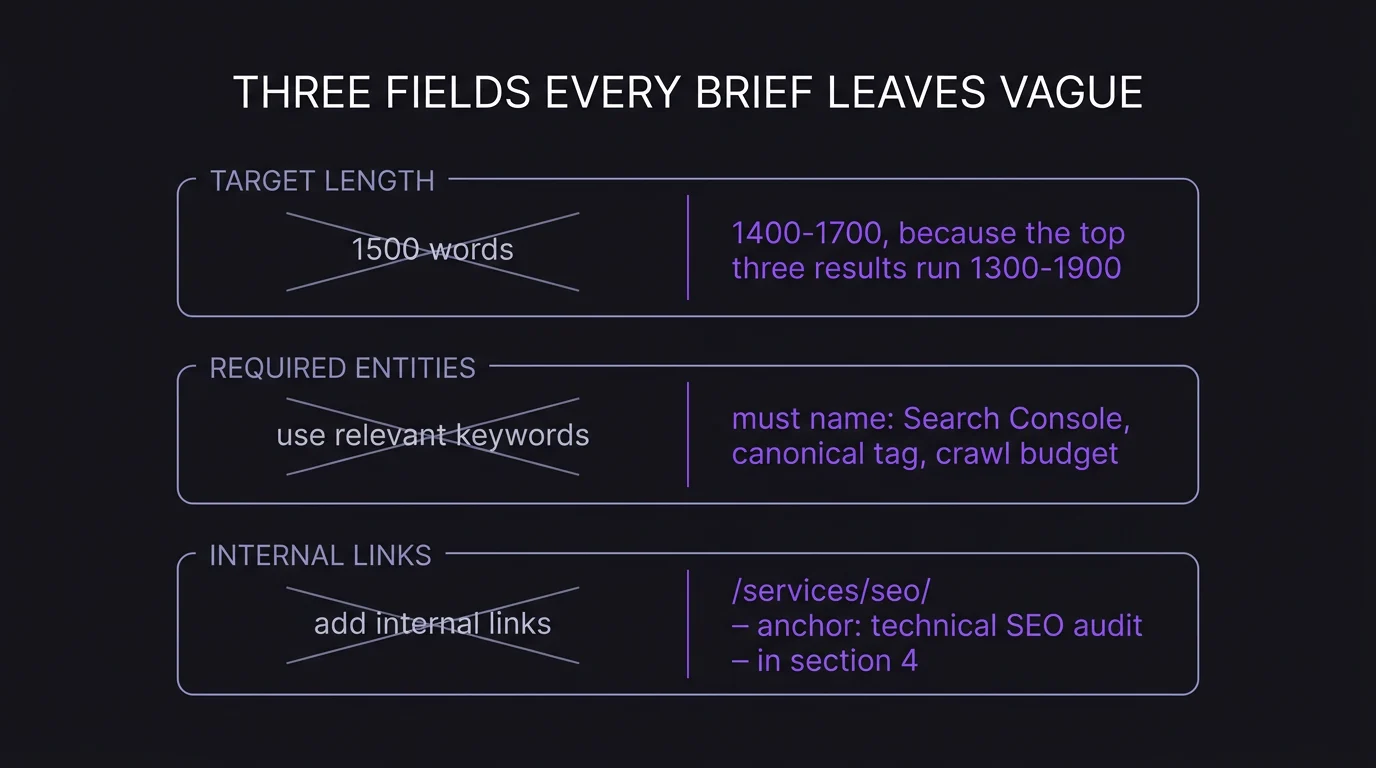
Target length, written as a range with a reason
“1,500 words” tells the writer nothing except that you counted something once. A range plus a reason tells them when to stop and when to keep going. On a hypothetical pricing topic that field reads: 1,400–1,700, because the three pages currently ranking run 1,300 to 1,900 and none of them covers the pricing question. Now the writer knows that going long is fine if the extra length is the pricing section, and not fine if it is padding.
An exact number does one predictable thing: it produces filler at the end, where the writer is padding to hit it.
Required entities: the named things the piece must mention
The field that separates a brief from a keyword list. Entities are the specific things a knowledgeable person would inevitably name when covering this topic — tools, standards, mechanisms, named methods. Write them as a list the writer can tick off: must name Search Console, canonical tags, crawl budget and log files.
This is not keyword stuffing by another name. Keywords are phrases you want to match; entities are concepts whose absence gives away that the writer does not know the subject. A page about email deliverability that never says “SPF” was written by someone reading other blog posts.
Internal links, specified as URL plus anchor plus placement
“Add internal links where relevant” gets you links in the last paragraph, all anchored on the brand name. Specify all three parts:
| Target URL | Anchor text | Where |
|---|---|---|
| /services/content-marketing/ | content marketing services | Closing section, after the acceptance test |
| /blog/content-calendar/ | content calendar | Wherever the topic’s origin comes up |
One editorial link per target URL, in the body. A second link to the same page rarely changes anything and starts to read as filler.
The same assignment, written two ways
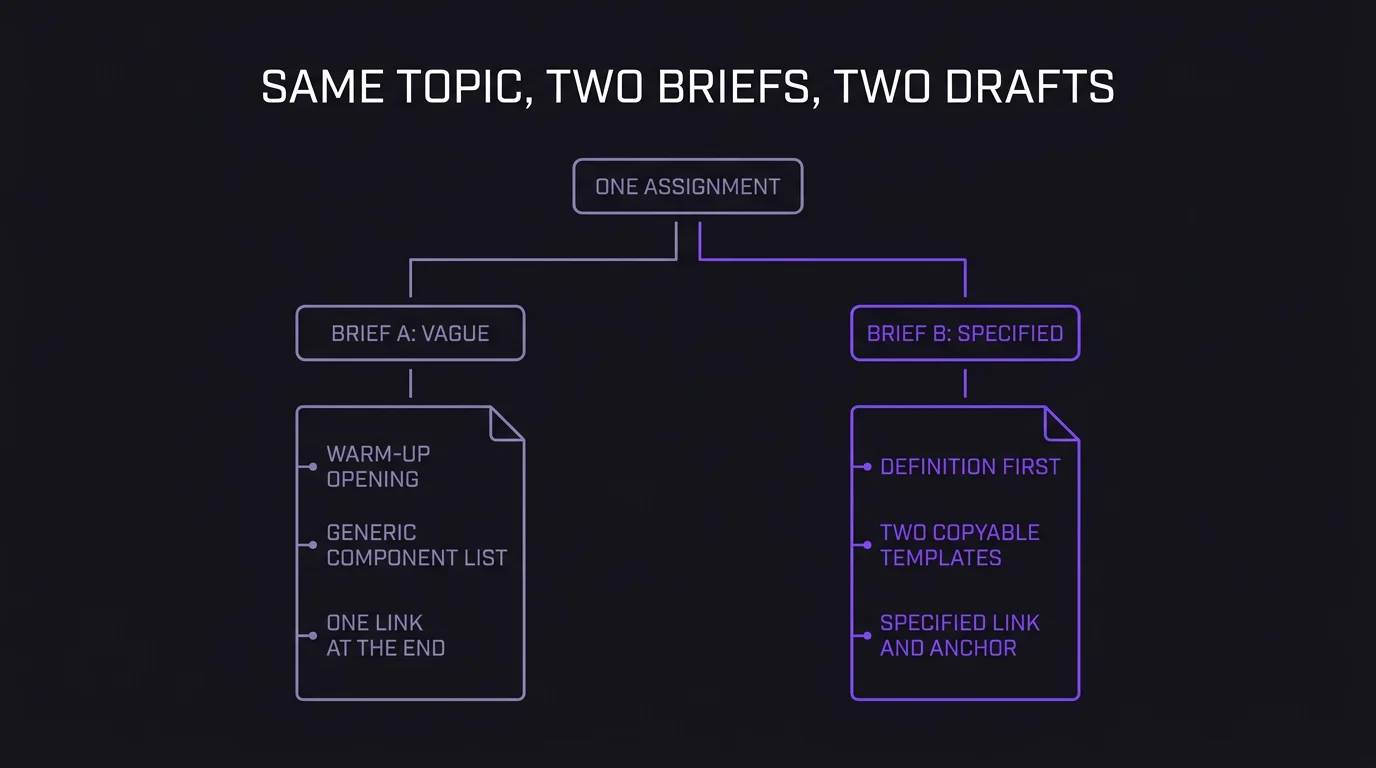
Below is one assignment, briefed twice. This is a worked demonstration rather than a measured trial — but the places where the two drafts diverge are predictable, and they are always the same places.
Brief A, as most briefs arrive:
Topic: content briefs
Keyword: content brief
Length: ~1500 words
Make it useful and engaging. Add internal links.
Brief B, the same assignment specified:
Question: how detailed does a brief need to be?
Angle: depth is set by the writer's missing context, not by the article.
       Nobody ranking makes this distinction.
Reader: marketing manager who briefs two or three writers a month
Must name: creative brief, style guide, outline, required entities
Sections: what it is not / depth depends on the writer / thin template /
          full template / three vague fields / worked example / what to cut /
          who writes it / where the topic comes from / how to tell it worked
Length: 2,600-3,000 — long enough to carry both templates in full
Links: /services/content-marketing/ (anchor "content marketing services",
       closing section)
Done when: a reader can copy both templates without adapting them
What the two produce:
| What the writer had to decide | Draft from brief A | Draft from brief B |
|---|---|---|
| Opening sentence | Warm-up about why content matters | Definition in the first line |
| Whether there is an argument | Restates the components list everyone has | Leads with the depth claim |
| Section order | Chronological: what, why, how | Answer first, templates second |
| The templates themselves | One generic list of components | Two complete, copyable blocks |
| Internal links | One, in the final paragraph, brand anchor | Specified target, anchor and section |
| What “done” means | Editor decides on reading it | Stated before drafting started |
Brief A is not shorter because the writer is trusted. It is shorter because the person writing it had not yet decided what the piece was for, and the brief is where that indecision becomes visible. Every unspecified field is a decision you have deferred to someone with less context than you, and it comes back as a revision round.
What to leave out of a content brief
Length is not the enemy; unusable length is. These are the five things that make a brief long without making it clearer.
- Company background nobody uses. Founding year, mission statement, the About page pasted in. If it will not change a sentence in the draft, it is not a brief field.
- The full keyword export. Forty phrases with volumes is a research artefact. Pick the primary, pick four or five secondaries, say where each belongs.
- Competitor URLs with no instruction. “Here are the top ten results” invites the writer to average them, which is exactly how you get the tenth version of the same page. Say what each one does and what none of them covers.
- An outline written down to H3 depth. At that point you have written the article and hired someone to fill it in. Specify the H2s and let the writer own the level below.
- “Make it engaging.” It is not a field. If you mean short paragraphs, say short paragraphs. If you mean a worked example in every section, say that.
Who writes the content brief, and how long it takes
The brief belongs to whoever owns the outcome — the editor, content strategist or marketing manager who will be judged on whether the piece works. Not the writer alone: a brief written by the person about to execute it cannot catch the assumptions that person is already making.
| Brief type | Who writes it | Realistic time | What eats the time |
|---|---|---|---|
| Thin, nine fields | Editor or content lead | 10–15 minutes | Deciding the angle |
| Full SEO brief, twenty-one fields | Content strategist, with a writer reviewing | 45–90 minutes | Reading the ranking pages properly (fields 13 and 14) |
| First brief for a new freelancer | Same, plus one call | 90 minutes plus 20 on a call | Voice rules and banned claims |
Times we budget when we brief, not measured averages — the angle decision moves the first row more than the field count does.
The reading in fields 13 and 14 is the part people skip when time is short, and it is the part that decides whether the piece has a reason to exist. Everything else in the brief can be assembled from what you already know.
Where the topic in the brief comes from
A brief starts with a decided topic. If you are choosing the topic at the moment you sit down to brief it, the angle field will be empty, because you have not yet worked out what this piece does that the last one did not. That decision belongs one step earlier, in your content calendar, where the piece has a slot, a stage of the funnel and a page it is supposed to support.
How to tell the content brief worked
Three checks, none of which require waiting for rankings.
- The writer asked no clarifying questions before starting. Questions before drafting are free and they name the missing field exactly. Add that field to the template — the same question from two different writers means the template has a hole, not that the writers are difficult.
- The first draft came back structurally correct. Sections in the right order, at roughly the right length, with the specified links present. Structural revisions are brief failures; sentence-level edits are normal editing.
- Revision rounds dropped on the second piece with the same writer. A brief template that works compounds — the second assignment should need fewer clarifications than the first, and if it does not, the template is not carrying what the writer actually needs.
Two briefs, one template file, four fields that flip depending on who is writing. That is the whole system, and it is cheaper to maintain than the revision rounds it replaces. If the bottleneck is not the template but the fact that nobody has time to fill it in, that is the point where our content marketing services take over the briefing as well as the writing.
11 / Reader questions
Frequently asked questions
01What is a content brief?
A content brief is the written specification a writer works from before drafting: the topic, the reader, the angle, the required structure, the search terms the piece has to serve, and the definition of done. It is a spec for one deliverable, not a strategy document and not a style guide.
02What is the difference between a content brief and a creative brief?
A creative brief covers a campaign and the message it carries across every format; a content brief covers one written deliverable and how it should be built. The creative brief answers what we are trying to make people feel. The content brief answers what this specific article has to contain.
03What should a content brief include?
At minimum: working title, target reader, the one question the piece answers, the angle, required H2 sections, a target length range, internal links with anchors, the call to action, and the deadline. Everything beyond those nine fields replaces context an outside writer lacks, or names production details nobody states in-house.
04How long should a content brief be?
One page for a writer who knows your product, two to three pages for one who does not. Length tracks the writer's missing context, not the length of the article. A 3,000-word piece for your in-house editor needs a shorter brief than a 900-word piece for a freelancer's first assignment.
05Who writes the content brief?
Whoever owns the outcome — the editor, content strategist or marketing manager judged on whether the piece works. When a writer briefs themselves, the brief records the plan they already had rather than testing it, so nobody catches the missing angle until the draft arrives.
06Do you need a content brief if the writer is on staff?
Yes, but a short one. A staff writer already carries the brand voice, the audience and the product in their head, so the brief only has to carry what is new about this piece: the angle, the required sections, the search terms and the definition of done. Nine fields is usually enough.
07Can AI write a content brief?
Half of it. A language model assembles the research half quickly — pulling the ranking pages apart, listing the questions they answer, proposing headings. It cannot supply the angle or the definition of done, because both depend on what your business sells and what you already published. Research assistant, not briefer.