Published
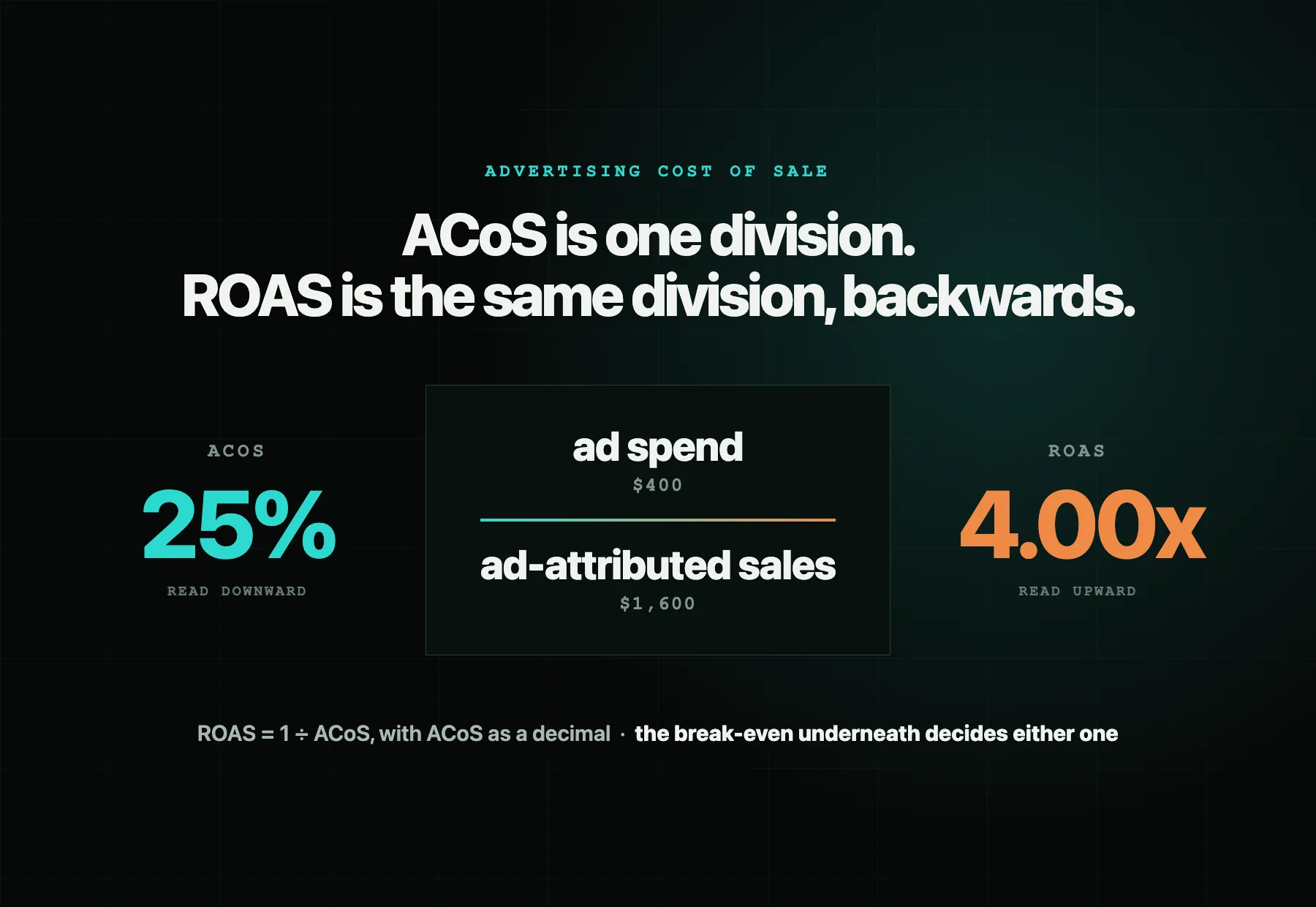
ACoS, advertising cost of sale, is ad spend divided by the sales advertising is credited with, expressed as a percentage. Amazon states it as (ad spend ÷ ad revenue) × 100: spend $50, be credited with $100 of attributed sales, and your ACoS is 50%. It is the exact inverse of ROAS, which is why a 25% ACoS is a 4x ROAS.
Two other things share the acronym and neither belongs to advertising. ACOS is the arccosine function in Excel, C++ and most maths libraries, and in medicine it is the older abbreviation for asthma-COPD overlap, now usually written ACO. If you arrived from either, this page is not the one.
How this was checked. In August 2026 we went to the platform documentation wherever it exists rather than to the pages quoting it: Amazon Ads’ own ACOS guide for the formula and the wording on benchmarks, Amazon’s 2026 US fee announcement to sellers, Walmart Connect’s advertiser reporting help for the window that platform actually defaults to, and Google Ads Help for the conversion-value metric. Where a claim is documented across Amazon’s help system rather than on one citable page — the Seller Central and Vendor Central attribution split is the case here — the table at the end says so instead of dressing it up. The unit-economics arithmetic is ours, worked on inputs named where they appear, and none of it is a benchmark.
The ACoS formula, and the two numbers Amazon puts into it
The numerator is easy and never disputed: what you spent on ads in the period. Every argument about ACoS is an argument about the denominator.
Ad-attributed sales are the sales the platform decides your advertising caused. That decision has three parts, all of them platform rules rather than facts about your business: a click has to happen, a purchase has to follow inside an attribution window, and the last ad clicked takes the whole credit. Change any of the three and the same shopping behaviour produces a different ACoS.
That is the part most definitions skip. ACoS is not a measurement of your advertising, it is a measurement of your advertising as scored by the platform running it. Everything below follows from taking that sentence seriously.
ACoS vs ROAS: the same division read from both ends
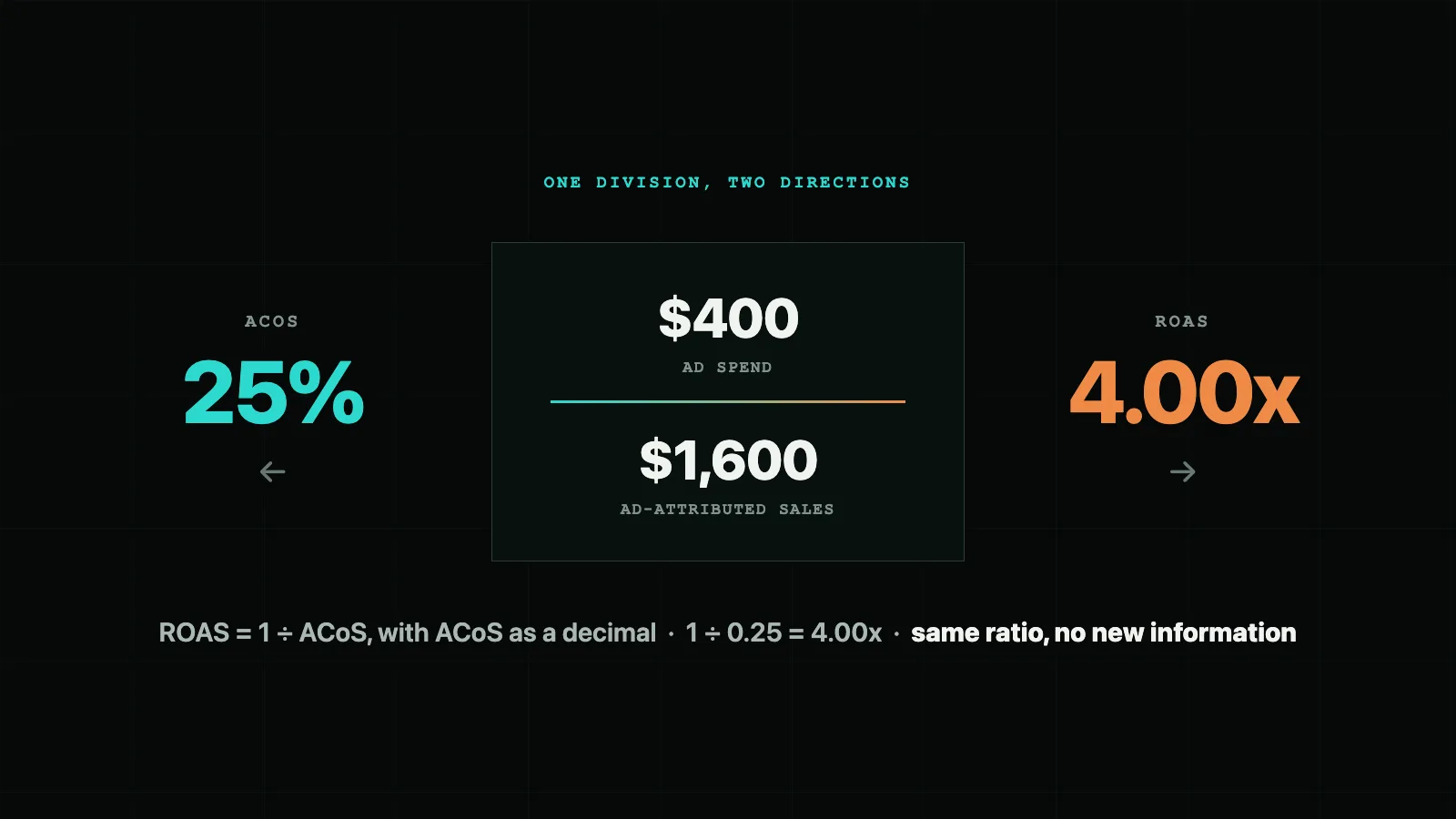
ROAS is attributed sales over ad spend. ACoS is ad spend over attributed sales, in percent. Same two quantities, opposite order, so one converts to the other with no loss and no extra input:
ROAS = 1 ÷ ACoS, and ACoS = 1 ÷ ROAS, with ACoS taken as a decimal on both sides: 1 ÷ 0.25 = 4.00x, and 1 ÷ 4.00 = 0.25, which is the 25% your console prints.
| ACoS | ROAS | Reads as |
|---|---|---|
| 10% | 10.00x | $1 of ads returns $10 of attributed sales |
| 15% | 6.67x | |
| 20% | 5.00x | |
| 25% | 4.00x | the conversion most people arrive looking for |
| 30% | 3.33x | |
| 40% | 2.50x | |
| 50% | 2.00x | ads take half of the attributed revenue |
| 75% | 1.33x | |
| 100% | 1.00x | ads cost exactly what they returned |
| 125% | 0.80x | attributed sales no longer cover the spend |
If you want the arithmetic in the other direction and the three denominators people put under it, the ROAS formula is worked through separately. Everything on this page treats the two as one number.
The inverse is exact, which is not the same as the two numbers being interchangeable
Because the conversion is lossless, no argument about which metric is “more accurate” survives contact with the arithmetic. What does survive is the question of what either number leaves out, and there are three answers.
Both sit above the fee line. Neither ACoS nor ROAS knows what the item cost you, what the marketplace charged to sell it, or what it cost to ship. Two products at an identical 25% ACoS can be one comfortable and one under water, and nothing in the reported metric tells you which is which. The break-even section below is the fix.
Both inherit the attribution window underneath them. A seven-day window and a fourteen-day window score the same shopping behaviour differently, so an ACoS is only comparable to another ACoS measured on the same window. Three sections down, this stops being theoretical.
Both count orders, not kept revenue. Attributed sales are recorded when the order is placed, and they are never netted against the refund that follows — whether that refund arrives inside the attribution window or long after it. Widening the window does not fix this, because the window is not what excluded the refund. On a category returning at any meaningful rate, every ACoS you have read was flattering by construction.
None of that is an argument for the multiple over the percentage, or the reverse. A percentage compares naturally against a margin, which is a percentage; a multiple compares naturally against a target, which is a multiple. That is the whole difference.
ACoS vs TACoS: the same spend over a denominator Amazon does not report
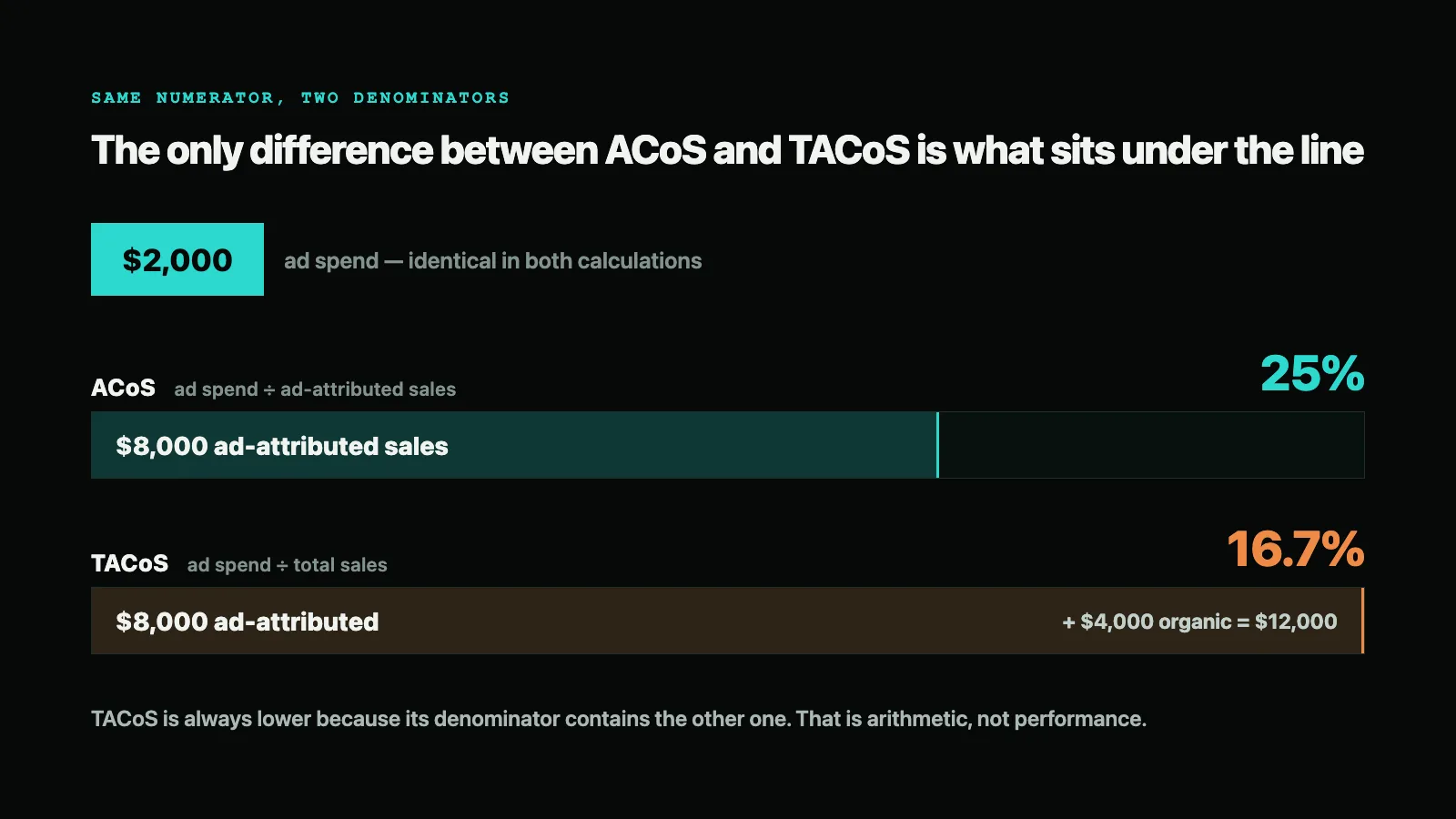
TACoS, total advertising cost of sale, keeps the numerator and widens the denominator to all sales, advertised and organic together.
| Formula | On $2,000 of spend, $8,000 attributed and $12,000 total | |
|---|---|---|
| ACoS | ad spend ÷ ad-attributed sales | $2,000 ÷ $8,000 = 25% |
| TACoS | ad spend ÷ total sales | $2,000 ÷ $12,000 = 16.7% |
TACoS is always the lower of the two, because its denominator contains the other one. That is arithmetic, not performance, and a falling TACoS only means something when the two denominators move apart — spend flat, organic sales climbing.
Two traps come with it. The first is that Amazon does not report TACoS in the ads console at all: it is a seller-community metric you assemble yourself by putting total sales from Business Reports under your ad spend, which is why no two tools agree on it to the decimal. The second is that the inverse rule does not survive the swap. Reading 1 ÷ 16.7% as a 6x return claims that advertising produced every organic sale in the denominator, which is the one thing TACoS was invented to avoid claiming.
Break-even ACoS from the full unit economics, not from gross margin
The usual shortcut says your margin is the ceiling for your ACoS. It is directionally right and numerically wrong for anyone selling on a marketplace, because gross margin is calculated before the marketplace takes its cut, and the marketplace takes its cut whether or not the sale came from an ad.
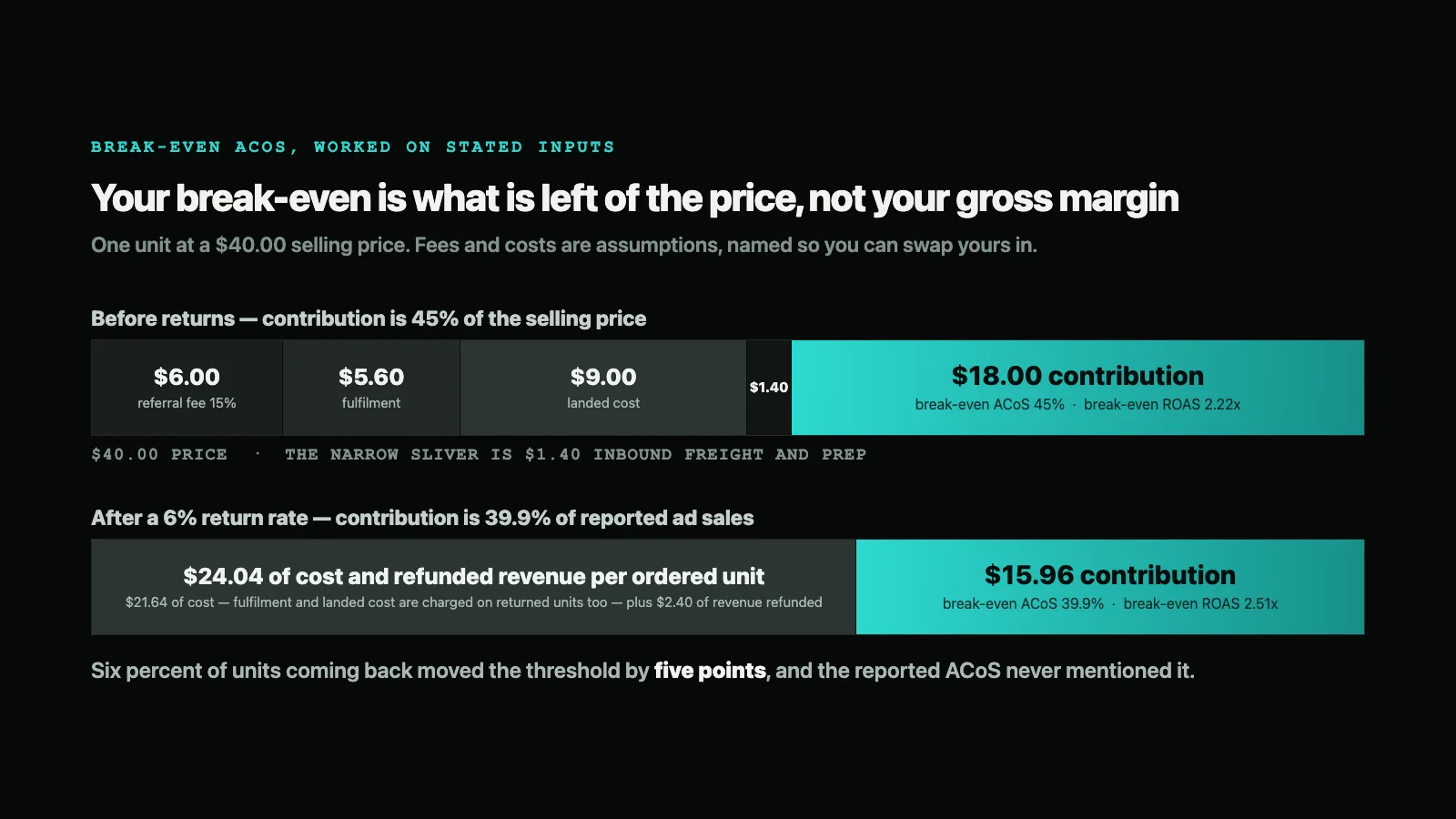
Break-even ACoS is what is left of the selling price after every variable cost except advertising, divided by that same selling price. Worked on one unit, with every input stated rather than assumed:
| Line | Per unit | Note |
|---|---|---|
| Selling price | $40.00 | the number ad-attributed sales are counted at |
| Referral fee | −$6.00 | 15%, the rate Amazon applies across most categories; check your own |
| Fulfilment fee | −$5.60 | assumption for a standard-size item |
| Landed product cost | −$9.00 | assumption |
| Inbound freight and prep | −$1.40 | assumption |
| Contribution before advertising | $18.00 | 45% of the selling price |
| Break-even ACoS | 45% | equivalent to a 2.22x break-even ROAS |
Now add returns, which is where the gross-margin shortcut goes properly wrong. Take a 6% return rate, assume the referral fee comes back on a refund while the fulfilment fee does not, and treat returned units as a total loss of product cost and freight. Across 100 ordered units: $3,760 kept revenue, less $564 of referral fees, less $560 of fulfilment charged on all 100 units, less $1,040 of landed cost and freight on all 100 units, leaves $1,596. Ad-attributed sales still report all 100 orders at $40, so the denominator is $4,000.
Break-even ACoS is now 39.9%, and the equivalent break-even ROAS has risen from 2.22x to 2.51x. Six percent of units coming back moved the threshold by five points, and the reported ACoS never mentioned it.
Why the same product reports a different ACoS on Sponsored Products, Brands and Display
Nothing in the formula changes between ad types. The window under the denominator does.
| Ad type | Click attribution window | Effect on the denominator |
|---|---|---|
| Sponsored Products, Seller Central | 7 days | shortest window, so the fewest conversions counted |
| Sponsored Products, Vendor Central | 14 days | same ads, twice the window |
| Sponsored Brands | 14 days | credit spans the advertised brand’s catalogue, wider than the advertiser’s own other SKUs |
| Sponsored Display | 14 days | includes view-through paths a search-only comparison never sees |
Cross-item credit is a matter of scope rather than presence: Sponsored Products reporting already separates advertised-SKU sales from other-SKU sales and computes ACoS on the total, so the clicked item is never the whole denominator on any of these.
A seller-account Sponsored Products campaign is scored on seven days of purchases; a Sponsored Brands campaign beside it is scored on fourteen. If a slice of your category converts in week two, the second campaign captures it and the first discards it, and the difference shows up as a lower ACoS that no bid change created. Ranking ad types against each other on ACoS therefore ranks their measurement windows first and their performance second.
The practical rule is narrow and worth keeping: compare ACoS within an ad type over time, and compare across ad types only on a number both of them can produce, such as contribution dollars.
The same metric off Amazon: Walmart Connect, Instacart and Google Ads
ACoS is an Amazon word, not an Amazon concept, and the moment you carry it to another platform the denominator changes shape again.
Walmart Connect reports ROAS rather than ACoS, and its advertiser reporting help sets the attribution window to 14 days post-click by default, with 3-day and 30-day options in the same dropdown. Invert that ROAS and you hold a number shaped exactly like an Amazon ACoS but measured over twice the window of a Seller Central Sponsored Products report, or more than four times it if someone left the report on 30 days. The comparison flatters Walmart, and the correction is to match the windows before comparing rather than to explain the gap with creative.
Instacart reports at basket level, where the interesting figures are basket penetration and share rather than a single efficiency ratio. An ACoS-shaped question gets an answer there, but it is not the question the platform is built to answer.
Google Ads has the metric under another name. The column called Conv. value / cost is ROAS by Google’s own definition, and inverting it gives you ACoS. If you would rather see the percentage directly, custom columns take arithmetic between metrics, so a column defined as cost divided by conversion value produces an ACoS your marketplace team can read without conversion. The window differs again, and the conversion action you chose is doing the work the marketplace does automatically.
This is the point where marketplace reporting and the rest of a paid account stop being separate conversations. If a brand’s Amazon ACoS, Walmart ROAS and Google conversion value are being read as three different scores rather than one economics question with three measurement windows, the fix is structural rather than a bid change — the sort of thing our paid media work starts with on any ecommerce and D2C account carrying more than one storefront.
What a good ACoS actually is, once you have your own break-even
Below your break-even ACoS you are making contribution on the ad-attributed order; above it you are buying something other than immediate profit. Amazon Ads says so itself, in as many words: there is no definitive number for a good ACoS, because it depends on the business under it. The published bands you will find quoted elsewhere are category conventions, not measurements.
Two reasons to run above break-even are defensible. The first is launch, where the ad spend is buying rank and review velocity that organic sales inherit later, and TACoS rather than ACoS is the number that shows whether it worked. The second is repeat purchase, where the first order is a deposit on a second one and the ceiling is set by customer lifetime value rather than by one transaction.
Two reasons are not defensible. Comparing your ACoS to an ad type measured on a different window is one, and using a category benchmark as a target is the other. Per-unit fees do not shrink with the price, so a low-priced item hands a much larger share of its revenue to fixed costs: the $40 item above survives a 39.9% ACoS, while a $9 consumable carrying a $1.35 referral fee, $3.20 of fulfilment, $2.00 of landed cost and $0.30 of freight has $2.15 left and breaks even at 23.9%. Neither of them learns anything from the other’s number. If the question you actually have is what multiple to aim for rather than what percentage, that argument belongs to the ROAS side of the same ratio, where published benchmark data exists to argue with.
Where each number came from, and which ones are only arithmetic
| Figure | Value | Where it comes from |
|---|---|---|
| ACoS formula | (ad spend ÷ ad revenue) × 100 | Amazon Ads, advertising cost of sales guide, read August 2026 |
| Amazon’s worked example | $50 spend on $100 sales = 50% | same guide |
| Amazon on benchmarks | “There isn’t a definitive number for a good Amazon ACOS” | same guide |
| ACoS to ROAS conversion table | every row, plus the $400 over $1,600 in the diagram | arithmetic only — 1 ÷ ACoS, nothing measured |
| TACoS example | $2,000 spend, $8,000 attributed, $12,000 total | our illustration; the figures are chosen, not observed |
| TACoS is not in the ads console | negative claim | Amazon’s advertising console reports ACoS; TACoS is assembled by sellers from Business Reports |
| Sponsored Products window | 7 days click, Seller Central; 14 days, Vendor Central | documented across Amazon’s advertising help rather than on one page; verified against two independent summaries, August 2026 |
| Sponsored Brands and Display window | 14 days click | same |
| Sponsored Brands brand-wide credit | credit spans the advertised brand’s catalogue | Amazon Ads campaign reporting documentation |
| 2026 US FBA fee change | +$0.08 per unit on average, effective 15 January 2026 | Amazon Selling Partners announcement to sellers |
| Referral fee used in the examples | 15% | Amazon’s US referral fee schedule, where 15% is the modal category rate; check your own category |
| Walmart Connect reporting | ROAS reported, ACoS not; 14-day post-click default, with 3-day and 30-day options | Walmart Connect advertiser reporting help, August 2026 |
| Instacart reporting | basket-level metrics rather than one efficiency ratio | retail-media reporting documentation and vendor summaries; weaker than the rest of this table |
| Google Ads equivalent | Conv. value / cost is conversion value divided by cost | Google Ads Help, conversion value per cost |
| Unit-economics examples | $40 price at 45%, then 39.9% after 6% returns; $9 item at 23.9% | our arithmetic on the stated inputs; not benchmarks |
Two caveats worth carrying out of the table. Third-party sources still describe Walmart Connect’s sponsored search as defaulting to a three-day window, which the platform’s own help page contradicts — read the Attribution dropdown in your own account rather than trusting either. And the fee figures move: Amazon put its 2026 US change at an average of $0.08 per unit, small enough to ignore in a worked example and large enough to matter on a thin item at volume. Recompute your break-even when your own category schedule changes, not when someone publishes an industry average.
10 / Reader questions
Frequently asked questions
01What is ACoS?
ACoS is advertising cost of sale: ad spend divided by the sales advertising is credited with, expressed as a percentage. Amazon writes it as (ad spend ÷ ad revenue) × 100, so $50 of spend returning $100 of attributed sales is a 50% ACoS. It measures what a sale costs you in advertising, before any product cost or platform fee.
02What ROAS is 25% ACoS?
A 4x ROAS. The two are exact inverses: ROAS equals 1 divided by ACoS, so 25% becomes 1 ÷ 0.25 = 4. The same rule gives 10x for a 10% ACoS, 2x for 50% and 1x for 100%. Neither number is more accurate than the other because both are the same division, read from opposite ends.
03What is a good ACoS on Amazon?
Anything below your own break-even ACoS, which is your contribution margin before advertising expressed as a percentage of the selling price. Amazon Ads states plainly that there is no definitive figure. A $40 item carrying a 15% referral fee, fulfilment, landed cost and a 6% return rate breaks even near 40%, while a $9 consumable paying similar per-unit fees breaks even near 24%, and both can sit in the same category.
04Is ACoS the same as ROAS?
It is the same ratio inverted, not a different measurement. Converting between them adds no information: if the underlying attributed sales figure is wrong, both numbers are wrong by the same amount. The practical difference is only that a percentage compares naturally against a margin, while a multiple compares naturally against a target.
05What is the difference between ACoS and TACoS?
The denominator. ACoS divides ad spend by ad-attributed sales only; TACoS divides the same spend by total sales, advertised and organic together. TACoS is therefore always lower, and it is not a metric Amazon reports in the ads console — you build it yourself from total sales in Business Reports.
06How do you calculate break-even ACoS?
Subtract every variable cost from the selling price, then divide what is left by that same selling price. On a $40 item carrying a $6 referral fee, $5.60 fulfilment, $9 landed cost and $1.40 inbound freight, $18 remains, so the break-even ACoS is 45% and the equivalent break-even ROAS is 2.22x. Returns push that break-even down.
07Does ACOS mean something else?
Yes, two other things, and neither is a marketing metric. ACOS is the arccosine function in Excel, C++ and most maths libraries, returning an angle in radians. In medicine it is the older abbreviation for asthma-COPD overlap, which clinical guidance now shortens to ACO. Search results for the bare acronym mix all three senses, so keyword volume on it overstates the advertising audience behind it.