
Published
To get real estate leads without buying them from a portal, work eight channels ranked by two numbers: what one lead costs, and how many weeks it takes to reach a signed deal. Past clients and referrals supply the largest share of business — 58% of buyers pick an agent through a referral or a prior relationship — and cost nothing but a cadence.
Most guides to this question hand you twenty ideas and not a single figure. The table below is the same list with the two numbers attached, because a cheap lead with a long tail is worse than an expensive one that closes this quarter.
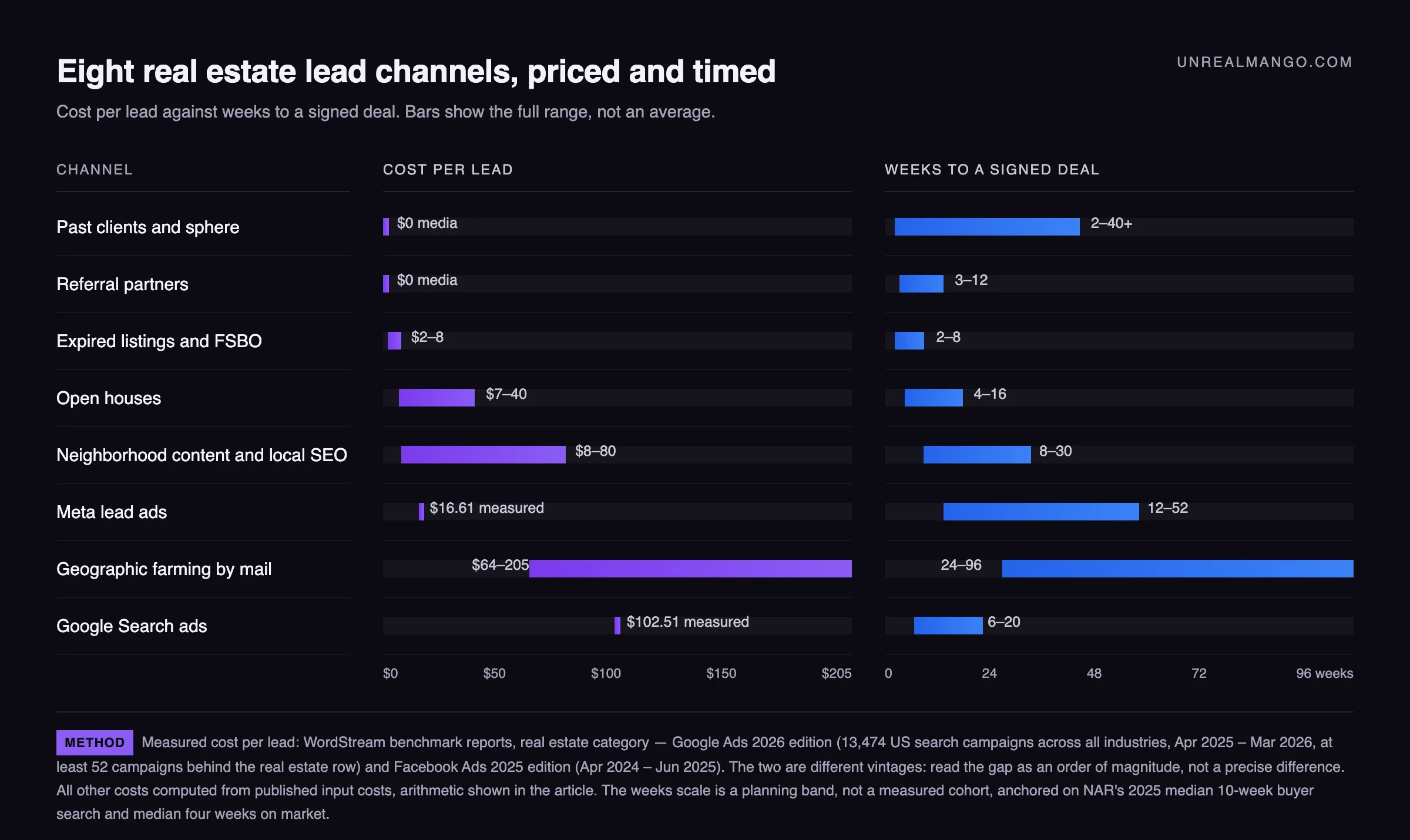
Eight real estate lead channels, priced and timed
Cost per lead is measured (an industry benchmark, cited), computed (our arithmetic from published input costs, shown in full in the sections below), or time-only where there is no media cost to divide. Nothing here is a quote, and nothing is invented.
| Channel | Cost per lead | Basis | Weeks to a signed deal | Where it wins |
|---|---|---|---|---|
| Past clients and sphere | $0 media | time only | 2–40+ | Highest close rate of any source; timing is unpredictable |
| Referral partners | $0 media | time only | 3–12 | Arrives pre-qualified and already in motion |
| Expired listings and FSBO | $2–8 | computed | 2–8 | Fastest: the seller has already decided to sell |
| Open houses | $7–40 | computed | 4–16 | Puts you in front of buyers physically in market |
| Neighborhood content and local SEO | $8–80, falling | computed | 8–30 | Compounds — the same page keeps producing |
| Meta lead ads | $16.61 | measured | 12–52 | Volume, at the earliest stage of intent |
| Geographic farming by mail | $64–205 | computed | 24–96 | Listing share in one area, over years |
| Google Search ads | $102.51 | measured | 6–20 | Active searchers, the highest intent you can buy |
Method. Measured figures come from WordStream’s benchmark reports for the real estate category. The Google set is the 2026 edition, drawn from 13,474 US search campaigns across all industries running April 2025 – March 2026, with each industry row resting on a subset of at least 52 active campaigns. The Facebook set is the 2025 edition, covering April 2024 – June 2025; WordStream has published a 2026 Google edition but not yet a 2026 Facebook one, so read the gap between the two as an order of magnitude rather than a precise difference. Computed figures divide published input costs by a stated response assumption, with the arithmetic shown where the channel is discussed. The weeks column is a planning band, not a measured cohort: it is derived from where each channel catches a person in their decision, anchored on NAR’s 2025 finding that the typical buyer searched for a median of 10 weeks and that homes spent a median of four weeks on market. Use it to sequence your effort, not to forecast a specific deal.
Why a $17 lead can cost more than a $100 one
Cost per lead is a media number. It says nothing about the hours the lead will consume before it pays, and hours are the scarcer input for a working agent.
Put the two costs on the same line. The gap between the cheapest and the most expensive paid lead above is $102.51 − $16.61 — call it $86. Suppose the cheap lead needs 20 hours of nurture and the expensive one needs 4, a 16-hour difference. Divide: $86 ÷ 16 ≈ $5.40. The cheap lead is only genuinely cheaper if an hour of your time is worth less than about five dollars.
The 20-and-4 figures are an illustration; the formula is the part to keep:
Breakeven hourly rate = (difference in cost per lead) ÷ (difference in hours per lead)
Plug in your own hours. If the answer lands below what your time is worth, the cheaper channel is the more expensive one.
For scale on the other side of the equation: NAR’s 2026 Member Profile puts the typical member at nine transaction sides and $59,200 in median gross income for 2025 — on the order of $6,600 of gross income per side, though dividing one median by another is a rough gauge rather than an average commission. A channel that pays out in eighteen months is not feeding this year’s nine.
The 58% who come through a personal connection, not a search
The single largest source of real estate business is not a channel you buy. In NAR’s 2025 Profile of Home Buyers and Sellers, 43% of buyers chose an agent who was referred by — or was — a friend, neighbor or relative, and a further 15% used an agent they had worked with before. That is 58% of buyers arriving through a personal connection rather than a search.
Sellers concentrate even harder: 37% referred and 29% repeat, which NAR itself totals as 66% of recent sellers using an agent who was referred to them or one they had already worked with. And 80% of sellers contacted only one agent before choosing.
That last number is the one that should change your week. Being the second agent a seller calls is worth very little, because four sellers in five never make a second call.
Now the leak. NAR reports that 91% of buyers would use their agent again or recommend them, and that 15% of this year’s buyers did use an agent they had worked with before. Those are not two ends of one measurement — the first is an intention captured at closing, the second is a share of a single year’s buyers, a fifth of whom are buying for the first time and have no previous agent to return to. But the direction is the point: the intention to reuse is close to universal and reuse is not, because nobody stays in touch across the eleven years the median seller now owns a home before moving on. That is a contact problem, not a service one.
The industry is slowly fixing it. NAR’s 2026 Member Profile shows the typical member earned 28% of business from past clients and customers, up from 20% the year before, and among members with 16 or more years of experience repeat business is around half the pipeline.
Free real estate leads start in a database you already own
Free does not mean effortless. It means no media spend and a fixed weekly time cost.
The database pass. Export every contact you have — past clients, everyone who signed in at an open house, everyone who ever asked you a question. Tag each one with the year they last transacted. Anyone past year seven is inside the window where the median owner starts thinking about moving.
The cadence that keeps it warm. Four touches a year is the floor: two of them property-specific to the person’s own address, two of them not about real estate at all. Anything less and you are a stranger with a logo when they finally move.
Referral partners. Loan officers, title reps, escrow officers, estate attorneys, general contractors, property managers. Each of them meets people at the exact moment a move becomes real. One partner who sends two deals a year outperforms most ad budgets — and unlike an ad account, the relationship keeps working when you stop paying attention for a month.
Neighborhood content. Write about the six streets you actually know: what sold, what it went for, what the HOA changed, what the school boundary does. The cost here is production rather than media: budget $150–400 for a researched neighborhood page — the sales data, the photographs, an hour of writing you either do yourself or buy. Five to twenty enquiries over its first year computes to $8–80 per lead ($150 ÷ 20 at the good end, $400 ÷ 5 at the bad end). This is the one channel where the denominator keeps growing while the numerator stays fixed, which is what “falling” means in the table — and it is also the one that needs a site able to capture the visitor, which is a build question. What a website redesign costs is a different conversation from what it earns.
Buyer leads and the ten-week window they arrive in
Buyer leads are the ones agents most often mishandle, because they arrive early and get judged as though they arrived late.
NAR’s 2025 data says 46% of buyers begin by looking online at properties, while 20% contact an agent as their first action. So the majority of buyers spend part of their median 10-week search invisible to you — browsing, not enquiring. By the time they fill in a form they are usually somewhere in the middle of that window, not the start.
Three ways to catch them without a portal subscription:
- Open houses, run as capture events. Cost is $40–120 per event in signage, print and refreshments. Three to six usable contacts is a normal yield, which computes to $7–40 per lead ($40 ÷ 6 at the good end, $120 ÷ 3 at the bad end). Everyone who walks through is by definition in market.
- Community content that answers pre-search questions. “What $600,000 buys in three neighborhoods” catches people two months before they contact anyone.
- A single, obvious way to reach you on every page. Not a chatbot, not a gate — a phone number and a form that a person on a phone can complete in fifteen seconds.
The buyers you catch at week two of ten will look like bad leads for six weeks and then transact. That is not a lead quality problem; it is a cadence problem, and the cadence section below is the fix.
Seller leads: farming a neighborhood with the postage arithmetic shown
Geographic farming is the channel most often recommended without a number attached. Here is the number.
USPS Every Door Direct Mail retail postage is $0.26 per piece in 2026. Print and production on a 5,000-piece drop run the all-in cost to roughly $0.32–$0.41 per piece, from a 6.5×9 postcard through an 8.5×11 flat with design, per current commercial EDDM pricing. A single 5,000-home drop therefore costs about $1,600–$2,050.
Now the response assumption, stated openly because everything downstream depends on it. Cross-industry benchmarks are far too optimistic for this use: the ANA’s 2023 Response Rate Report puts direct mail at 15.6% on house lists and 10.8% on prospect lists, but those measure response to a direct offer, usually from a list that already knows the sender — not a homeowner volunteering that they might sell. (That report no longer breaks response out by format at all; the sample per format was too small.) For farming, plan on 0.2%–0.5%.
- At 0.5%: 5,000 × 0.005 = 25 responses. $1,600 ÷ 25 = $64 per lead.
- At 0.2%: 5,000 × 0.002 = 10 responses. $2,050 ÷ 10 = $205 per lead.
That is the $64–205 band in the table, and it is why farming is a listing-share strategy rather than a lead-volume one. You are not buying ten conversations. You are buying the position of being the name the neighborhood recognizes when 80% of sellers make their one and only call.
Two rules that change the arithmetic more than the creative does:
- Repetition beats reach. Six drops to 800 homes outperforms one drop to 5,000 — same postage, entirely different recall.
- Specificity beats polish. The address of the house that just sold and the price it closed at outperforms a photograph of you.
The other seller channel worth the time is expired listings and FSBO. Data services run $60–100 a month, and 12–30 reachable contacts a month computes to $2–8 per lead ($60 ÷ 30 at the low end, $100 ÷ 12 at the high end). These are the fastest-closing leads in the table for one reason: the decision to sell has already been made, and you are competing on execution rather than persuasion.
What a real estate lead costs on Meta and on Google Search
Two paid channels, two very different jobs, both measured rather than guessed.
| Meta lead ads | Google Search ads | |
|---|---|---|
| Cost per lead | $16.61 | $102.51 |
| Cost per click | $1.57 | $3.22 |
| Click-through rate | 3.75% | 7.61% |
| Conversion rate | 9.53% | 3.70% |
| Data window | Apr 2024 – Jun 2025 | Apr 2025 – Mar 2026 |
Source: WordStream benchmark reports, real estate category — Facebook Ads 2025 edition and Google Ads 2026 edition. WordStream reports cost per lead on a narrower set of campaigns than cost per click, so these rows do not multiply out to one another.
The two channels price a lead roughly six times apart, and the mechanism shows up in the click cost and the conversion rate. Meta interrupts someone who was not looking, which is why the click is cheap and the form fills easily — a 9.53% conversion rate is high because the ask is low. Google catches someone typing a query, which is why the click costs more and the form is harder — 3.70% — but the person on the other end has already decided to act.
You are not choosing the cheaper number. You are choosing which end of the ten-week search window you want to buy into. Budget-setting for the search side is its own exercise, and how much Google Ads cost works through the arithmetic in full.
One line on buying leads from a portal, since it is the alternative this article is written against: the economics of portal leads turn on their price, their exclusivity and their conversion rate, and that deserves its own analysis rather than a paragraph here.
The follow-up cadence: six calls, five emails, and the twenty-hour cliff
This is where generated leads are actually lost, and there is real data on it.
The Lead Response Management study — Elkington and Oldroyd, 2007, built on three years of data from six companies covering more than 15,000 leads and over 100,000 call attempts — found that between a five-minute and a thirty-minute response, the odds of making contact fall by a factor of 100 and the odds of qualifying fall by a factor of 21. The odds of reaching a lead drop more than tenfold within the first hour alone. Past roughly 20 hours, additional dials begin to hurt rather than help. It is not a real estate sample, but it remains the largest dataset published on response timing.
Velocify’s analysis of about 3.5 million leads adds the other half: 93% of leads that eventually converted were reached by the sixth call attempt, and five was the optimal number of emails.
Combine them and the cadence writes itself.
| When | Action | Why this slot |
|---|---|---|
| 0–5 minutes | Call 1 | The entire 21× qualification advantage lives here |
| Same day, +1 hour | Call 2 + email 1 | Contact odds have already fallen tenfold; a second channel opens |
| Day 1 | Call 3, different time of day | Rotate windows: 8–9am and 4–5pm test best for qualifying |
| Day 3 | Call 4 + email 2 | Inside the window where most conversions are still made |
| Day 7 | Call 5 + email 3 | Persistence, not pressure — change the reason for the call |
| Day 14 | Call 6 + email 4 | The attempt that closes the 93% |
| Day 30 | Email 5, then move to the quarterly database cadence | The lead is not dead, it is early |
Two details from the same study that most cadences ignore: for making contact, 4–6pm tests best and Thursday outperforms the worst day by about 50%; for qualifying, the windows are 8–9am and 4–5pm, with the morning hour the stronger of the two, and Wednesday the leading day.
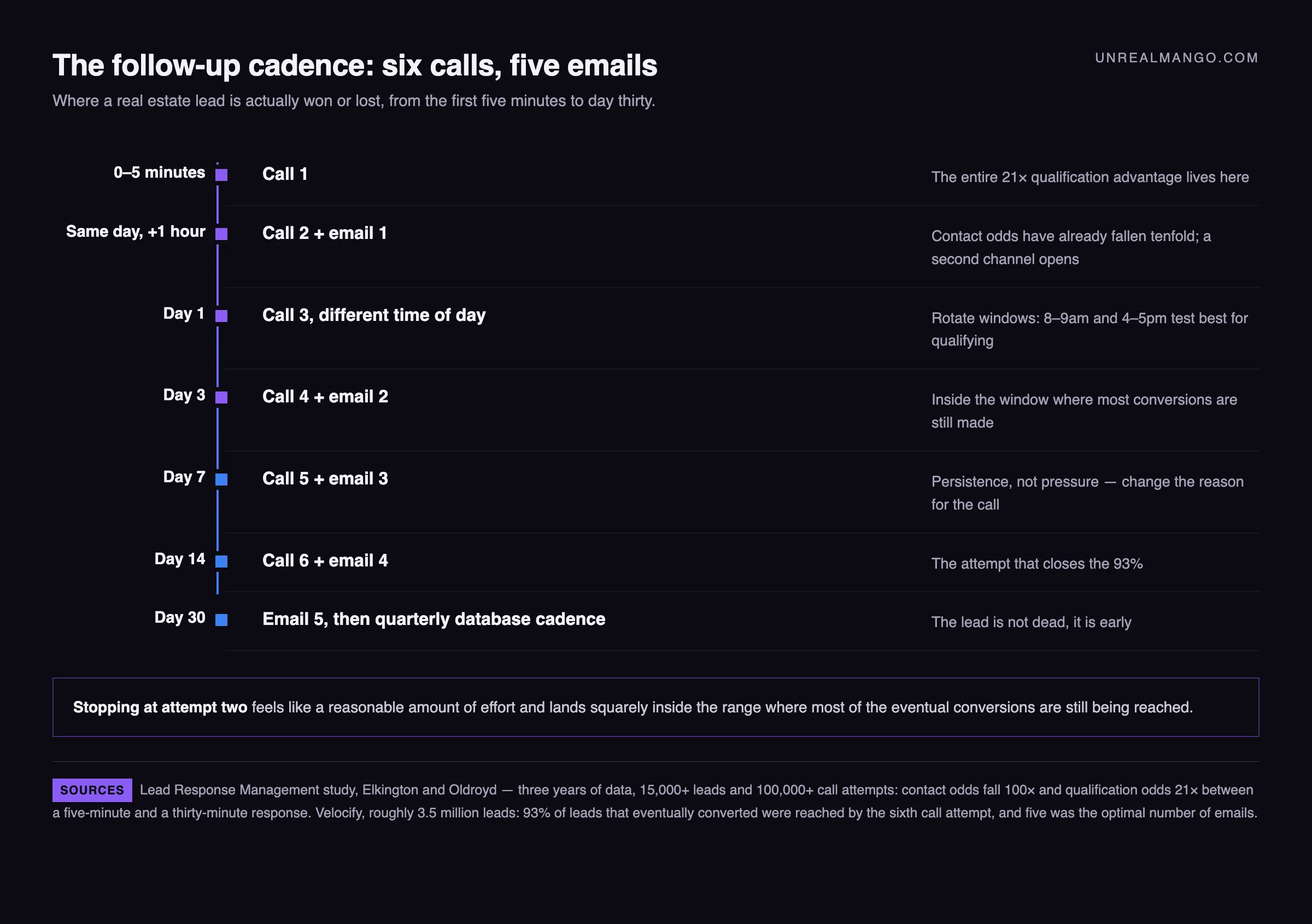
The failure mode is not laziness. It is stopping at attempt two, which feels like a reasonable amount of effort and lands squarely inside the range where most of the eventual conversions are still being reached.
A first-ninety-days plan for a new real estate agent
New agents get told to do all eight channels. Do three, in this order, because the first two produce contacts in weeks and the third takes a quarter to start.
Days 1–30 — the people who already know you. Build the database. Reach out to every contact individually, not as a broadcast. This is where 58% of the industry’s buyer relationships originate, and you already have the list.
Days 15–60 — put yourself where in-market people are. Ask for open houses nobody else wants, including other agents’ listings. Add expired and FSBO outreach: $60–100 a month, and the shortest path to a signed deal in the table.
Days 30–90 — build the two referral partnerships. One loan officer, one title or escrow rep. Two, chosen carefully, beat twelve collected at a networking event.
Hold paid channels until there is a cadence to feed them into. A lead that costs $16.61 and gets one call is worth less than no lead at all, because it also cost you the belief that the channel works.
Which lead channel to kill, and what to measure before you kill it
Most agents drop a channel on a feeling, at the exact point where the planning band said it would still be quiet.
Measure three things per channel, monthly:
- Contacts, not leads. A form fill you never reached is not a lead. Contact rate is the first number that tells you whether the problem is the channel or the response time.
- Contacts that reach a qualifying conversation — budget, timeline, motivation, and whether they can transact at all. The distinction between a marketing-qualified and a sales-qualified contact is the same one every industry fights over, and MQL versus SQL sets out where the line actually falls.
- Weeks from first contact to signed agreement. Compare it against the planning band above. A channel running inside its band is working; you are just early.
Kill a channel only after it has had its full band plus one month, and only if contact rate is the thing that failed. If contact rate is fine and qualification is not, the channel is delivering people at the wrong stage — and that is a targeting fix, not a reason to leave.
The whole grid — channels, costs, cadence, measurement — is one operating system rather than eight tactics, which is how we build it for the firms we work with in real estate and property marketing.
What to do this week
- Export your database and tag every contact by the year they last transacted.
- Pick one channel from the top half of the cost table and one from the bottom half. Two, not eight.
- Write the six-call, five-email cadence into whatever CRM you have, with the intervals above, before the next lead arrives.
- Book the first open house and the first two partner conversations for the next fourteen days.
The 58% figure is the strategy. The cadence is the execution. Everything else in the table is a decision about how long you are willing to wait.
12 / Reader questions
Frequently asked questions
01How much do real estate leads cost?
A lead you generate yourself costs from nothing to about $200, depending on the channel. Meta lead ads averaged $16.61 per lead in real estate and Google Search ads averaged $102.51 in WordStream's benchmarks, while a 5,000-piece farming drop computes to $64–205. Leads from past clients and referral partners carry no media cost at all — only your time.
02Are paid real estate leads worth it?
Paid leads are worth it when you can answer within five minutes and run a six-call cadence; otherwise they are not. The Lead Response Management study found the odds of qualifying a lead fall 21 times between a five-minute and a thirty-minute response, so a paid lead sitting in an inbox overnight has already lost most of its value.
03How do you get real estate leads for free?
Free real estate leads come from two places: your own past-client database and referral partners such as loan officers and title reps. NAR's 2025 buyer data shows 58% of buyers chose an agent through a referral or a prior relationship rather than through a search, which is the largest single source in the industry and costs no media spend. Neighborhood content is the near-free third option — it costs production time rather than media.
04How do new real estate agents get their first leads?
New agents get their first leads from people who already know them, then from open houses and expired listings. Both of those put you in front of someone already in market, so the wait is measured in weeks and months rather than quarters and years. Paid channels come later, once there is a cadence to feed them into.
05How long does it take to convert a real estate lead?
Plan on two to twenty weeks, depending on where the channel catches the person. An expired listing can sign inside a fortnight because the decision to sell is already made. A buyer who found you at week two of a search will take four months — NAR's 2025 data puts the typical buyer's search at a median of 10 weeks, plus a median four weeks on market.
06How many times should you follow up with a real estate lead?
Six calls and five emails, spread over about 30 days. Velocify's analysis of roughly 3.5 million leads found 93% of the leads that eventually converted were reached by the sixth call attempt, and that five was the optimal number of emails. Stopping at two attempts ends the sequence inside the window where most conversions still happen.