Published
Indie game marketing is not a list of tactics you choose from — it is a countdown assembled from deadlines Valve set before you started. A store page must sit public for two weeks before you can ship. Your release date locks 14 days out. Next Fest registration closes 43 to 49 days before the fest, and each game gets exactly one, ever. Miss one gate and the others move.
How this was checked. Every rule and date below comes from Steamworks Documentation, read on 10 August 2026, with the exact page named at each claim. Valve revises these pages without notice — the October 2026 registration deadline, for example, had already passed when this article published — so treat the offsets as the durable part and re-check the specific dates before you plan against them. For this query in the United States, Google returns an AI Overview and a top ten made of tactic lists: a 10-step plan, a five-ways listicle, two Reddit threads, a zero-budget guide. None of them contains a date.
Steam sets the indie game marketing timeline before you do
Most launch advice starts from what you want to do and asks when to do it. The platform works the other way: it publishes fixed offsets, and your plan has to fit between them. Four of them do nearly all the damage when missed.
| Gate | Offset, and from what | What it blocks if missed | Source |
|---|---|---|---|
| Store presence submitted for review | 7 days before you want the page live, 3–5 business days to clear | Nothing can start — the two-week clock has not begun | Steam Release Process |
| Store page public as “coming soon” | 14 days minimum before release | You cannot release at all | Steam Release Process |
| Release date lock | 14 days before your stated date | You can no longer change the date | Steam Release Dates |
| Next Fest registration | 43–49 days before the fest starts | The slot is gone, and each game gets only one | Steamworks Next Fest pages |
Read the first two rows together and the practical floor is not two weeks. Submit store presence, wait three to five business days for review, then hold the approved page as “coming soon” for fourteen days, then get a build reviewed. Three weeks between “I have a store page draft” and “I am allowed to press the button” is the realistic minimum, and it assumes review passes first time.
The build review is a second, separate queue. Valve requires store presence to be submitted for review before you can submit a build for review — the store page has to be in the queue first. The documentation does not state how long build review takes, so leave slack: the three-week floor assumes the build clears inside the fourteen-day coming-soon window. Nothing about this is negotiable by spending money.
The two-week “coming soon” rule that fixes your earliest release date
Valve’s wording in the release process documentation is direct: “Once your store page has been approved and it’s presence has been set to ‘coming soon’ for a least 2 weeks and the build is reviewed, you will be able to release your game.”
Two details in that sentence get lost in most retellings.
The clock starts on approval, not on the day you started writing the page. If review takes five business days and comes back with changes, the fourteen days start after the fix clears, not before. Teams that build the page the same week they want to ship discover this at the worst possible moment.
And release is manual. Games do not go live on a schedule — Valve requires you to click “Release App” yourself at the moment you choose. That is a small mercy on launch day and a trap if the person holding the account is asleep in another timezone.
Valve also removes weekends from the advance scheduling options and says plainly that while you can release on a weekend, they generally do not recommend it, because Steam staff are not available to help if something breaks. If your launch plan has a Saturday in it, you are choosing to launch without support.
The T-14 lock: the day your release date stops being editable
This is the gate that surprises people who have shipped software anywhere else. Per Steam’s release date documentation, “You can change the release date of your game up to two weeks prior to your specified date.” After that: “Once you are within that two week window, your game will start showing up more in ‘upcoming releases’ lists. Once this visibility starts, you can no longer adjust your release date.”
The trade is explicit. Steam gives you upcoming-release visibility, and in exchange takes away your ability to slip. Fourteen days before your date, the date becomes a commitment to the platform, not a plan on your whiteboard.
Everything downstream inherits that lock. Press embargoes, streamer scheduling, trailer drops and the marketing plan you built around them all assume a date that is now fixed for you rather than by you. If the build is not going to make it, T-14 is the last day you find that out cheaply — which means your go/no-go decision has to happen before it, not on it.
Steam Next Fest deadlines repeat on near-identical offsets every edition
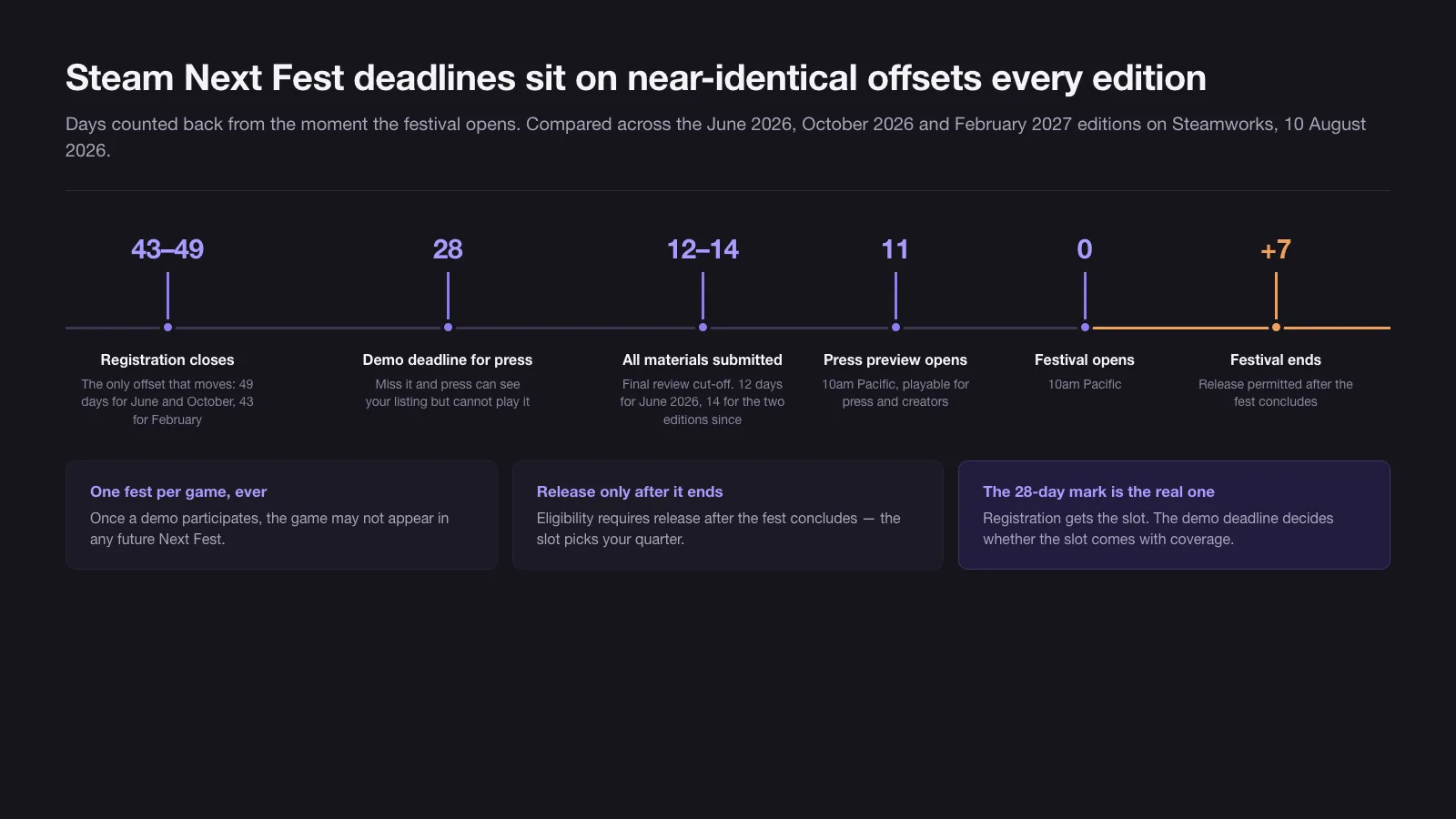
Next Fest is the one moment Valve hands a small game a large audience, and its schedule is more regular than the coverage suggests. Comparing the published milestone lists for three consecutive editions on 10 August 2026, the offsets from the festival start barely move.
| Milestone | June 2026 | October 2026 | February 2027 | Offset from start |
|---|---|---|---|---|
| Registration deadline | 27 April | 31 August | 10 January | 43–49 days |
| Demo deadline for press preview | 18 May | 21 September | 25 January | 28 days |
| All materials submitted for review | 3 June | 5 October | 8 February | 12–14 days |
| Press preview opens, 10am Pacific | 4 June | 8 October | 11 February | 11 days |
| Festival begins, 10am Pacific | 15 June | 19 October | 22 February | 0 |
| Festival ends | 22 June | 26 October | 1 March | +7 days (after start) |
Two inner deadlines hold exactly across all three editions: 28 days for a demo press can play, 11 days to press preview. Registration is the loose one — 49 days for the June and October editions, 43 for February. Final materials moved once, from 12 days for June 2026 to 14 for the two editions after it. Count back 14 and you are safe in all three.
That 11-day press preview is the part most plans get wrong. Press and creators are handed a playable build eleven days before your fest week, which means your outreach is not a fest-week activity — it is a mid-month-before activity. If your demo is not submitted by the 28-day mark, journalists can see your game listed during preview but cannot play it, and you have spent your one fest with the coverage window closed. Getting that outreach right is ordinary pitch craft on an unusual clock; the structure of a pitch that a games journalist will actually open does not change because the deadline is Valve’s.
The eligibility list is short and each item is a hard gate. Per the Steamworks pages for both the October 2026 and February 2027 editions, a game must be associated with a developer account in good standing, have a store page that is published and public, not be a prologue or chapter one or otherwise a demo version of content customers can already get, include a publicly playable demo by the time the festival begins, and be released only after the fest concludes.
One fest per game, and what that does to your release quarter
The February 2027 documentation states it without room to negotiate: “A game may only appear once in Steam Next Fest. Choose the Steam Next Fest that works best for your release timeline, as once your demo participates in the event, it may not appear in any future Steam Next Fests.”
Combine that with the rule that you may only release after the fest ends, and the fest stops being a marketing beat. It becomes the thing that picks your release quarter. The October 2026 fest concludes at 10am Pacific on 26 October and release is permitted after that, so 27 October is the date to plan against — the safe reading of “after the conclusion of the fest”. For February 2027 that date is 2 March. There is no version of this where you do the fest in February and ship in January.
The one-shot rule also punishes the instinct to enter early “for feedback”. A demo that goes into a fest eighteen months before launch has spent the slot, and the edition closest to your actual release — the one where fest wishlists convert into launch-day sales rather than aging for a year and a half — is no longer available to you. What those aging wishlists are actually worth, and why the thresholds quoted around them mean different things depending on which pool they were measured against, is a separate question with its own confusing arithmetic.
Press keys have a three-week floor you cannot shorten
Key distribution has a deadline nobody puts on a launch calendar, because it is measured from a date that is not a marketing date at all.
Per the Steamworks keys documentation: “Developers launching their first game on Steam must wait three weeks after the creation of an AppID before they can request Steam keys.” Not three weeks before launch — three weeks after the AppID exists. For a first-time developer, the AppID creation date is the true start of the press campaign, and it usually happens quietly, months before anyone thinks about outreach.
The volume limits are generous enough that they rarely bind: up to 5,000 Default Release keys to support retail and other stores, and generally up to 2,500 Release State Override (beta) keys, which are the ones that grant pre-release access to press and creators. Requests beyond those are reviewed case by case with no guarantee.
Two restrictions matter for outreach planning. Selling Release State Override keys is never permitted. And keys should not be given away free unless the game is also free to Steam customers, with an exception for small giveaways under 100 keys — which quietly caps the “1,000 keys to a Discord” tactic that circulates in launch threads.
Why paid traffic at launch does not buy Steam visibility
Here the platform documentation contradicts most of what ranks for this query. Valve’s visibility page states three things that dismantle the standard launch playbook, each under its own heading.
Under “Store Page Traffic Doesn’t Matter”: “The traffic landing on your store page is not a factor in your Steam store visibility.”
Under “Conversion Rate Doesn’t Matter”: “The conversion rate of users landing on your store page and making a purchase is not a factor in visibility on Steam.”
Under “Wishlists (Mostly) Aren’t a Factor”: “With a few exceptions like the Popular Upcoming tab, wishlists are not a factor in your game’s algorithmic visibility on Steam.”
And asked directly whether you can pay for your game to show up to more customers, Valve answers: “Nope.”
What Steam does count is narrower and harder to fake. “Are people buying and playing your game? This is a strong signal to Steam that there is interest.” The New Releases Queue works against you if you already have attention — it generates each visitor’s queue “prioritizing the titles that have the least amount of views since release”. The main capsule is “driven by what players spend time and money on, rather than Valve curation”. Review score drops out entirely as long as you are Mixed or above, which Valve puts at 40% positive.
The practical consequence is not “never run ads”. It is that ads have to be justified by the players they bring who actually buy and play, because the second-order benefit everyone assumes — that traffic and wishlists feed the algorithm and unlock organic reach — is one Valve explicitly denies. Spending to push store page traffic in the hope of triggering discovery is buying the input that Steam says it ignores.
Post-launch, the visibility you can actually schedule is the update round. Each product starts with five, each runs up to 30 days or one million homepage impressions, whichever comes first, and each requires a community announcement posted within the last 30 days. There is a scheduling trap in them: start a round before or during a seasonal sale and your game gets no update-round visibility on those days — but the days still count against the 30. Five rounds is a budget, and burning one into the Winter Sale spends it for nothing.
The 30-day discount cooldown decides your first sale event
Seasonal sales are open to all released games, so getting into the sale is not the problem. Discounting inside it is. Valve’s discounting rules block a discount within 30 days of release, within 30 days of any currency price increase, and for 30 days after a launch discount ends.
Line that up against the published calendar, read on 10 August 2026, and specific launches are pre-decided.
| Next Fest | Earliest legal release | Next seasonal sale | Can you discount in it? |
|---|---|---|---|
| October 2026 (ends 26 Oct) | 27 October 2026 | Winter Sale, 17 Dec – 4 Jan | Yes — ship by 17 November to discount from day one, or by early December to join partway |
| February 2027 (ends 1 Mar) | 2 March 2027 | Spring Sale, 18–25 Mar | No — 30 days from a 2 March release ends after the sale closes |
| June 2027 (ends 21 Jun) | 22 June 2027 | Summer Sale, 24 Jun – 8 Jul | No — the sale opens two days after you are allowed to ship |
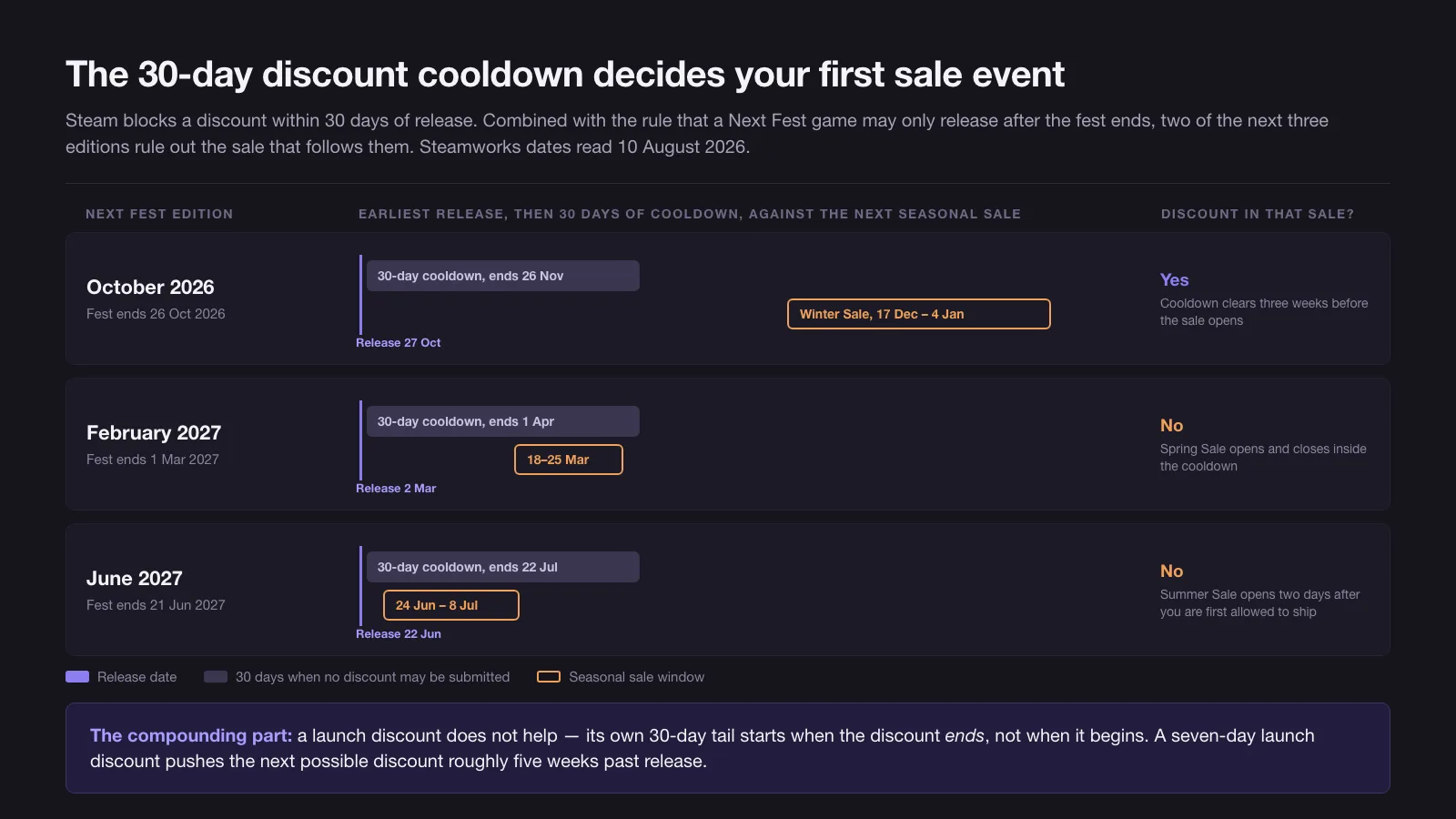
The June 2027 case is the cleanest illustration of how these rules compound. The fest ends 21 June, you may not release before 22 June, and the Summer Sale opens 24 June and closes 8 July. A game that does everything right is inside the biggest sale of the year and cannot put a number on it.
One escape hatch exists, and it only helps the first row. Valve allows joining a seasonal sale already in progress if your cooldown expires mid-sale, which widens the October window by about three weeks but does nothing for February or June, where the cooldown outlasts the whole sale.
A launch discount makes it worse rather than better, because its own 30-day tail starts when the discount ends, not when it begins. Run a seven-day launch discount and you have pushed your next possible discount out by roughly five weeks from release. That is a defensible choice — it just has to be made knowing which sale it forfeits.
One number worth planning around: a discount of 20% or greater automatically triggers email notifications to every player with your game wishlisted. That is the mechanism wishlists genuinely serve, and it is why they matter despite not feeding the visibility algorithm. Under 20%, no emails go out.
Indie game marketing strategies that fit inside the platform calendar
Working backwards from a target launch date, the sequence that satisfies every gate above looks like this.
- Create the AppID first, and treat that date as day zero. For a first game, keys cannot be requested for three weeks after it exists. Everything press-related descends from this date.
- Pick your Next Fest before you pick your release date. One per game forever, and release is only permitted after it ends. The fest chooses the quarter; the quarter chooses the date.
- Count back from the fest start: 49 days for registration (43–49 in practice, check your edition’s page), 28 for a press-playable demo, 14 for final materials, 11 for press preview. The demo deadline is the one that decides whether your one fest comes with coverage.
- Get store presence submitted at least three weeks before your earliest acceptable ship date. Seven days ahead of when you want it live, three to five business days of review, then fourteen days public as “coming soon”, then build review.
- Set your date knowing it freezes at T-14. Make the go/no-go call before the lock, not on it.
- Check what the release date does to your first sale window. Thirty days from release, and 30 more after any launch discount ends.
- Budget the five update rounds, and do not start one into a seasonal sale. The days burn either way.
Two things sit outside the calendar and matter more than any of it. The capsule art and the trailer are what the algorithm shows when it decides to show you at all, and no deadline compliance rescues a page nobody clicks. And the game itself has to be one Steam players want — every visibility surface Valve describes measures whether people buy and play, which is a signal you cannot schedule.
The rest is arithmetic, and arithmetic is the part you can get right on the first try. If you are building the wider plan this calendar has to slot into — channels, budget, what gets measured — the structure of a marketing plan that survives contact with a real deadline applies here as it does anywhere else, and our work with games and interactive studios starts from the same countdown.
10 / Reader questions
Frequently asked questions
01How long before release does a Steam page need to be live?
At least two weeks. Valve's release documentation states that once your store page has been approved and set to coming soon for at least two weeks, and the build is reviewed, you can release. Because store presence review should be submitted at least seven days ahead and usually takes three to five business days, the practical floor from submission to earliest release is closer to three weeks. Checked 10 August 2026.
02Can a game be in Steam Next Fest more than once?
No. Valve's Next Fest documentation states a game may only appear once in Steam Next Fest, and once your demo participates it may not appear in any future edition. That makes the slot a one-time choice tied to your release timing, not a recurring channel you can retry each quarter. Checked 10 August 2026.
03When are the upcoming Steam Next Fest dates?
Per Steamworks documentation on 10 August 2026: October 2026 runs 19–26 October, February 2027 runs 22 February to 1 March, and June 2027 runs 14–21 June. Registration deadlines land 43 to 49 days before each start — 31 August 2026 for the October edition and 10 January 2027 for the February one. Verify on Steamworks before planning, as Valve moves these.
04Do wishlists affect your game's visibility on Steam?
Mostly no. Valve's visibility documentation states that with a few exceptions such as the Popular Upcoming tab, wishlists are not a factor in algorithmic visibility. Wishlists still matter — they drive launch and discount emails to interested players — but they are a notification list, not a ranking input for Steam's recommendation surfaces. Checked 10 August 2026.
05Should an indie game run paid ads at launch?
Paid traffic does not buy Steam visibility. Valve states plainly that store page traffic is not a factor in store visibility, that conversion rate is not a factor, and that you cannot pay for your game to show up to more customers. What Steam does count is purchases and playtime. Ads can still be worth running to reach players who will buy, but not as a lever on the algorithm.
06How many Steam keys can you request for press and streamers?
Up to 5,000 Default Release keys for a launching game, and generally up to 2,500 Release State Override (beta) keys for pre-release access. Developers launching their first game must wait three weeks after the AppID is created before they can request keys at all, which puts a hard floor under any press campaign. Checked 10 August 2026.
07When can an indie game first appear in a Steam sale with a discount?
Thirty days after release at the earliest. Seasonal sales are open to all released games, but Valve's discounting rules block a discount within 30 days of release and for 30 days after a launch discount ends. A game leaving Next Fest in June 2027 therefore cannot discount during the Summer Sale, which opens two days after the earliest date that game is allowed to ship.