Published
A marketing plan template is nine sections: summary, goal, customer, market, positioning, channels, budget, timeline, measurement. Every template on the first page of Google hands you those nine headings blank. What none of them show is that the same nine sections produce three completely different documents depending on what the business sells.
How this was checked. For this query in the United States on 10 August 2026, Google returns an AI Overview above nine organic results. Two of those results are files rather than pages — a PDF from the Small Business Administration and a .docx sitting in a media library — one is a Reddit thread from 2019, and one is a Forbes column published in September 2013. The AI Overview closes by asking the searcher what their industry is and whether the plan is quarterly, annual or product-specific, because a list of section names does not answer the question on its own. The three plans below are worked examples, not case studies: every input is stated, every output is arithmetic on those inputs, and where a quotient does not land on a whole unit it is rounded up and the rounding is shown.
What a marketing plan contains, and what each section is load-bearing for
The section list is not contested. Google’s own AI Overview for this query gives eight — executive summary, mission and business goals, SWOT, target audience and personas, competitive analysis, strategies and channels, budget and resources, timeline and KPIs. Pull positioning out of the SWOT box where it usually hides, and split “timeline and KPIs” into a schedule and a stopping rule, and you get nine.
The table below reads in document order. The failure column is the more useful half: every section has a version that survives review and still tells nobody what to do on Monday.
| Section | What belongs in it | The version that makes the plan useless |
|---|---|---|
| Executive summary | The goal, the three channels, the budget and the review date, in one paragraph | A mission statement with no number in it |
| Goal | One revenue or volume figure, a date, and the arithmetic connecting the two | “Increase brand awareness” |
| Customer | Who buys, and the event that starts them looking | A persona with a stock photo and a first name |
| Market and competitors | What the buyer uses instead of you, and what it costs them | A market-size figure copied from an industry report |
| Positioning | The comparison you win, and the one you lose | A list of adjectives every competitor also claims |
| Channels | Two or three, each tied to a number from the goal arithmetic | Nine channels, one line each |
| Budget | One monthly figure and what it buys per unit of result | A total with no denominator |
| Timeline | What must be true at months three, six and twelve | A Gantt chart of tasks already assigned |
| Measurement | The metric, the review date, and the number that triggers a stop | “We will track KPIs” |
How the budget splits across those channels is its own piece of arithmetic with its own failure modes, and it is a separate document from this one — here the budget is one line and one derived cost per unit of result.
The whole plan as nine sentences you fill in
Section headings are the part everyone already has. The part that stalls people is the first sentence under each heading. So here is the plan as nine sentence stems, one per section, in the order you write them rather than the order the finished document reads.
- Goal. Over the next
___months we will grow___from___to___, which is___additional___at an average value of___.- Customer. We sell to
___, who start looking when___happens.- Market and competitors. They solve this today with
___, which costs them___, and the alternatives they weigh against us are___.- Positioning. We win that comparison on
___, and we lose it when___.- Channels. We will reach them through
___,___and___, because___.- Budget. This costs
___per month, which works out to___per___.- Timeline. By month three
___, by month six___, by month twelve___.- Measurement. We review on the
___of each month, and we stop anything that has not produced___by___.- Executive summary. Written last: the eight sentences above, in order, with the numbers left in.
The goal sentence goes first because every number after it is derived from it. If you cannot fill sentence one with a figure, the remaining eight are decoration — and that is true of the blank templates too, which is why a downloaded file so often ends up half-completed.
Each of the three plans below fills in sentences one to eight, and closes with a paragraph headed where this plan actually breaks. That closing paragraph is commentary rather than a tenth section: it is the thing you would notice reading someone else’s plan, and never notice reading your own.
Plan one: a two-van plumbing company adding $180,000
Goal. Over the next 12 months we will grow service revenue from about $393,000 to about $573,000. At an average job value of $420 that is 429 additional jobs — $180,000 ÷ $420 is 428.6, rounded up — or 36 a month.
Customer. Homeowners aged 35 to 65 within a 25-minute drive, who start looking the hour something is leaking. There is no consideration phase to nurture; there is a phone that rings or does not.
Market and competitors. They solve this today by searching on a phone and calling the first firm that answers, which costs them somewhere in the same $350 to $450 band we quote in. The alternatives they weigh are the two other local firms with review counts above 200 and whichever national booking app served them an ad.
Positioning. We win on same-day arrival with a named time window. We lose whenever the quote is given over the phone before anyone has seen the job.
Channels. Local search and the map pack, paid search on emergency terms, and the existing customer list for maintenance work — because 429 jobs at a 55% booking rate means 780 qualified calls a year, or 65 a month, and only the first two channels produce calls in the hour they are needed. Google Ads pricing for that kind of emergency term is the input that decides whether the paid line survives; for a worked channel-by-channel version of this arithmetic in one local vertical, see our breakdown of real estate lead channels.
Budget. $2,400 a month, which is $28,800 a year, or $67 per booked job — 16% of the average job value.
Timeline. By month three the map-pack listing ranks in the top three for two emergency terms. By month six calls run at 65 a month. By month twelve the company is booking 36 additional jobs a month, which is a 429-job annual run rate; the first full 429-job year is the one after.
Measurement. We review on the 5th of each month on one number: qualified calls. We stop any channel that has not produced a booked job by day 60.
Where this plan actually breaks. Not in demand — in vans. Two technicians working five days a week, minus statutory holidays and two weeks off each, average about 20 working days a month, and at three jobs a day that is 120 job slots. The company currently completes 78 a month, which is 65% of capacity. Adding 36 takes it to 114, or 95%. The plan clears the ceiling with 5% to spare, which means it works this year and cannot be repeated: run the same growth again in year two and there is no room, at which point the honest document is a hiring plan with a marketing section attached, not the other way round.
Plan two: a skincare brand where the growth is in the second order
Goal. Over the next 12 months we will take revenue from $840,000 to a $1,200,000 annual run rate. At a $58 average order value that increment is 6,207 orders a year — $360,000 ÷ $58 is 6,206.9 — or 517 a month once the run rate is reached.
Customer. Women aged 28 to 45 who already use a three-step routine and are replacing one product in it, not building a routine from nothing. They start looking when the product they have runs out, which makes the timing of the second email more important than the wording of the first.
Market and competitors. They solve this today by reordering the thing they already own, at $32 to $45 on a pharmacy shelf. The alternatives are two established brands stocked in those pharmacies and whatever a creator they follow demonstrated that week.
Positioning. We win on a single reformulated actives claim that can be shown on skin in 30 seconds of video. We lose on any comparison that starts at the shelf, where we are not present.
Channels. Paid social for first purchase, creator seeding for the demonstration, and owned email and SMS for the repeat — because at a mature 1.35 orders per customer per year, 6,207 orders need 4,598 new customers, and at a 1.2% conversion rate on new-visitor sessions that is 383,167 sessions a year, or 31,931 a month. Treat 4,598 as a floor: a customer acquired in month eleven cannot deliver 1.35 orders inside the plan year.
Budget. $9,000 a month, which is $108,000 a year, or $23.49 per new customer. Against $78.30 of first-year revenue per customer at 62% gross margin, each new customer returns $48.55 of gross profit — 2.07 times what it cost to acquire them.
Timeline. By month three the repeat rate is instrumented and the second-order window is known. By month six new-visitor sessions run at 32,000 a month. By month twelve the business is at a $1.2M annual run rate; the $1.2M calendar year is the one after.
Measurement. We review on the 5th on two numbers: new customers, and orders per customer over a rolling twelve months. We stop any creator partnership that has not produced a first order within 30 days of the post.
Where this plan actually breaks. The traffic requirement. The existing $840,000 comes from about 14,483 orders a year, and at a 2.1% blended conversion rate that is roughly 689,667 sessions. The plan asks for another 383,167 on top of that at the lower rate new visitors convert at — 56% more traffic than the brand currently gets, in a year, on $9,000 a month.
The other lever is cheaper and sits in the goal arithmetic rather than in the channels. Lift orders per customer per year from 1.35 to 1.55 — one more repeat purchase from one customer in five — and the same 6,207 orders need 4,005 new customers instead of 4,598. That is 593 fewer customers to acquire, 49,417 fewer sessions a year, and 13% off the additional traffic requirement without touching the ad account. It is not a rounding error and it is not a substitute either: 13% is a discount on the problem, not a solution to it.
Plan three: a compliance vendor whose plan year was decided last year
Goal. Over the next 12 months we will grow the contract book from $7.6M to $10.0M of annual recurring revenue before churn, which is $2,400,000 of new ARR. At an $80,000 average contract value that is 30 new customers.
Customer. Heads of compliance at 500-to-2,000-employee financial services firms, who start looking when an audit finding lands or a regulation gets a commencement date. Nobody in this market buys because a piece of content was good.
Market and competitors. They solve this today with a spreadsheet and two contractors, which costs roughly $180,000 a year in people, or with one of three incumbent platforms already embedded in the audit workflow. The real alternative in most deals is doing nothing for another year.
Positioning. We win on the migration path off the spreadsheet, evidenced in a pilot. We lose on procurement, where the incumbents are already an approved vendor and we are a new supplier form.
Channels. Field events, an analyst-adjacent research programme, and outbound to a named account list — because 30 deals at a 22% win rate means 137 sales-qualified opportunities, and at a 28% MQL-to-SQL conversion rate, counting an SQL as an opportunity sales has accepted, that is 490 marketing-qualified leads, or 41 a month.
Budget. $34,000 a month, which is $408,000 a year, or $833 per marketing-qualified lead and $13,600 of marketing cost per closed deal — 17% of first-year contract value.
Timeline. By month three the named account list is built, the pilot offer is defined, and MQLs run at 41 a month. By month six the first cohort sourced inside the plan year is in late-stage. By month twelve $10.9M of qualified pipeline is standing on the books for next year — and the same $10.9M had to be there on day one for this year to land.
Measurement. We review on the 5th on one number: qualified pipeline created this month. We stop any channel that has not produced an opportunity within nine months, one full sales cycle.
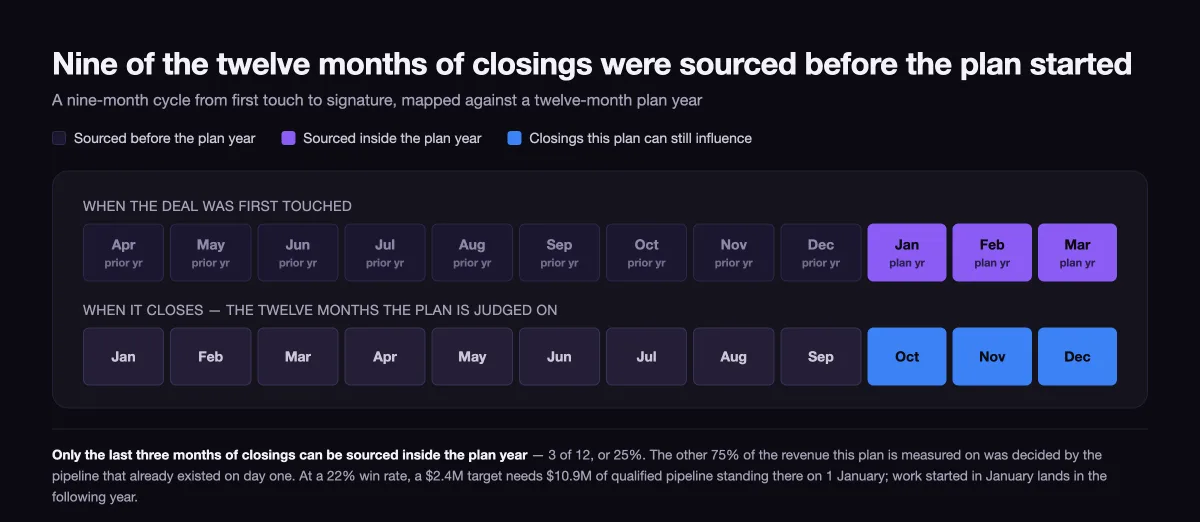
Where this plan actually breaks. The calendar. First touch to signature runs about nine months. A deal that closes in December had to be sourced in March; a deal closing any time in the first nine months of the year was sourced before the year began. So nine of the twelve months of closings — 75% of the revenue this plan is judged on — were already determined by the pipeline that existed on day one. The activity in this plan is, almost entirely, next year’s revenue.
That has one blunt consequence for how the document is read. If the pipeline on 1 January is short of $10.9M, no amount of marketing started in January fixes this year, and a plan that promises otherwise is describing a different company.
Same nine sections, three different numbers running the plan
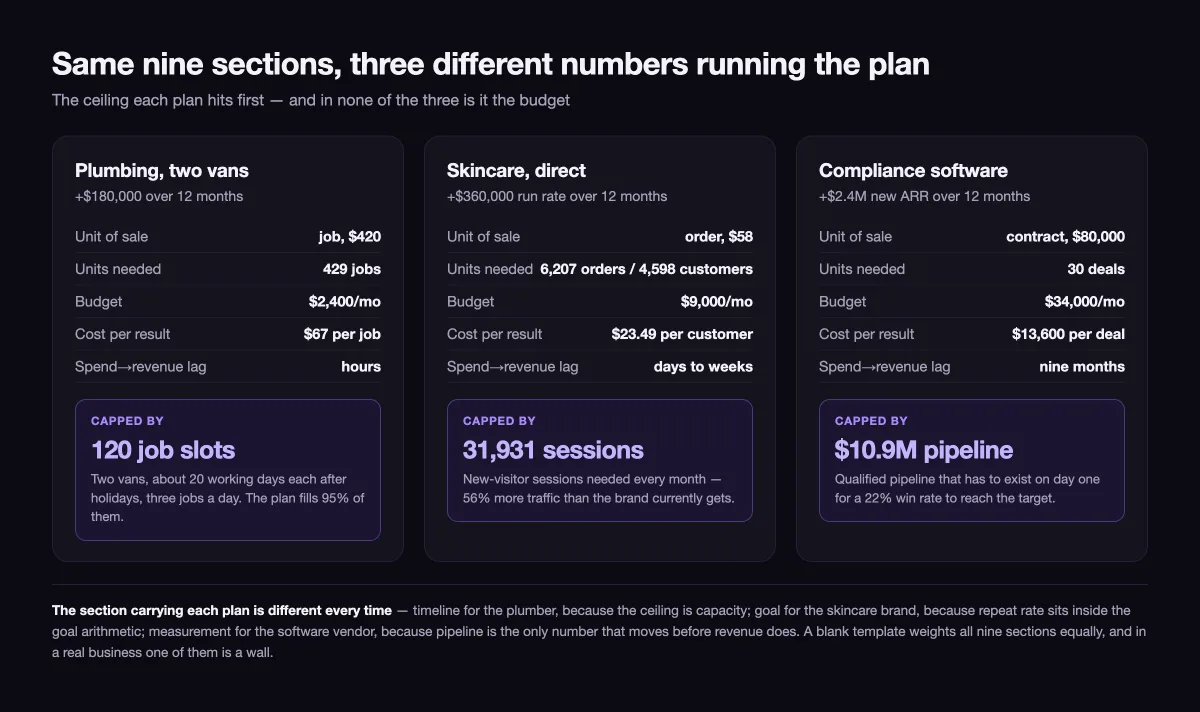
Put the three side by side and the useful pattern is what did not change. All three run the same eight working sections in the same order, with the executive summary assembled last out of them, and all three fit on one page. What differs is which single number the plan is actually governed by — and it is never the budget.
| Plumbing, two vans | Skincare, direct | Compliance software | |
|---|---|---|---|
| Revenue goal | +$180,000 | +$360,000 run rate | +$2.4M new ARR |
| Unit of sale | job, $420 | order, $58 | contract, $80,000 |
| Units needed | 429 jobs | 6,207 orders from 4,598 new customers | 30 deals |
| Budget | $2,400/mo | $9,000/mo | $34,000/mo |
| Cost per unit of result | $67 per booked job | $23.49 per new customer | $13,600 per closed deal |
| The number that caps the plan | 120 job slots a month | 31,931 new sessions a month | $10.9M of pipeline on day one |
| Lag from spend to revenue | hours | days to weeks | nine months |
| What a bad month costs you | that month | that quarter | next autumn |
| Section that carries the plan | timeline, because it is capacity | goal, because repeat rate sits in it | measurement, because pipeline is the leading number |
Three ceilings, three different sections doing the work. This is the reason a blank template feels unhelpful even when it is complete: it presents nine sections as equally weighted, and in any real business one of them is a wall and the other eight are furniture.
Reverse arithmetic: from the revenue number back to reach
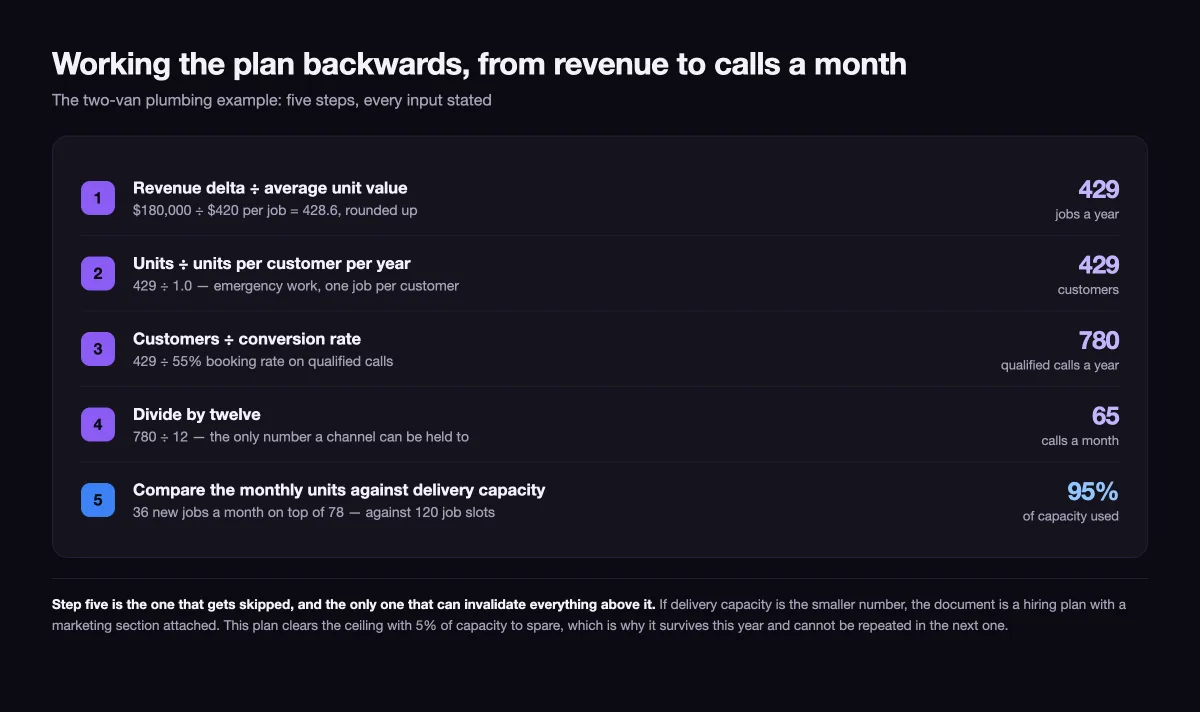
Every one of the three plans was built the same way, backwards, in five steps. It is short enough to do in one sitting, and it is the part the templates leave out.
- Revenue delta ÷ average unit value = units. $180,000 ÷ $420 = 428.6, call it 429 jobs.
- Units ÷ units per customer per year = customers. For the plumber this is 1.0, so 429 customers. For the skincare brand it is 1.35, which is why 6,207 orders need only 4,598 people.
- Customers ÷ conversion rate = qualified leads, sessions or calls. 429 ÷ 55% = 780 calls a year.
- Divide by twelve. 65 calls a month. This is the number that goes in the channels sentence, and it is the only number a channel can be held to.
- Compare the monthly units against delivery capacity. 36 extra jobs a month on top of the 78 already done, against 120 monthly job slots — 95% of capacity. If capacity is the smaller number, stop writing a marketing plan.
Step five is the one that gets skipped, and it is the only step that can invalidate everything above it. A plan whose demand target exceeds what the business can deliver does not fail quietly — it fails by winning, in month nine, with a two-week backlog and a review score that takes a year to repair. If the reverse arithmetic keeps landing on a number the business cannot serve, the conversation to have is about what the marketing strategy is actually for before anyone opens a template again.
The 3-3-3 rule, the 5 C’s and the seven steps that turn out to be eight
Search for a marketing plan template and Google will offer you three framework questions before it offers you a template. They are worth exactly as much as their sources, and the sources vary more than you would expect.
The 3-3-3 rule does not have a definition. Checked on 10 August 2026, one published guide defines it as three brand messages, three audience segments and three prioritised channels. Another, written by a managing director and published the same way, defines it as three seconds to capture attention, three key messages and three reinforcing elements for recall. Neither credits an originator; the second concedes that “interpretations vary slightly depending on context”, which is generous for two definitions that share nothing but the digits. A rule you cannot state the same way twice is not a planning tool, and nothing in this article is built on it.
The 5 C’s are real and are not a plan. Company, Customers, Competitors, Collaborators and Climate — Climate sometimes taught as Context or Conditions — is a durable checklist for the situation analysis. It tells you what to look at before writing. It contains no goal, no budget, no dates and no stopping rule, so a document organised around the 5 C’s is a research summary that ends where the plan should start.
The seven steps are usually eight. The publication Google surfaces for “how do you write a simple marketing plan” is a University of Florida extension guide titled as eight steps, of which Google’s snippet shows six. Its actual eight are objectives, target market demographics, competition, product or service, place and distribution, promotion, pricing, and budget. That is not an error on anyone’s part; it is what happens when a continuous piece of work gets counted, and those eight can be split into five steps or nine with equal honesty. Chase the count and you are optimising the table of contents.
What happens to the plan in month four
Marketing plans are not usually wrong. They are abandoned, and the point of abandonment is normally the first month a channel underperforms and there is no written rule about what to do next.
Three things keep a plan alive past that point, and all three are already in the nine sentences.
A review date, not a review cadence. “Monthly” is not a date and will be skipped. The 5th is a date. In all three plans above the review is on the 5th and reads one or two named numbers, never a dashboard.
A stop rule with a number in it. “We stop any channel that has not produced a booked job by day 60” is a decision made in advance, when nobody is defending anything. Written after the fact, the same sentence becomes an argument.
A goal number nobody has quietly renegotiated. Targets drift when the arithmetic behind them is not written down. If the goal sentence still shows 429 jobs at $420, a proposal to change it has to argue with the number rather than around it.
The timeline sentence turns into dated rows in a content calendar once the channels are chosen, and that calendar is a separate artefact with failure modes of its own — a plan that has become a calendar has stopped being a plan and started being a schedule, which is progress, but only if the review date survives the transition.
10 / Reader questions
Frequently asked questions
01What are the 7 steps of a marketing plan?
There is no canonical seven: the steps almost every list shares are setting a revenue goal, defining the customer, sizing the market and naming competitors, stating a position, choosing channels, setting a budget and deciding how the plan is measured. Counts differ because sources split or merge the same work — the University of Florida extension publication Google features for this query is titled as eight steps, and the summary Google pulls into the snippet shows six of them.
02What are the 5 components of a marketing plan?
The five-component version of a marketing plan is goal, target customer, positioning, channels and budget — the standard nine-section list with the executive summary, competitor analysis, timeline and measurement removed, which is a usable minimum for a plan that has to fit on one page provided the measurement line goes back in before anyone spends money.
03What are the 5 C's of a marketing plan?
The 5 C's are Company, Customers, Competitors, Collaborators and Climate, the last sometimes taught as Context or Conditions. It is a checklist for the situation analysis rather than a structure for the document: it tells you what to look at before writing, and says nothing about goals, budget, timing or how the result gets measured.
04What is the 3-3-3 rule in marketing?
There is no agreed 3-3-3 rule, which is the practical answer. Checked on 10 August 2026, one published version defines it as three brand messages, three audience segments and three channels; another defines it as three seconds to capture attention, three key messages and three reinforcing elements for recall. Neither credits an originator, and two definitions that share nothing but the digits cannot both be a rule.
05How do you write a simple marketing plan?
Write it as nine sentences, one per section, starting with the goal and its arithmetic and finishing with the executive summary, which is assembled last out of the eight above it. A plan that fits on a page gets read in month four, which is the only month that matters; a thirty-page plan is a document about planning. Fill the goal sentence in first, because every later number is derived from it.
06What is the difference between a marketing plan and a marketing strategy?
A strategy is the choice of who you serve and why they should pick you; a plan is the dated, costed schedule for acting on that choice. The strategy fits in two sentences and rarely changes inside a year. The plan is nine sections with numbers in them and is expected to be edited every quarter.
07How long should a marketing plan be?
One to three pages for a business under roughly fifty people, and rarely more than ten for anyone else. Length correlates with how many people must agree rather than with how much marketing gets done. The test is whether the person executing it can restate the goal, the channels and the review date from memory.