Published
A media kit is one place holding everything an outsider needs to describe you accurately or decide whether to pay you — logo files, facts, photos, audience numbers, a contact. Three different documents share that name, and two of them get confused constantly: one is sent to press, one is sent to brands. The third, a publisher’s advertising kit, is covered further down.
The eight examples below are real, currently public, and openable by anyone. Six are brand kits, one is a publisher rate kit, one is a newsletter kit that behaves exactly like a creator kit.
How this was checked. Every kit named on this page was opened directly in August 2026 and the section names, figures and rules quoted here are taken from those pages, not from other articles about them. Where a page would not render its file list without JavaScript, this article says so rather than describing contents it could not see. Market figures come from named published reports with their sample sizes and the year they actually measure. Where no primary source exists for a claim that circulates widely, this page says that too.
Two media kits that travel in opposite directions
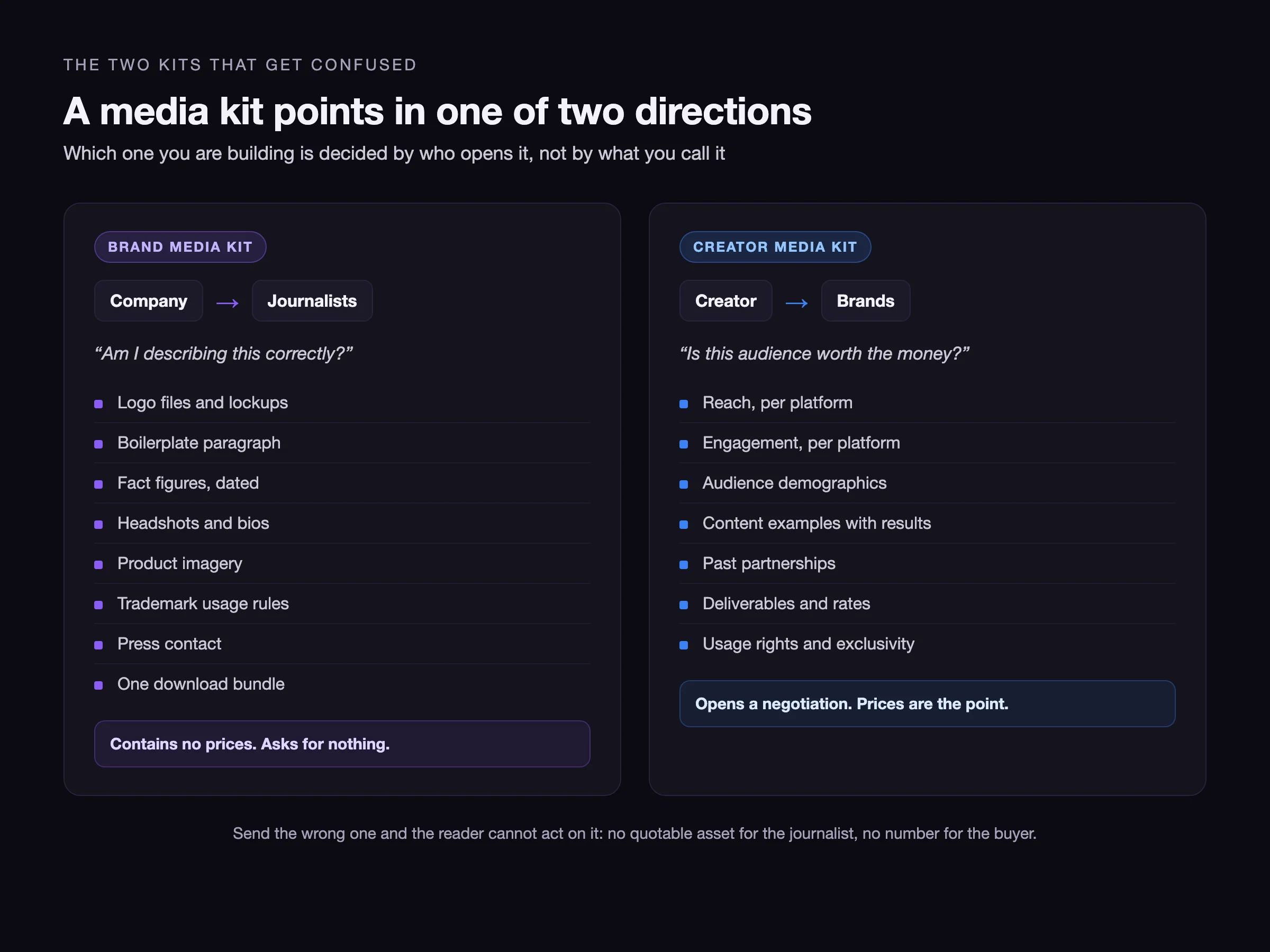
The brand media kit travels outward from a company to people who write about it. Its job is accuracy and control: correct logo, correct spelling of the founder’s name, a figure the reporter can cite without emailing to confirm it. Nothing in it is negotiable, and nothing in it is priced.
The creator media kit travels outward from a person to companies who might pay them. Its job is qualification and price: how many people, how engaged, who they are, what a post costs, what the brand may do with the footage afterwards. Almost everything in it is negotiable, and the whole document exists to open that negotiation.
| Brand media kit | Creator media kit | |
|---|---|---|
| Sent to | Journalists, editors, partners | Brand and agency partnership teams |
| Reader’s question | Am I describing this correctly? | Is this audience worth the money? |
| Core content | Logos, boilerplate, fact figures, headshots, imagery | Reach, engagement, demographics, past partnerships |
| Numbers shown | Company facts, dated | Audience metrics, per platform |
| Prices | Never | Usually, as a starting point |
| Legal weight | Trademark usage rules | Usage rights, exclusivity, licensing window |
| Lives at | A permanent newsroom URL | A PDF or link sent per pitch |
| Goes stale when | A headline figure changes | Every quarter, faster on a growing account |
The tell is the direction of the ask. A brand kit asks nothing; it removes work from the reader. A creator kit asks for money; it has to remove doubt first.
Inside a brand media kit: what a newsroom expects to find
Eight components recur across the brand kits examined for this article. Not one of them ships all eight.
- Logo files, in more than one format and lockup. Primary mark, symbol-only mark, and a monotone version for single-color printing. Vector matters more than resolution here: a reporter placing your logo on a dark background needs an SVG or EPS, not a white-boxed PNG.
- A boilerplate paragraph. Two or three sentences the outlet can paste verbatim. Stripe’s runs: “Our mission is to increase the GDP of the internet. Stripe is a technology company that builds economic infrastructure for the internet.”
- Fact figures, dated. Numbers a journalist can cite without a confirmation email. The date stamp is the part most kits skip and the part that decides whether the number gets used.
- Executive headshots and short bios. Print-resolution, current, and named so the file itself identifies the person.
- Product or service imagery. Screenshots, packshots, interior shots — whatever the story would need a picture of.
- Usage and trademark rules. What may be recolored, resized or reproduced, and what may not.
- A press contact. One email address that a person reads.
- A download bundle. One archive so the reporter takes everything in a single click rather than saving twelve files.
Two things belong in the kit but are not the kit. Full brand guidelines are a separate, longer document about how the identity is used across every surface; a media kit links to them rather than containing them. And the announcement itself is not kit material either — the structure of that document is covered separately in our guide to press release examples, because a release is written to expire and a kit is written to persist.
Inside an influencer media kit: what a brand checks first
No rigorous published survey of what brands look for inside a creator media kit appears to exist, and the ranked lists of “what brands want in a media kit” checked for this article all trace back to unsourced marketing content. What does exist, and is far more useful, is the set of fields the marketplaces themselves expose — because those are the fields a brand-side buyer actually sees when they shop.
TikTok’s Creator Marketplace surfaces to brands: average views per video, follower count and follower growth rate, engagement rate, the creator’s most recent and most popular videos, previous brand partnerships, and follower gender and location. That is a de facto specification for a creator kit, written by the platform rather than by a blog.
Around that core, a complete kit carries four more blocks:
- Audience demographics, not just size. Age band, gender split, top countries or cities. A brand selling in one market pays for reach in that market, not for a global follower count.
- Content examples with results attached. Three or four posts, each with its own view and engagement figures, so the numbers are checkable against live posts rather than asserted in a summary.
- Deliverables and rates. What one unit of work is — a video, a set of stories, a carousel — and what it costs. Collabstr’s 2026 report, built on first-party marketplace data covering 2025, found 80% of all engagements cost under $300, 18% land between $301 and $1,000, and only 2% exceed $1,000. A rate card that opens at $2,500 is not describing the same market most deals happen in.
- Terms: usage rights, exclusivity, whitelisting. Usage rights are the brand’s right to run your content outside your own feed — in paid ads, on their site, in email — defined by channel, territory and duration. Exclusivity is your agreement not to work with their competitors for a set period. Whitelisting is the brand running paid ads from your handle, which both platforms now have official names for: Meta calls it Partnership Ads, the format it previously called Branded Content Ads, and TikTok calls it Spark Ads, authorized through a post authorization code with a duration you set.
That last block is the one most creator kits omit, and the survey of roughly 900 marketers and creators fielded for Aspire’s 2026 State of Influencer Marketing report explains why omitting it is expensive: 67% of brands write content usage rights into the creator’s initial contract or rate, and 77% repurpose creator content in paid ads. Usage is the default case, not the upsell. A kit silent on usage invites the brand to price it at zero.
impact.com publishes the most-quoted uplift figures for these terms — 20 to 50% of base rate for usage rights, 20 to 100% for exclusivity, and 5 to 20% of the brand’s total paid ad spend for amplification. Worth knowing, and worth labeling honestly: those come from named in-house experts, not from a dataset. Anyone stating “usage rights add 30%” as a measured fact is repeating guidance without saying so.
Eight media kit examples worth opening
Each of these is public and loads without a login. They are ordered from the most complete brand kit to the kit that most resembles what a creator sends.
1. Stripe — the complete classic kit
Sections it publishes: About Stripe · Fast facts · Leadership · Board members · Media assets · The Stripe logo · Stripe badge · Media gallery.
Stripe’s newsroom information page comes closer than anything else here: seven of the eight components, in one place. The fast facts block gives four citable figures — $1.4T+ in payments processed in 2024, 135+ currencies and payment methods, 50+ countries, and 100+ industry leaders processing over $1B annually — each phrased so a reporter can lift it whole. Ten named leaders and eight board members appear with photos and titles, and the leadership photos and bios download as a single archive rather than as eleven separate saves.
What to copy: the leadership bundle. Most kits make a journalist right-click ten images. What it still misses: there is no press contact email on the page, and the fast facts carry no date stamp. The most complete kit in the set has no person on it.
2. Atlassian — the kit that treats people as a first-class section
Sections it publishes: Executives · Founder headshots · Logos · Atlassian products · Company overview · Press releases.
Atlassian is the only example that gathers the leadership team and the board of directors into a single named headshots-and-biographies section, and the only one that gives founder headshots a separate block and download archive of their own. The company overview covers history, mission, values, milestones and current facts in one place, and the page carries a working press contact — press@atlassian.com — with an explicit invitation for press or speaking requests.
What to copy: the press contact framed as an offer rather than a formality.
3. Airbnb — the kit that dates its own numbers
Sections it publishes: About us · Fast facts · Founders · The Airbnb story.
Airbnb’s newsroom carries the most quotable boilerplate of the set — the company “was born in 2007 when two hosts welcomed three guests to their San Francisco home” — and a fact block that is explicitly stamped “Last updated May 2026”, including 9M+ active listings, 150K+ cities and towns, 220+ countries and regions, 2.5B+ all-time guest arrivals, 5.5M+ hosts, $380B+ earned by hosts and $18B+ in taxes collected and remitted. It also carries a legal guard no other kit here has, stating that the newsroom is aimed at journalists and that listings referenced on it are illustrative rather than endorsed.
What to copy: the date stamp on the fact block. It is the cheapest credibility signal in a media kit. One practical catch: the separate media assets page returns a page but builds its asset grid in JavaScript, so the file list is not in the source. Anything reading the page without executing scripts — including a growing share of AI crawlers — sees an empty shelf.
4. Spotify — the kit that is a library, not a document
How it is structured: a single index of per-campaign kits behind a load-more button, each labeled with its file count. Investor Day 2026 (116 files), 2025 Wrapped (149), 2024 Wrapped (143), Now Playing 2024 (105), Loud & Clear 2025 (24), Loud & Clear 2026 (23), Afrobeats (11), $10B Payout (5), and more.
Spotify does not publish one evergreen kit. It publishes a shelf of news-event bundles with a “Download All” archive. This is the right model for a company that makes announcements often enough that a single kit would either bloat or go stale.
Where it falls short: the logo files on these pages are PNGs, named for their color variant rather than offered in a choice of formats. A designer needing vector has to go elsewhere.
5. Shopify — brand guidelines wearing a media kit’s clothes
Sections it publishes: Primary logo · Monotone logos · The Shopping Bag · Clear space · Minimum size · Best practices · Trademark Usage Guidelines.
Shopify’s brand assets page is not really a press kit; it is a rules page with downloads attached. It publishes hard specifications — a minimum logo width of 80px on screen and 28mm in print — and a nine-item list of prohibitions covering stretching, rotating, stacking, gradients, low-contrast backgrounds and inventing your own variant. Its trademark language is the strictest in this set: use of the brand assets must be expressly authorized in writing, and misuse triggers automatic termination of the license.
What to copy: publishing the numbers. “Use it at a reasonable size” produces arguments; “80px minimum” does not. What it costs: no press contact, no fact sheet, no bios. A journalist arriving here still has nothing to write with.
6. Netflix — the usage rules taken to their logical end
How it is structured: a company assets page split into Brand, Product and Office tabs, with the brand tab holding exactly two items — the logo and the symbol — plus a separate two-page usage guidance PDF.
The PDF publishes exact color values for Netflix Red (HEX #E50914, RGB 229 9 20, CMYK 0 96 93 2, PMS 1795 C) and defines clear space as half the width of the N. Its “avoid” list is the most memorable writing in any media kit here, because it is about physical objects rather than files: avoid doormats and rugs “or anywhere else people walk”; avoid scratch-offs and dart boards; avoid disposable items such as plastic cups and paper napkins; avoid food, because “we don’t want our logo to be sliced, bitten, or digested.”
What to copy: the tone. Rules written as sentences get followed more often than rules written as a compliance grid.
7. The Atlantic — the publisher kit, published in full
What it publishes: an ungated eight-page 2026 media kit PDF carrying the display specs, print specs and close-date calendar inside it, plus a separate advertising-guidelines PDF — all reachable without a form.
This is a rate kit rather than a press kit, and it shows what that document contains when nothing is held back. Audience figures are stated flat: 230M+ monthly reach, 16.2M monthly digital uniques, 4.5M print readers per issue, 10.9M social followers, 1.7M newsletter recipients, 2.1M monthly podcast downloads. Specifications are equally concrete — display sizes 970x250, 728x90, 300x600 and 300x250, a 500KB maximum file size, fifteen-second animation limit and a five-business-day lead time — alongside print trim dimensions and the flat rule that no cancellations are accepted after space close.
The part everyone assumes is there and is not: prices. A complete eight-page media kit with reach, formats, specs and a calendar contains no rates and no CPMs.
8. TLDR — the closest public thing to a creator kit
What it publishes: every newsletter in the portfolio with its own subscriber count and open rate, three defined ad placements with word limits, an advertiser cap, and no prices.
TLDR’s advertiser page lists each title separately — TLDR Tech at 1.6M subscribers and 47% open rate, TLDR AI at 1.15M and 47%, TLDR Marketing at 330k and 43%, and so on down the list — alongside 8M+ total reach, a 41% average open rate and the claim that 22% of readers are VP level or above. The placements are specified to the word: Quick Links gets 30 words and one call to action, Secondary gets 50 words and two, Primary gets a logo plus 100 words and three. Only three advertisers run per issue.
Why it belongs in a media kit article: this is the structure a creator kit is supposed to have — audience broken out by property, engagement stated per property, deliverables defined as units with limits, and a scarcity term. Individual creator kits almost never appear publicly; they circulate as PDFs attached to emails. Newsletter and podcast sponsor pages are where the same document is visible, and TLDR is the cleanest specimen of it.
The publisher media kit: a third document with the same name
There is a third thing called a media kit, and it is why searches for one often land somewhere confusing. When a magazine, newspaper or newsletter says “media kit”, it means its advertising sales document: audience size, reader profile, ad formats, production specifications and deadlines. That is what people are looking for when they search for a specific title’s kit by name.
The consistent finding across the publishers checked for this article is that none of them publish prices. The Atlantic ships a complete eight-page kit with no rates in it. The New York Times advertising site publishes extensive audience data — every figure carrying a numbered source footnote, including a candid note that its internal metrics would not align with Comscore or Ipsos — but no pricing. Condé Nast’s advertising presence is three paragraphs and a contact form, with no audience number attached to Vogue anywhere on its brand page. TechCrunch’s advertise page converts to a newsletter signup.
A second finding is practical: several major publisher ad pages block non-browser requests outright, so “just look at their media kit” is not always advice you can follow. Among the publishers that do publish a full kit, the rate is the single thing held back. It is the reason for the meeting.
Sending the wrong media kit, and what it costs
The two kits fail in opposite directions, and each failure is legible to the person receiving it.
Sending a creator kit to a journalist. The reporter opens a document that leads with follower counts and a rate card. Nothing in it is quotable, no asset is downloadable at print resolution, and the price list reads as a request for coverage in exchange for money — which is the one thing an editorial contact cannot give you. The email dies there, and it takes the relationship with it. What the reporter wanted was a short argument for a story with the reference material attached behind it; the argument itself is a different document, and we cover how those are built in media pitch examples.
Sending a brand kit to a partnerships team. The buyer opens boilerplate, logo files and a mission statement. There is no audience number, no engagement figure, no deliverable and no price, so they cannot evaluate you against the four other creators in the shortlist without a second email. Most of the time there is no second email. The shortlist is long and the cost of skipping an unclear candidate is close to zero.
Sending an investor deck instead of either. A deck argues a company’s future to someone deciding whether to fund it; a media kit describes a present state to someone deciding whether to write about you or work with you. The two are built for different verdicts, and the deck’s structure is a topic of its own in what is in a pitch deck.
The underlying rule is simple enough to test before sending: if the reader cannot pay you, do not include prices. If the reader can, do not make them ask.
Asking rate against paid rate: the gap inside a creator kit
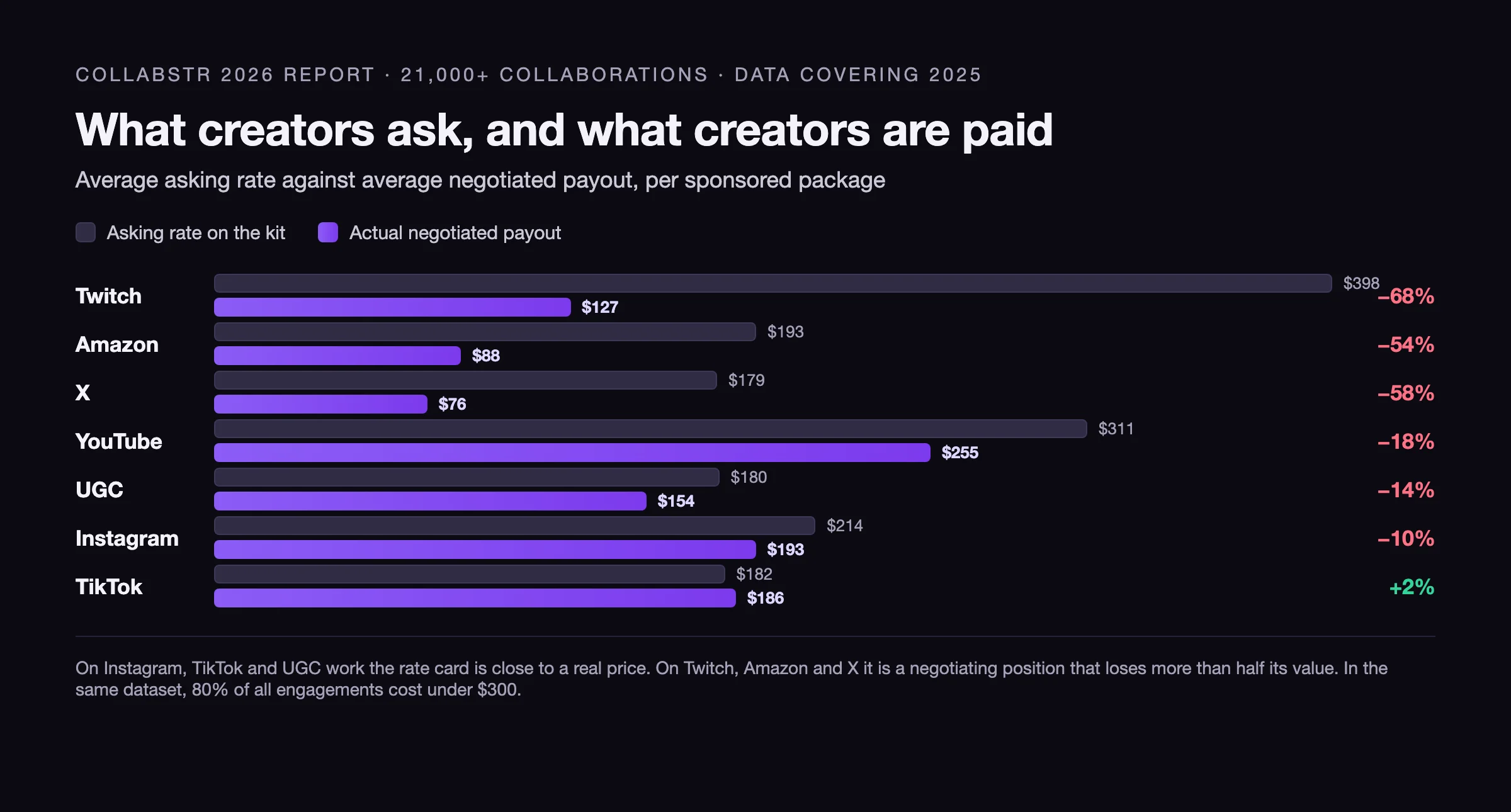
A rate card in a media kit is an opening number, and there is published transaction data showing how far it moves. Collabstr’s 2026 report draws on anonymized first-party marketplace data — more than 21,000 collaborations and over 472,000 packages reviewed for pricing, covering 2025 — and reports asking rates and negotiated payouts separately.
| Platform | Creator asking rate | Actual negotiated payout | Gap |
|---|---|---|---|
| Twitch | $398 | $127 | −68% |
| Amazon | $193 | $88 | −54% |
| X | $179 | $76 | −58% |
| YouTube | $311 | $255 | −18% |
| UGC | $180 | $154 | −14% |
| $214 | $193 | −10% | |
| TikTok | $182 | $186 | +2% |
The spread is the useful part. On Instagram, TikTok and UGC work, the asking rate is roughly what gets paid — the market has settled and a rate card there is close to a real price. On Twitch, X and Amazon, the asking rate is a negotiating position that loses more than half its value, which tells a creator on those platforms that the number in the kit is doing less work than the evidence around it.
The second number that gets misread is engagement, and the cause is the denominator. HypeAuditor now calculates engagement rate as likes and comments divided by views, falling back to a follower-based figure for accounts without enough Reels. Two kits can therefore show very different percentages for identical performance, and neither is lying. Anyone comparing creators should check which denominator each kit used before treating the numbers as comparable. Two percentages built on different denominators are not two measurements of the same thing, and averaging them produces a figure that describes neither account.
The tier bands are just as slippery. HypeAuditor’s State of Influencer Marketing 2025 report, built on 76 million Instagram accounts and analyzing 2024, puts Instagram nano creators at 2.19% — but that number is welded to its own definition of nano as 1,000 to 10,000 followers. Narrow the band and the average rises, because the smallest accounts carry the highest rates; widen it and the average falls. A kit quoting a tier benchmark without the follower range behind it is quoting nothing.
One benchmark gets borrowed constantly and qualified almost never: the Quid report, published in March 2026 and formerly the Rival IQ benchmark study, gives median engagement of 0.30% on Instagram, 2.01% on TikTok, 0.21% on YouTube and 0.03% on X. Those are company-account medians, drawn from 150 companies sampled at random in each of eighteen industries, and creators appear inside them only as one industry among the eighteen. A creator kit quoting the all-industry figure as its baseline is comparing itself to the wrong population. The period is stated in the report itself: the 2026 edition measures 2025, dating its X figure to 2025 against a 2024 comparison.
Where a media kit lives, and when it goes stale
Hosting decides how often the kit gets used. Three patterns showed up in the examples above, and they are not interchangeable.
A permanent newsroom URL is right for a brand kit. It can be linked from every release, indexed, and cited by someone who found you a year after the announcement. Stripe, Atlassian and Airbnb all run this pattern.
A campaign bundle library suits a company announcing often, as Spotify does with per-event kits carrying file counts from 5 to 149. The cost is that there is no single evergreen kit to link to.
A hosted document behind a stable link is the creator and publisher pattern. It travels in an email and can be replaced without the recipient noticing. Its weakness is invisibility: because these live in inboxes, individual creator kits are effectively absent from the public web, which is why the articles promising “real influencer media kit examples” tend to show templates instead.
Two hosting mistakes are worth naming. Putting the whole kit behind a form is common on the publisher side and it works against you when the reader is a journalist on deadline rather than a lead. And building the asset list in JavaScript, as Airbnb’s assets page does, means anything reading the page without running scripts — including the AI crawlers now assembling answers about your company — sees a page with no assets on it.
On refresh cadence, the useful discipline is the one Airbnb applies: date the numbers. A creator kit needs a quarterly pass because audience and rate figures move fast and a stale follower count is checkable in five seconds. A brand kit only needs revisiting when a headline figure changes, which in practice means whoever owns the kit has to hear about the change. Undated figures are the actual failure — a reader who cannot tell whether a number is current will treat it as old.
Naming the reader before you build the kit
If you are building a brand kit, start from the eight components above and be honest about which ones you will skip. If your assets page carries no press contact, as Stripe’s does not, put one on it anyway. If it carries no fact block, as Shopify’s does not, accept that reporters will keep emailing to ask for figures. That composition work usually sits inside a wider earned-media program, which is what our digital PR practice is built around.
If you are building a creator kit, the highest-return additions are the ones most kits omit: audience demographics rather than size alone, per-post results attached to real examples, and explicit terms for usage rights and exclusivity. Given that 67% of brands now write usage into the first contract, that section is not a bonus — it is the part that determines whether the first offer is a fair one. Brand-side teams evaluating those kits at volume are the other half of this problem, and that is the work our influencer marketing team does.
Either way, the first decision is the one that fixes everything downstream: name the reader before you name the file.
10 / Reader questions
Frequently asked questions
01What is a media kit?
A media kit is a single place holding everything someone needs to write about you or buy from you: logo files, facts, photos, audience numbers and a contact. It is not a pitch and not an announcement — it is the reference material the pitch points at.
02What is in a media kit?
It depends which of the two kits you mean. A brand media kit holds logo files, a boilerplate paragraph, dated fact figures, executive headshots and bios, product imagery, usage rules and a press contact. A creator media kit holds audience size, engagement, demographics, past partnerships, deliverables and rates.
03What is an example of a media kit?
Stripe's newsroom information page is the clearest brand example: boilerplate, four numeric fast facts, ten leadership photos and bios as a downloadable file, a logo kit and a trademark usage agreement. On the publisher side, The Atlantic posts its full 2026 media kit as an ungated eight-page PDF.
04What is the difference between a media kit and a press kit?
In practice, none — the two names are used for the same brand-side folder of assets and facts. Companies label the same page either way: Slack calls it a media kit, Atlassian calls it a press kit, and the contents overlap almost entirely. The real split is brand kit versus creator kit.
05How do you make a media kit?
Decide who receives it first, because that sets the contents. A kit for journalists leads with assets and verifiable facts; a kit for brand partnerships leads with audience data and deliverables. Then host it at a stable URL, date every figure, and diary a refresh so the numbers do not rot.
06What is a PDF media kit?
A PDF media kit is the whole kit compressed into one downloadable document, common on the publisher and creator side. The Atlantic publishes its 2026 kit this way, ungated. The tradeoff is that a PDF cannot hold high-resolution asset files, so brand kits usually stay as web pages with downloads.
07What should an influencer put in a media kit?
Audience size and engagement per platform, audience demographics, three or four content examples, named past partnerships, deliverables with rates, and terms for usage rights and exclusivity. Aspire's 2026 survey found 67% of brands write usage rights into the creator's initial contract or rate, so leaving that out invites a low first offer.
08How often should a media kit be updated?
Every quarter for a creator kit, and whenever a headline figure changes for a brand kit. Airbnb dates its fact block outright — its newsroom figures carry a 'Last updated May 2026' stamp. An undated number is the fastest way to look careless to a journalist checking it.