
Published
Account-based marketing is a business-to-business strategy that treats a named list of companies as the unit of targeting instead of individual leads. At a 20% close rate on the target list it pays for itself above roughly $21,000 in annual contract value for a one-to-few program and roughly $100,000 for one-to-one; at a more ordinary 10% both thresholds double, on the arithmetic below.
How this was checked. For this query in the United States on August 10, 2026, Google returned an AI Overview, a People Also Ask block, a Perspectives panel and an organic page made up of Salesforce, Demandbase, a Reddit thread in r/DigitalMarketing, LinkedIn, Optimizely, Adobe, Atlassian and one YouTube video. Every publisher result defines the term. Not one publishes a cost per account, a break-even, or a rule for choosing between the three tiers. The cost question shows up only in the Perspectives panel, which carries a thread in r/b2bmarketing from June 8, 2026 asking whether anyone has run account-based marketing for products under $1,000. This page answers that thread with arithmetic. One note before anything else: the abbreviation ABM is used here only after it is spelled out, because the three letters alone belong mostly to something else. Google Ads keyword data pulled on August 10, 2026 puts the bare term abm at about 90,500 US searches a month, and every one of its top twenty-five suggestions is ABM Industries, a listed facility services company: its careers pages, its parking division, its stock. The question what is account-based marketing draws 1,300 a month.
Account-based marketing in one paragraph, and where the money actually goes
The term dates to 2003 and the Information Technology Services Marketing Association, where Bev Burgess, then running its European arm, codified the framework the market still uses: a small number of accounts treated as individual markets, with marketing and sales working the same list. The idea is not complicated. The cost is where it gets interesting, because the parts that make account-based marketing different from ordinary demand generation are the parts that refuse to amortize. Research is per account. A point of view worth sending to a named CFO is per account. Sales alignment meetings are per account. Media and tooling do spread across a longer list, which is exactly why the cheap tier is the one built around them and the expensive tier is the one built around human attention.
That is the reason the three tiers exist at all. They are not three levels of ambition. They are three answers to one question: how many accounts can a single marketer carry before the personalization stops being personal?
Account-based marketing is: a targeting and measurement unit — the company, not the person.
- It is not a channel. There is no account-based channel. You run the same email, paid social and events you already run, pointed at a shorter list.
- It is not outbound sales with better slides. Outbound picks contacts. This picks companies, then covers everyone inside who touches the decision.
- It is not lead generation with a target list bolted on. If you still report on lead volume at the end of the quarter, you have kept the old unit of measurement and only changed the targeting.
Thirteen people inside the account decide, and that is what account targeting buys
Forrester’s The State Of Business Buying, 2026, published on January 21, 2026 and built on its 2025 buyer survey, reports that the typical business buying decision now involves 13 internal stakeholders and nine external influencers, and that procurement professionals are decision-makers in 53% of buying cycles.
Split that number, because the halves behave differently. The 13 internal stakeholders sit inside the target company: they are the entire case for account-level targeting, because they are reachable, they share an employer domain, and no lead-level model will ever tell you that four of them woke up at once. The nine external influencers — analysts, consultants, peers, partners — are not employees of the account, and account targeting cannot reach them at all. Any claim that account-based marketing covers all 22 is overselling it.
Thirteen internal stakeholders is worth chasing when the contract is large. It is a comically expensive way to sell a $400-a-month tool that one department head can approve on a card.
It also explains why a lead count stops being a useful number here. One form fill from a 13-person internal buying group tells you almost nothing; four form fills from four different functions inside the same company tell you a great deal. If your funnel still hands sales a scored individual rather than an account with a heat reading, the mismatch shows up as arguments about lead quality — which is a separate problem with its own line between marketing and sales qualification.
Cost per account across one-to-one, one-to-few and programmatic
The tier names and their structure come from the original framework: strategic account-based marketing one-to-one, ABM Lite one-to-few for small clusters of accounts with similar issues, and programmatic one-to-many for dozens or hundreds of accounts. What the framework does not do is price them, so here is a model that does. The account counts below — 8, 40 and 500 — are this model’s assumptions, not the framework’s, which puts no numbers on the middle tier at all.
Method, and where it is weakest. The salary input is derived rather than assumed: the US Bureau of Labor Statistics puts the median annual wage for marketing managers at $161,030 as of May 2024, and its Employer Costs for Employee Compensation release for March 2026 puts wages and salaries at 69.9% of total employer compensation in private industry. That grosses the median up to about $230,400 fully loaded. Two caveats worth stating out loud. The 69.9% is the all-occupations private-industry average, and management roles carry a different wage-to-benefit split, so this is an approximation rather than a measurement. And the divisor — how many accounts one marketer can carry — is a straight assumption, yet it spans 8 to 500 across the table, a factor of sixty-two, while the BLS figure merely scales whatever the divisor produces. Change the divisor first; it is the load-bearing input. The remaining three lines are model inputs too, deliberately round, and meant to be replaced with your own.
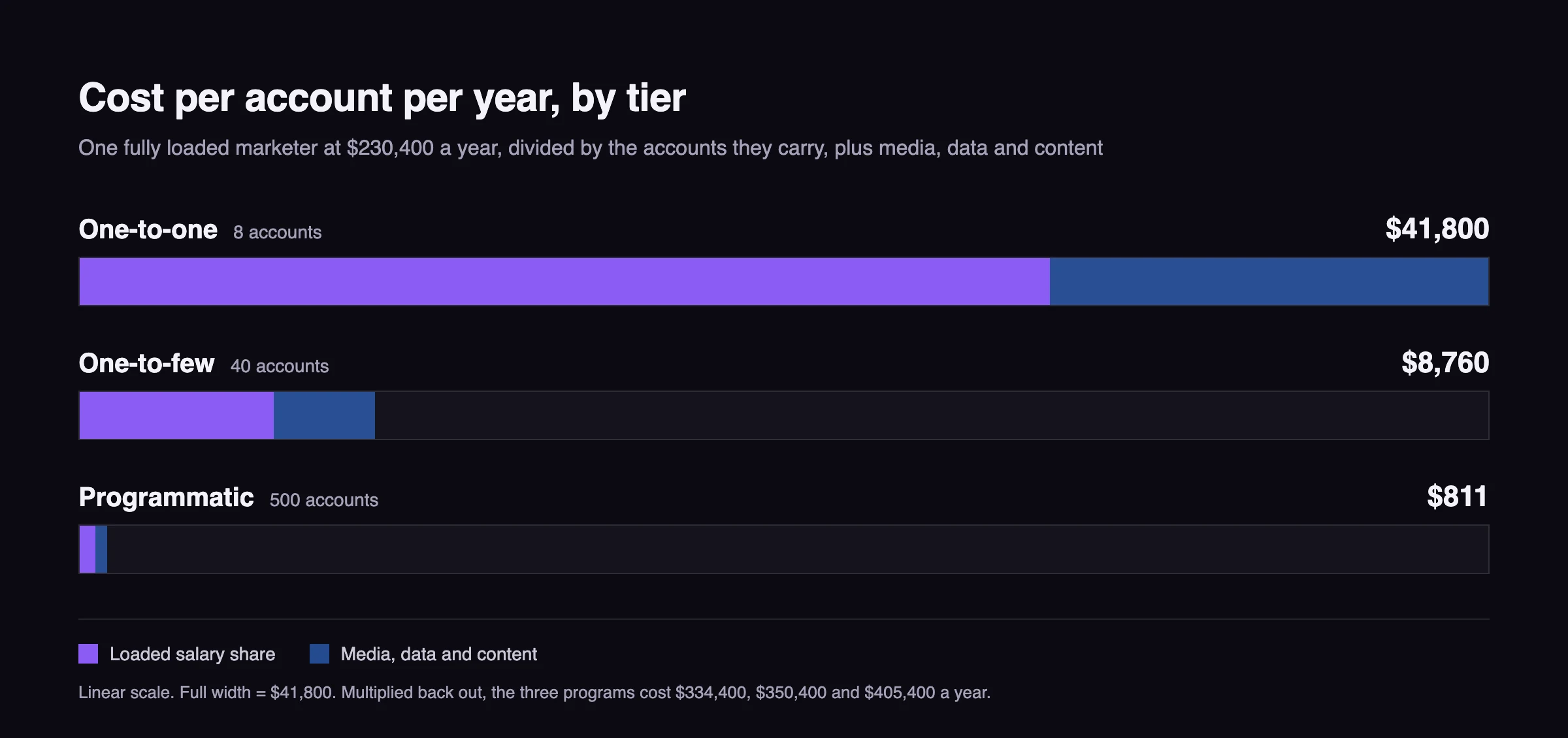
| Cost per account per year | One-to-one (8 accounts) | One-to-few (40 accounts) | Programmatic (500 accounts) |
|---|---|---|---|
| One fully loaded marketer at $230,400, divided by accounts carried | $28,800 | $5,760 | $461 |
| Paid media, bought against a batched audience | $5,000 | $1,200 | $150 |
| Data, intent and platform licenses | $2,000 | $800 | $200 |
| Custom content, events, direct mail | $6,000 | $1,000 | $0 |
| Total per account per year | $41,800 | $8,760 | $811 |
The media line says batched for a reason covered further down: even a one-to-one program buys its paid layer against all eight accounts at once, because once buying-group filters are applied a single account rarely clears LinkedIn’s 300-matched-member minimum.
The interesting number is not in the table. It is what happens when you multiply each column back out: $334,400 a year for the one-to-one program, $350,400 for one-to-few, $405,400 for programmatic. The three tiers cost roughly the same in total. Choosing a tier is not choosing a budget. It is choosing how thinly to spread a budget you were going to spend anyway — and therefore choosing which deal sizes the program can support.
The break-even formula for a target account
One line of algebra, and it is the line the ranking pages leave out:
Break-even annual contract value = cost per account per year ÷ (win rate × gross margin × years retained)
Win rate here means the share of accounts on the target list that become customers within the year, not the share of opportunities that close. Gross margin, because revenue that goes straight back out as cost of delivery cannot pay for marketing. Years retained, because a program that only ever pays for itself in year one is being measured too harshly.
Holding gross margin at 70% and retention at three years — replace both with yours — the model produces this:
| Win rate on the target list | One-to-one | One-to-few | Programmatic |
|---|---|---|---|
| 5% | $398,000 | $83,000 | $7,700 |
| 10% | $199,000 | $42,000 | $3,900 |
| 20% | $100,000 | $21,000 | $1,900 |
| 30% | $66,000 | $14,000 | $1,300 |
Read the 20% row first. In our experience a fifth of a cold named list closing inside a year is a good year rather than a typical one, so treat that row as the optimistic case: at that rate one-to-one needs a six-figure contract to stand up, one-to-few needs about $21,000, and programmatic clears its own cost at around $1,900. If your own last four quarters say something different, use your number — that is the point of putting the formula on the page instead of a benchmark.
Three honest qualifiers. First, this is an absolute break-even, not an incremental one: it asks whether the program pays for itself, not whether it beats the same money spent on ordinary demand generation. The incremental test is harder, and the win rate you should put in the formula for it is the lift over what those accounts would have converted at anyway. Second, the formula divides one year of program cost by three years of margin, which assumes you land the account and then stop spending on it. Keep spending to hold the account and the three-year term collapses toward one: at a single year of margin, the 20% row moves from $21,000 to $63,000 for one-to-few and from $100,000 to $299,000 for one-to-one. Third, the model prices one marketer, one media budget and one tooling stack — it does not price the sales capacity that has to work the list, which for one-to-one is usually the larger cost of the two.
Four worked price points, from $1,000 to $180,000 of contract value
Turn the formula around and it answers a more useful question. Given what you actually charge, what close rate would each tier have to hit to break even?
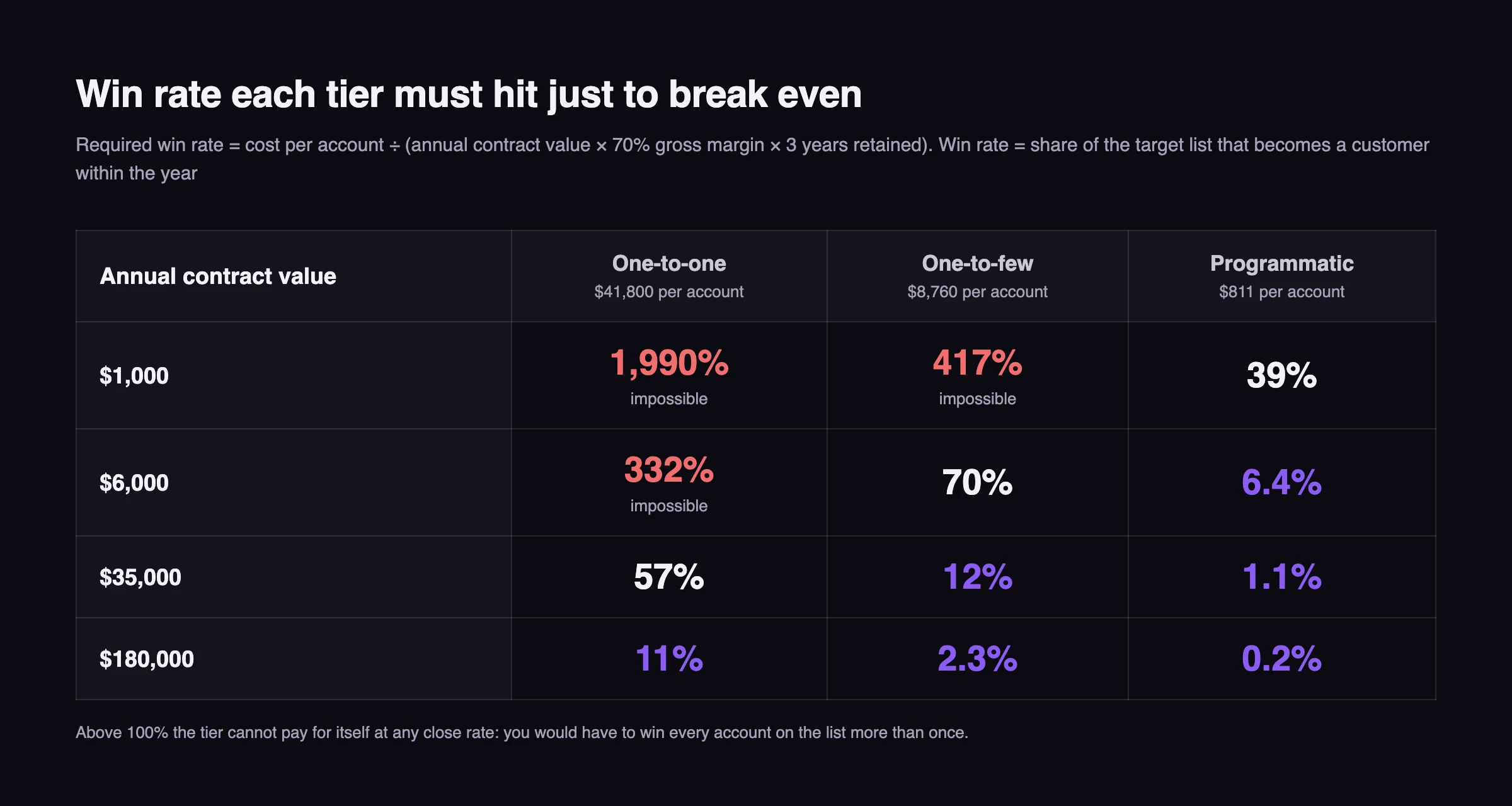
| Required win rate to break even | One-to-one | One-to-few | Programmatic |
|---|---|---|---|
| $1,000 annual contract value | 1,990% | 417% | 39% |
| $6,000 annual contract value | 332% | 70% | 6.4% |
| $35,000 annual contract value | 57% | 12% | 1.1% |
| $180,000 annual contract value | 11% | 2.3% | 0.2% |
The top row is the answer to the r/b2bmarketing thread, which asked specifically about products under $1,000. Two of the three tiers return a number above 100%, and a number above 100% is not a demanding target, it is an impossible one — you would have to win every account on the list several times over. Only programmatic survives at that price, and it survives needing 39% of a five-hundred-account list, which is not a marketing plan so much as a wish. Below roughly $6,000 in annual contract value, the two personalized tiers are the wrong instrument outright and only programmatic still has a number under 100% — which is a narrow escape, not an endorsement.
At $35,000 the picture is ordinary rather than dramatic. One-to-few needs 12%, which is a real target a real team can argue about. One-to-one needs 57%, which almost nothing sustains on a cold list.
At $180,000 everything works, and the choice stops being about break-even and starts being about capacity: 11% of eight accounts is one deal, so the one-to-one program lives or dies on a single win, while 2.3% of forty accounts is roughly one deal as well but with five times as many chances to get there. Concentration is the hidden risk in the top tier, and it does not show up in a cost table.
The media floor that pushes one-to-one programs toward giant companies
There is a hard platform constraint that quietly shapes the tier for you. LinkedIn will not serve a campaign until the audience contains at least 300 matched members. That is a floor, not a recommendation.
Now count. A single company clears 300 easily if you target everyone who works there, but nobody runs account-based advertising that way — the whole point is to reach a defined buying group, so you layer job function and seniority filters on top. Two or three functions at manager level and above will typically leave you a few dozen matched profiles at a company of a few thousand staff, and the campaign will not run. How far the filters cut depends on your own targeting, so check it in Campaign Manager rather than trusting a rule of thumb, ours included.
The practical consequence is not that single-account media is forbidden. It is that single-account media is only reliably available at the very top of the market, which is why one-to-one target lists skew toward companies most vendors will never sell to. Everyone else batches. A one-to-one program therefore spends its real money on the things that work at a sample size of one — research, custom content, direct outreach, events and executive time — and runs its paid layer across the whole tier at once. That is the mechanical reason the middle tier exists, and it is why thought leader ads run from individual profiles tend to carry more of the load in account-based programs than company-page advertising does.
When account-based marketing is the wrong move
Six situations where the honest answer is no, in rough order of how often they come up.
- Your contract value sits below the tier’s break-even. The arithmetic above, run with your own margin and retention. If every tier needs a close rate your team has never hit on any list, stop.
- One person can approve the purchase. The 13-stakeholder figure is the case for account coverage. When the buying group is one department head with a card, you are paying to reach twelve colleagues who are not in the room.
- You cannot name the accounts. If nobody can produce a list of 50 companies you would genuinely want, the problem is segmentation, not targeting, and an account-based program will simply automate the confusion.
- There is no sales motion to receive it. Self-serve and product-led businesses can run account-based advertising, but the engagement signals have nobody to hand them to, and unactioned signals are just an expensive dashboard.
- You need pipeline this quarter. This is a go-to-market motion measured over quarters rather than weeks, and enterprise sales cycles are long enough that the first cohort will not resolve inside one.
- Marketing and sales do not share the list. Two lists is not a small process problem. It is the failure mode: marketing reports engagement on accounts sales is not working, and both sides conclude the other is wrong.
If several of these describe you, the fix is usually not a smaller version of the same program. It is going back to segment-level demand generation until either the contract value or the buying-group complexity moves.
How to run this arithmetic on your own pipeline
Six numbers, and you can do it in a spreadsheet before you talk to anyone.
- Your fully loaded annual marketing cost. Take the salary and divide by 0.699 to add the employer burden. Add any contractor or agency retainer that would sit on this program.
- Accounts one person can carry. Divide the number above by it to get the people cost per account. Be pessimistic: this is the line that decides everything else, and the one most plans get wrong by a factor of two.
- Your media, data and content spend per account per year. In the model above this is 31% of the one-to-one cost per account and 43% of the programmatic one, so leaving it out will flatter you badly. Add it to step 2 and you have the cost per account.
- Your gross margin. Not your revenue. The margin is what is available to pay for acquisition.
- Realistic retention in years. Use your own cohort data if you have it, and the shortest defensible number if you do not.
- The close rate your team has actually achieved on a comparable named list in the last four quarters. Not the aspiration.
Put those into the break-even formula and you get one number: the contract value below which the tier you were about to pick loses money. Compare it to what you charge. If the gap is uncomfortable, drop a tier before you drop the idea — programmatic works at price points where one-to-one is arithmetic fiction, and roughly the same money — $334,400 to $405,400 a year in the model above — buys any of the three.
That decision belongs in the plan rather than in a campaign brief, alongside the channel mix and the budget it competes with; if you are building that document from scratch, our marketing plan structure has the section it goes in. And if you would rather have the model run against your own pipeline than build it yourself, that is the kind of work our B2B and enterprise practice does before anyone writes a campaign.
09 / Reader questions
Frequently asked questions
01What is account-based marketing in simple terms?
It is a business-to-business strategy where a named list of companies, not individual leads, is the unit of targeting. Marketing and sales agree on the list first, then build campaigns for the buying group inside each company. The account is the audience; the person is a route into it.
02What is the difference between account-based marketing and traditional marketing?
Traditional demand generation starts with an audience and hopes the right companies appear in it. Account-based marketing starts with the companies and works backwards to the people. That inversion changes the unit of measurement too: pipeline is counted per account, not per lead.
03What is the minimum deal size for account-based marketing to be worth it?
On the model in this article, a one-to-few program needs about $21,000 in annual contract value and a one-to-one program about $100,000, assuming a 20% close rate on the target list, 70% gross margin and three years of retention. Programmatic clears its cost near $1,900.
04What is the difference between field marketing and account-based marketing?
Field marketing organizes around a territory, a segment or an event and measures attendance and regional pipeline. Account-based marketing organizes around named companies and measures engagement inside those companies. The two overlap in practice: field events are often a tactic inside an account-based program.
05Can you give an example of account-based marketing?
A vendor picks forty logistics companies with more than 2,000 staff, builds one research note on freight cost per lane for that segment, runs it as paid social against the buying group in those forty companies only, and hands sales a weekly list of which of the forty engaged.
06Does ABM mean account-based marketing or something else?
In marketing, ABM means account-based marketing. The bare abbreviation belongs to something else on the open web: search suggestions for the three letters alone are dominated by ABM Industries, a listed US facility services company, and the letters also stand for anti-ballistic missile and activity-based management.